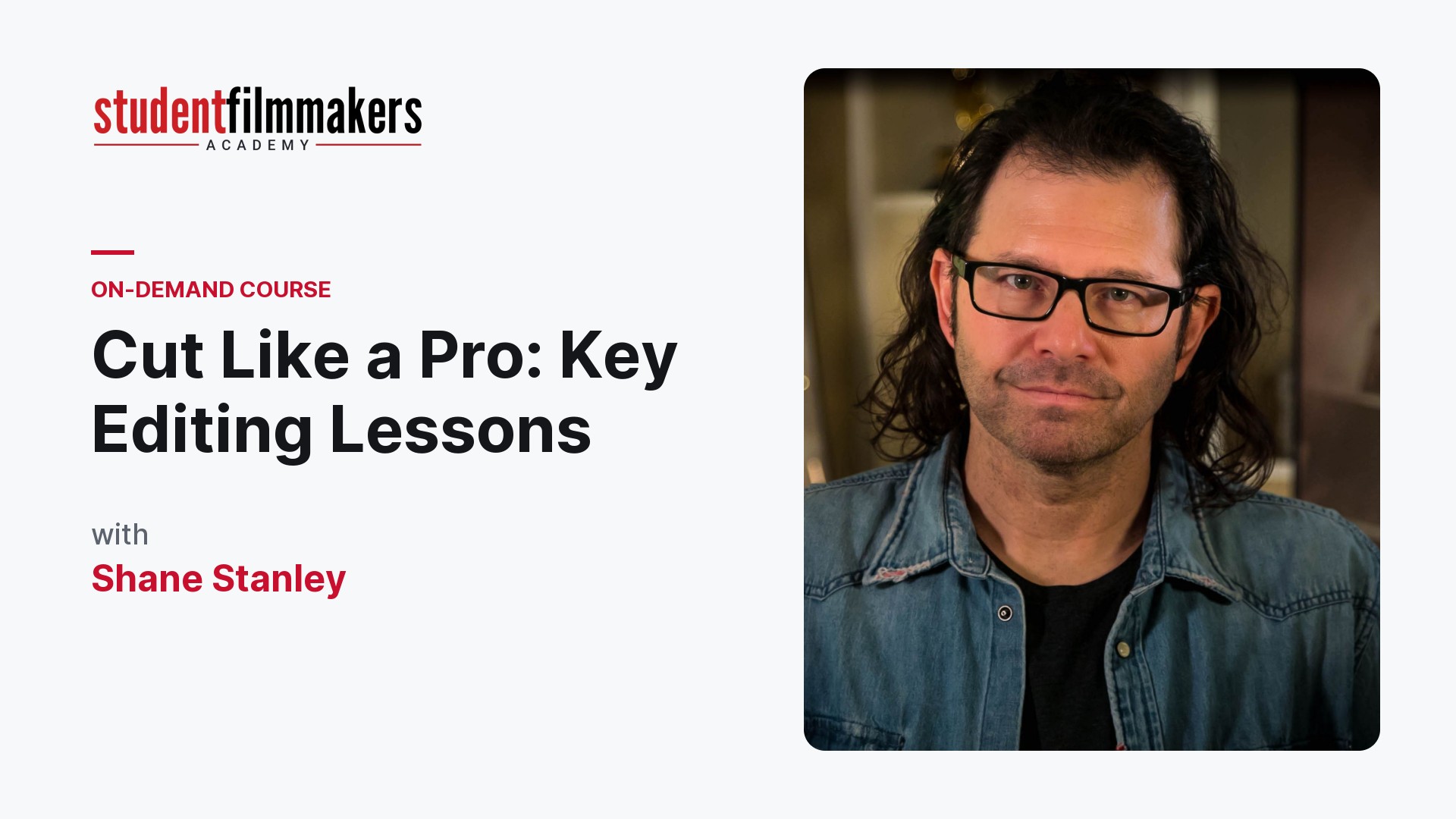
Before Shane Stanley directed Night Train and Double Threat, he spent decades as an editor and dialogue editor, and he still cuts his own films. The Emmy-winning filmmaker’s main editing lesson is that pace is felt, not measured: watch every take, listen to a scene with your eyes closed, and remember that the cut is the version of the film the world actually sees.
Stanley likes to say every movie gets made three times: on the page, on set and in the edit. In this class he worked through how an editor bridges all three, with stories from his own cutting room and from films he admires.
Why watch every take, not just the circled ones?
Stanley doesn’t work with circled takes. On a set, a script supervisor will often ask the director which take they liked, and the “good” one gets circled. Years in the edit bay taught him to distrust that:
“What I love on set most of the time is not what I thought it was when I got to the edit bay.”
The reverse is true too. Takes he wasn’t excited about on the day often hold the best moments. Unless an actor trips on “action,” he said, every take has some gold in it, and an editor can blend the opening of one take with the middle of another.
His example came from a Civil War film he had just finished. Actor David B. Meadows, a Shakespearean actor and former Navy SEAL, had an opening scene on horseback with a horse that would not stand still. Meadows grew frustrated as the horse kept circling and turning his back to camera. Stanley, cutting the scene in his head, knew he already had the entrance and the ending and needed one clean middle section. He called out pickups whenever the horse calmed for 18 seconds and told the unhappy actor, “Dave, I need you to trust me. We got it.” At the premiere, Meadows hugged him and told him he was right.
Which comes first: performance or picture?
Performance, for both Stanley and editor Frank Reynolds, who cut In the Bedroom and worked with him more than once. The hard part is when the best acting take has a soft focus pull or a missed camera move. Then you dig for a balance: use the other camera, cut to the listener while the perfect line plays, and come back when actor and camera line up again.
That kind of trick is common. Stanley estimates that 30 to 40 percent of the audio in his cuts isn’t what you see on screen at that moment. He worked as a dialogue editor for about five years, and he can usually smooth a “rubbery” line by slowing or speeding the dialogue a fraction.
Before he commits, he exports the scene to his sound mixer and asks if it can be saved. Either the answer is “I got it,” or it’s time to plan ADR.
How do you find the pace of a scene?
Some editors set a metronome ticking in the edit bay to hold a steady tempo. Stanley lays in temp music before he cuts. If a scene happens in a pizza place with a jukebox, he picks what the jukebox would play and cuts to it. Some call it a thump track.
The music can also play against the scene, a quiet, careful talk over aggressive metal, or a frantic argument over soft classical. Either way, it forces you to know the scene’s purpose, its beats and where it leads.
He also warned that a scene cut in real time usually drags. Actors leave a courtesy beat before each line so the other actor’s coverage can be cut cleanly, and those gaps add up. Tighten them so the conversation overlaps the way real ones do.
When starting a new film, Stanley still feels like he has “two left hands.” His fix is to begin with the short, simple scenes, park them, and work up to the bigger ones, like getting back on a bike.
What is the closed-eyes listening test?
When he is close to locking picture, he hits play, gets up and walks away from the screen:
“I listen as if I’m listening to a conversation in the booth next to me at a restaurant that I have nothing to do with.”
If it doesn’t sound like real people talking, with overlap and natural rhythm, it isn’t done. He does the opposite check as well: a scene should flow with the sound off. He builds sound effects into his cuts too, from squeaky chairs to a distant plane or car alarm to add tension or cover a flaw, and records his own Foley on an iPhone, dropping on the floor or crumpling paper when the library doesn’t have it.
How long is too long to hold a shot?
A filmmaker in the class proposed a 10-second rule: if nothing changes in the frame for 10 seconds, the pace feels slow. Stanley pushed back with long takes that never drag, like the famous opening shot of The Player, and said there shouldn’t be a rule. What matters is the composition, the scene, and whether a slow push-in is quietly changing the frame. He learned the old-school way from directors who wanted the master held as long as possible, and from his father, who won his Emmys cutting and directing documentaries he treated like films, with days of b-roll on every subject.
His favorite tool for long dialogue is the listener:
“Some of the best stuff is the actors listening. It’s not always the person talking.”
When your instinct says cut, try holding two or three more seconds. And when you do cut, the question the old directors kept asking him still applies: why are you cutting here? Because you’re bored is not an answer.
How do you keep a long talk scene alive?
Stanley pointed to Sideways. The long night of wine and talk between Paul Giamatti and Virginia Madsen is broken into four places: standing, then sitting, then off to find another bottle, then out on the back porch. On paper it is pages of two people talking about wine; on screen it never sits still.
He also shared a storytelling device from Wells Root’s book Writing the Script: the dynamite under the couch. If someone plants a lit stick of dynamite before two people sit down to talk, the same dull scene becomes unbearable suspense. Root was Stanley’s godfather.
For action, the lesson is the opposite: don’t keep everything at full intensity. He praised the first The Fast and the Furious for an opening truck heist that grabs you, followed by story and character scenes that let the film breathe.
What should a director learn from editing?
A lot. A good camera operator, Stanley said, will “count to three and then cut” after the director calls it, in case the editor needs to dissolve out. Operators who whip the camera the instant they hear “cut” can wreck a usable ending. Actors gain by watching their raw footage to see their strengths and weaknesses, not just a polished reel. Producers should know cutting, because once the director’s cut period ends, often 8 to 14 weeks, they sit in the chair.
On set, a DIT who builds loose assemblies can catch problems early, like dead pixels on one camera or a patterned tie that flickers on screen. Stanley once had to reshoot a scene because editorial called about exactly that tie.
His own numbers: about four months from start to locked picture on a 90-minute film, cutting 20 to 30 minutes a day. One four-minute improvised monologue in his film Six Days in Evergreen took him a month, then another week. He cuts mostly in Adobe and hands his mixer as many as 36 audio tracks.
He closed with a line he credits to Beavis and Butt-Head, of all places: the trims you leave out of a film matter as much as the ones you make.
For more on rhythm and structure, read Editing Structure: Avoid Over-Cutting and Mixed Emotions: Film Editing and the Narrative Through-Line. Directors working with a separate cutter may like Collaborating with Your Editor.
The full class also covers the director’s cut versus the producer’s cut, fixing slow documentary interviews, and AI in the edit bay.