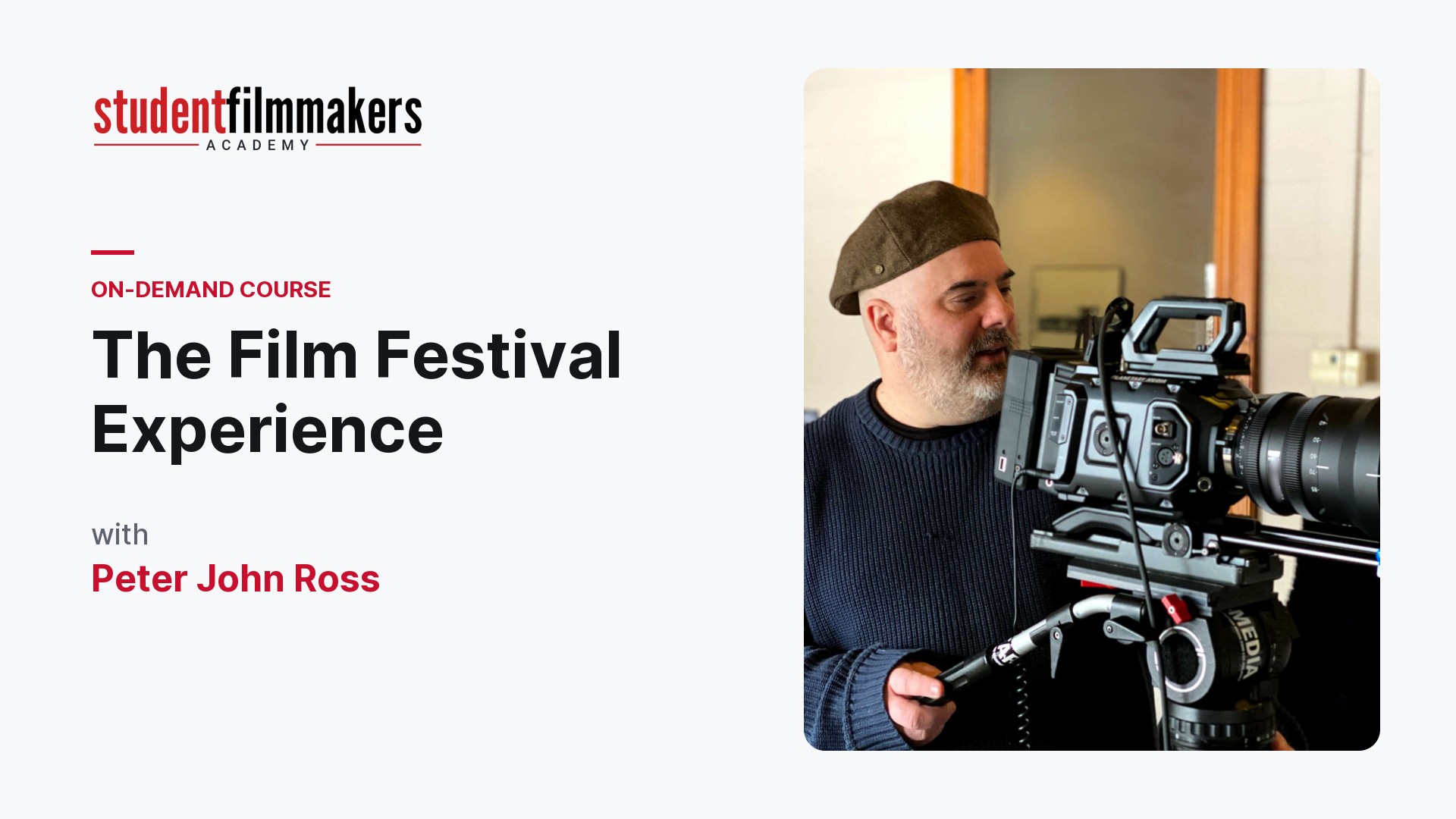
Peter John Ross is a Columbus, Ohio filmmaker with six regional Emmy nominations who made the indie horror feature Horrors of War. He also bought the Indie Gathering International Film Festival, held each August in Cleveland, after attending it for some 20 years. After more than 400 festivals in 24 years, his core advice is businesslike: a finished film is a product, and festivals are how you prove to a distributor that strangers think it is worth paying for. He shared his festival playbook, from submission fees to the angriest Q&A of his life, in a live class with StudentFilmmakers.
Why should a filmmaker go to festivals at all?
Ross starts with a line that surprises first-timers:
“Completing the film is not even the halfway mark for the things you need to do to market and sell your product.”
Everyone loves their own film, he said, and that love creates bias. Festivals answer the question your friends cannot. Being selected means people with no stake in your film thought an audience would pay to see it, and an award separates it further. Add press coverage and you have one more unbiased party vouching for the work. Then there is networking: the DP or actor you meet at the after-party may be on your next set.
The biggest value, though, is the screening itself. “Did you achieve your goals as a filmmaker?” he asked. “The only way you’re really gonna find it out for real is in a movie theater with a bunch of people you do not know.” You can feel boredom in a room and hear whether the laughs land. His current documentary went through about 27 revisions based on festival screenings. A cast-and-crew screening is always worth holding as a thank-you, he added, but it is stacked in your favor and “doesn’t really count.”
How much should you budget for submission fees?
| Festival tier | Typical fee Ross quoted |
|---|---|
| Average festival | $25 to $35 |
| Larger festivals | $55 to $75 |
| Marquee festivals | $100 to $125, with even lower odds |
Fees are paid whether you get in or not, and most films do not get in. Set aside at least $500 apart from the production budget for a short. For a feature, he budgets a minimum of $1,200 to $2,000 in fees alone, before travel, hotels, food and time off work. Nearly every festival now takes entries through FilmFreeway, and he urges filmmakers to read each listing to see what kind of films that festival actually programs.
His tip from the festival director’s chair: just ask.
“Email the film festival and ask, can you get either a waiver or a discount code? 75, 90% of the time, they will give you a discount.”
He hands out 10 percent off freely, and a rare 50 percent if the story and the film move him.
Which festivals are worth skipping?
Ross avoids three kinds. Online-only festivals, because a feature is too easy to pirate and there is no cinema experience. Festivals with “award” in the name that run monthly and accept most entries, because laurels from them add little value. And, unless you have someone on the inside, the top tier. He said Sundance had over 7,000 submissions for about 200 slots in 2024. “You have better luck at a casino,” he told the class. He would rather screen at a small college in a town of 1,200 people.
Plan premieres too. Some festivals require a world premiere, others a country, state or city premiere, so map out your order before submitting widely. There is more on picking your first festival in our archive.
How do you get press for a festival screening?
Three to five weeks before the festival, send a properly formatted press release to local media, regional websites, event calendars, local Reddit groups and radio stations in the festival’s city. Then pick up the phone:
“90% of the times I’ve gotten in printed press about a screening or about a film I’ve done is because of the follow-up phone call.”
Ask whether they received the release and if they have questions. It shows you are not spraying releases everywhere. Festivals love filmmakers who bring an audience. If you can, arrive the day before your screening and stay the day after. If you cannot attend, mail a stack of postcards. And go see other filmmakers’ films. They will come to yours.
What should you do with a rejection letter?
In 2021 Ross was turned down by the New Jersey Documentary Film Festival with a form email. Instead of firing back, he thanked them for watching and asked whether his logline, synopsis, trailer or poster could be better. The director wrote back that they could take only 13 percent of submissions, that nine judges had narrowed the Sunday night slot to his film and one other, and that the other won by a single vote. He offered a free submission next year.
Ross reshot three interviews and re-edited the documentary, nearly forgot to resubmit, and was reminded by the director himself. The new cut won the festival’s only award and played to a sold-out final night. “I was able to take a rejection letter and turn it into a win with the same festival all by being polite and completely open to criticism,” he said. Festival directors talk to each other, and they remember who was gracious and who was nasty.
How do you survive a festival Q&A?
Treat it as public speaking, he said, and bring producers and cast on stage with you. If nobody raises a hand, start it yourself by asking someone what they thought of a scene. In 2010, Ross talked for two and a half hours after a screening with a director named Gareth Edwards, who later made Godzilla and Rogue One. That kindness made Ross a fan for life.
His own worst moment came at the last festival stop for Horrors of War, his Nazi zombie werewolf feature, in Marietta, Ohio. After nearly two years of festival screenings his ego had grown, he admitted. A local critic’s first question accused the film of ignoring the Holocaust, and for 20 minutes people walked to the mic to say what they disliked. He calls it brutal and necessary. Being open to criticism, he said, does not mean you stop loving your film. It means fixing the flaws in this one or the next.
Smaller tips from the Q&A
- Insurance: Most festivals do not require errors and omissions insurance, because your contract makes you liable for the film’s content.
- Standing out: One short called Granny Panties handed out branded underwear. Horror teams come in full makeup. Make the stunt fit your film and hurt no one.
- Files: More theaters want a DCP, and he was surprised how good his documentary looked in one.
- Business: Set up a separate LLC for each film and run its festival costs through it.
- Icebreakers: Ask every filmmaker in a shorts block a question, and find something kind to say about each film.
Ross’s own article Screening Your Film Independently and Film Festivals covers four-walling, which he still recommends, and 4 Tips for Submitting to Film Festivals adds a short checklist.