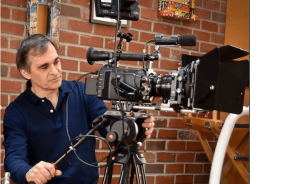
Meet Christopher Hall, a filmmaker and a member of the StudentFilmmakers Filmmakers Network. See Christopher’s Network profile to connect.
We Asked 7 Questions
Start networking with film and video makers of all levels around the globe. Login or Sign Up at StudentFilmmakers Magazine’s Featured Networker for this issue is Christopher Hall. networking.studentfilmmakers.com/profile/Oneimill Can you tell us about your work as a writer and director, and how you got started?
Christopher Hall: My experience as a filmmaker started in high school. Being inspired by films like Star Wars and much later, I became very interested in the films and style of Stanley Kubrick and Paul Thomas Anderson. I wanted to tell unique stories through film, but I originally started out in animation. I tried this for a number of years, but I found that I was more interested in live action filmmaking, as it allowed for a greater way to tell the stories I was interested in, which were primarily dramas. I was unable to afford film school, so I started acquiring equipment, and writing simple stories that I could easily shoot with my friends and other acquaintances. All the while, trying to find my “voice” as a filmmaker. As time passed, my stories became more complex and branched from films that were under ten minutes, to feature length scripts that required research into areas I knew little about. I treated my earliest films like learning opportunities, often focusing on either a specific genre, or trying out film techniques. Many of these films had a lot of problems, but from each film, I learned what my strengths were, and what areas I needed to improve.
Can you share with us a little bit about your film that you recently completed?
Christopher Hall: After three years of making a few short films, and attempting an extremely low budget live action film, I completed my short film, “Inheritance,” in November of 2013. The film served not only as my first horror film, but also as the culmination of all of those learning experiences.
The film itself focuses on a character named Robert, who following the death of his grandfather, receives his inheritance of an ancient statue of Lilith. Slowly, the statue grabs hold of Robert and bends his mind to its will. Fearing for his sanity, Robert starts withdrawing from life and from his girlfriend Ellen, who fears that he wants to leave her.
With “Inheritance,” I was trying to go for a more psychological aspect of the story, where, at least I hope, the audience is left questioning whether the events taking place in the film are really happening, or if everything is happening in Robert’s head, and he received an inherited madness from his reclusive grandfather.
This film was heavily inspired by my interest in Gothic Horror writers like HP Lovecraft and Edgar Allen Poe. It was also inspired by my own experiences with sleep walking, and the eerie feelings of finding objects that I was relocating while sleepwalking.
Being that this was your first time editing, can you share with us some of the challenges and solutions?
Christopher Hall: Going into editing, I was pretty unprepared for how much work I was in for. We spent about five weeks shooting the film – irregular scheduling and a few setbacks pushed the film back longer than I had planned – and by the time I had finished editing, about eight weeks had passed all together. So much goes into editing. Not only did I have to make sure that actions matched, especially when cutting on actions, but I had to make sure a consistent look to the film, and make sure that I was conservative with scenes. As the writer and director, of course I’m going to feel that every scene is crucial, but I had to look at what I was editing from the standpoint of the audience, and determine whether a scene was essential to the pacing. That was perhaps the most difficult part of the editing process, looking at my work and having to tell myself that, “Yes, I want this scene in the final film because I wrote it, but if I was watching this film, would I critique this moment, or would a certain sequence take me out of what I was watching.”
At one point when I was editing, I realized that we never showed an essential prop; it was cut out of the frame. I panicked. Quickly, I had to recreate a lot of what was shown in the previously shot footage, and shoot an entire shot that included that prop so that there would not be this massive plot hole at the end of the film.
What did you edit with and why?
Q&A with Featured Networker Christopher Hall
Christopher Hall: Due to budgeting constraints, I chose a more affordable, consumer level, editing software package, Movie Edit Pro 2013. Overall, it does have a lot of the same tools that you can find with packages by Adobe, and other companies, but it’s not necessarily made for professional work, so it had a tendency to lag, especially by the end of editing a 24-minute film.
If you can share a few editing tips for first-time editors what would they be?
Christopher Hall: My advice for first time editors is to wait until the film is fully arrange and cut, render it, and watch it. This will be a rough cut, so there will be some issues, but by doing this, it will give you great insight into the pacing of the film as a whole, and you will be able to see what needs to be changed, or what you can play with. Make whatever corrections need to be made, and keep doing this process of editing and viewing. It can be time consuming, but from my own experience, it really helped me ensure that I made the best film possible.
Another tip I have is if you know what the music is going to be, and you have a great piece of music that really fits a scene, try to edit that scene to fit the music. It gives the film an almost operatic feel where the music and actions are so well synchronized it’s like they were both made for each other. It’ll help with pacing a scene, too.
Can you tell us a little bit about shooting with the Canon HF-100 and your shoot to post workflow?
Christopher Hall: We chose to use a Canon HF-100 primarily out of budgetary necessity. It is an affordable camera, and as long as you provide constant even lighting, it turns out amazing results. It does have some drawbacks, reds are not usually as pronounced, but utilizing a warming filter helped to reduce a lot of those problems. In terms of how much work had to be done in post, we tried, as much as possible, to control the image quality while filming. For example, all of the night scenes feature what looks like a blue filter, but we actually utilized blue lighting, and a simple tungsten setting, to give the video that look. These scenes were the hardest because, as anyone who has used a consumer level camcorder knows, the less light you have, the more “noise” you’ll get in the image. So we had to constantly monitor what was being shot, often immediately sitting down to review the footage after shooting it.
Most of the post conversion was focused on contrast, gamma levels, and brightness. You do lose some contrast from when you shoot to when you transfer the files, but it was easily fixed in post-production. Due to how much lighting was used for filming, we had to digitally darken some shots, which helped give it more of a “film look”.
Ultimately, the best comments I received from those who saw a rough cut where from those who thought we had used a DSLR camera, or some who asked for screenshots to keep as photographs.
What are some of your current projects?
Christopher Hall: Currently, we are working on continuing with our short film series. “Inheritance” will be the first film in this series, which I’m using to learn more about specific genres. Our next film is going to be “Personal Space,” which is comedy about an elevator operator’s first day of work, and all of the unique characters he meets. I also have a drama called, “Decomposition,” and an action-tragedy called, “Scorned,” but for now I’m really focused on my first comedy.
Related filmmaking guides
Keep learning filmmaking
Want more lessons like this? Join StudentFilmmakers free for live webinars with working pros, and stream on-demand filmmaking classes in cinematography, directing, screenwriting, sound and post.