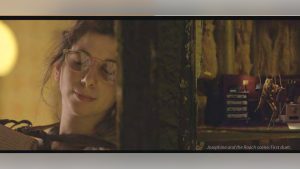
Director Gleb Osatinski talks about his debut Pisces of an Unconscious Mind, shot on DSLR with David Berman and Emmy winner Richard Manichello.
Pisces of an Unconscious Mind, features leading roles played by David Berman and Emmy Award-winning director Richard Manichello. Shot entirely on DSLR, Pisces of an Unconscious Mind filmed in various New York locations including Montauk, Ft. Tilden, Midtown Manhattan, Downtown Manhattan, and Williamsburg.
Originally born raised in Kharkov, Ukraine, Gleb Osatinski, with his family, moved to New York in 1994 following the fall of the Soviet Union. In Russia, Osatinski graduated with a Masters in Physics, wrote scientific papers, and conducted experiments with superconductivity. Osatinski says that his background in physics helps with understanding light, camera movement, and creativity. “I think being a physicist helps overall with staying inside of a concept of whatever it is I am creating.”
StudentFilmmakers Magazine staff spotted Osatinski’s trailer for Pisces of an Unconscious Mind on The Film and Video Makers Network. Drawn by the performances of Berman Manichello, StudentFilmmakers Magazine staff sits down with Osatinski between filming to discuss directing the psychological drama and working with the actors.
StudentFilmmakers Magazine:
How did you cast for your film, Pisces of an Unconscious Mind?
Gleb Osatinski: I knew that I needed actors who would be able to bring elements of drama and absurdity together. At that time, I knew David Berman as a filmmaker and friend. By accident, I saw one of his pictures on Facebook, and it struck to me that he would fit the lead. I even didn’t have to ask him, he asked me. Subsequently, I asked David if he knew anyone who would fit the role of a Fisherman. He connected me with Richard Manichello. We met and instantly I knew he was perfect.
SF: What inspired the story for your film, Pisces of an Unconscious Mind?
Gleb Osatinski: A dream I had years ago. The first draft of the script was based on that dream. The story that evolved was based loosely on my life experiences. After I finished the first draft, I discussed it with David. David and I started collaborating. He became deeply connected to the story. We had a lot of conversations, which have triggered new ideas.
SF: How long did it take to write the script?
Gleb Osatinski: It took me a few days to write the original draft, and about three months to set the structure, and the story continues to evolve today in the editing room.
SF: Your two leading actors, David Berman Richard Manichello, are directors as well – Manichello being an Emmy award winning director. What was it like having three directors on the set? And two of them being your leading actors that you would be directing?
Gleb Osatinski: It was a very exciting and challenging experience for me, and definitely a steep learning curve. I wanted to create a truly creative collaboration between the three of us. They brought really good ideas, some of which I incorporated, trying not to deviate too far from my vision. Richard and David asked insightful questions, which triggered long discussions, which in the end brought so much depth into their performance. I felt that after rehearsals, I trusted their experience, and they trusted my intuition.
SF: What was your prerequisite for the crewmembers?
Gleb Osatinski: When I looked for my crew, I was looking for dreamers. I guess that was why I felt that making this film was like building a dream with multiple hands.
SF: Could you describe one of the most dramatic scenes in Pisces of an Unconscious Mind, and how you worked with the actors during the filming of that scene?
Gleb Osatinski: There is a scene in a therapist‘s office between the therapist and patient. The patient is challenged Osatinski’s Quick Tips
If you are writing and directing a psychological drama, you should think like a therapist, so that the moments that are played need to be truthful. Work your way down to discover deep emotions the character’s consciousness may be hiding. Work with your actors and ask them to use any techniques to get there and help them if you think you need to.
Like any film trust your vision and trust your story. Hide your ego and be receptive to the creative collaboration. Collaborate with everyone on the set. Let everyone speak and then decide.
Be open to learn deeper meanings of your own experiences because you might start seeing your own subconscious at work… or at play. to overcome psychological barriers.
The patient resists. There is a lot of tension. We see an internal and external struggle. Because of its intensity, we agreed not to over rehearse it. We really only blocked the scene and discussed nailing intricacies and dialog. When the time came to shoot, they nailed it.
SF: Tell us about the special effects.
Gleb Osatinski: I worked with FX designer Katya Austin to create special effects and with Jason Milani and Meagan Hester to build important prosthetics. The real challenge for us was to make prosthetics speak emotionally on camera and complement the story, and I think we succeeded.
SF: Did Murphy’s Law ever strike on the set while filming? And if so, what was the Challenge and Solution?
Gleb Osatinski: Yes! Our 15 passenger van with all equipment was locked with the key inside. Had it happened in Montauk, 3.5 hours away from New York, we would have been all walking home by feet. Luckily, it all happened two blocks away from the car rentals, and I got a second key within an hour. On the last day someone tried to break into it through the window, but perhaps was scared off leaving only a single screw in the rare glass door. An inverter we used for the early set stopped working; we had to drive at 2am to Home Depot to get a new one. One of the lavalieres just stopped working during the close-up of the most important monologue in the film. We were challenged every day, but we were lucky at the end. And the least to mention, the weather was always opposite to what it needed to be. Always. But you cannot control that, can you?
SF: What’s next in the project pipeline?
Gleb Osatinski: I have already started working on the next script, it is another allegory, this one representing relationship between father and son. Can’t wait to film it!
Related filmmaking guides
- Film directing: getting good performances
- Coverage and the master shot
- Camera angles in film: a beginner’s guide
Keep learning filmmaking
Want more lessons like this? Join StudentFilmmakers free for live webinars with working pros, and stream on-demand filmmaking classes in cinematography, directing, screenwriting, sound and post.