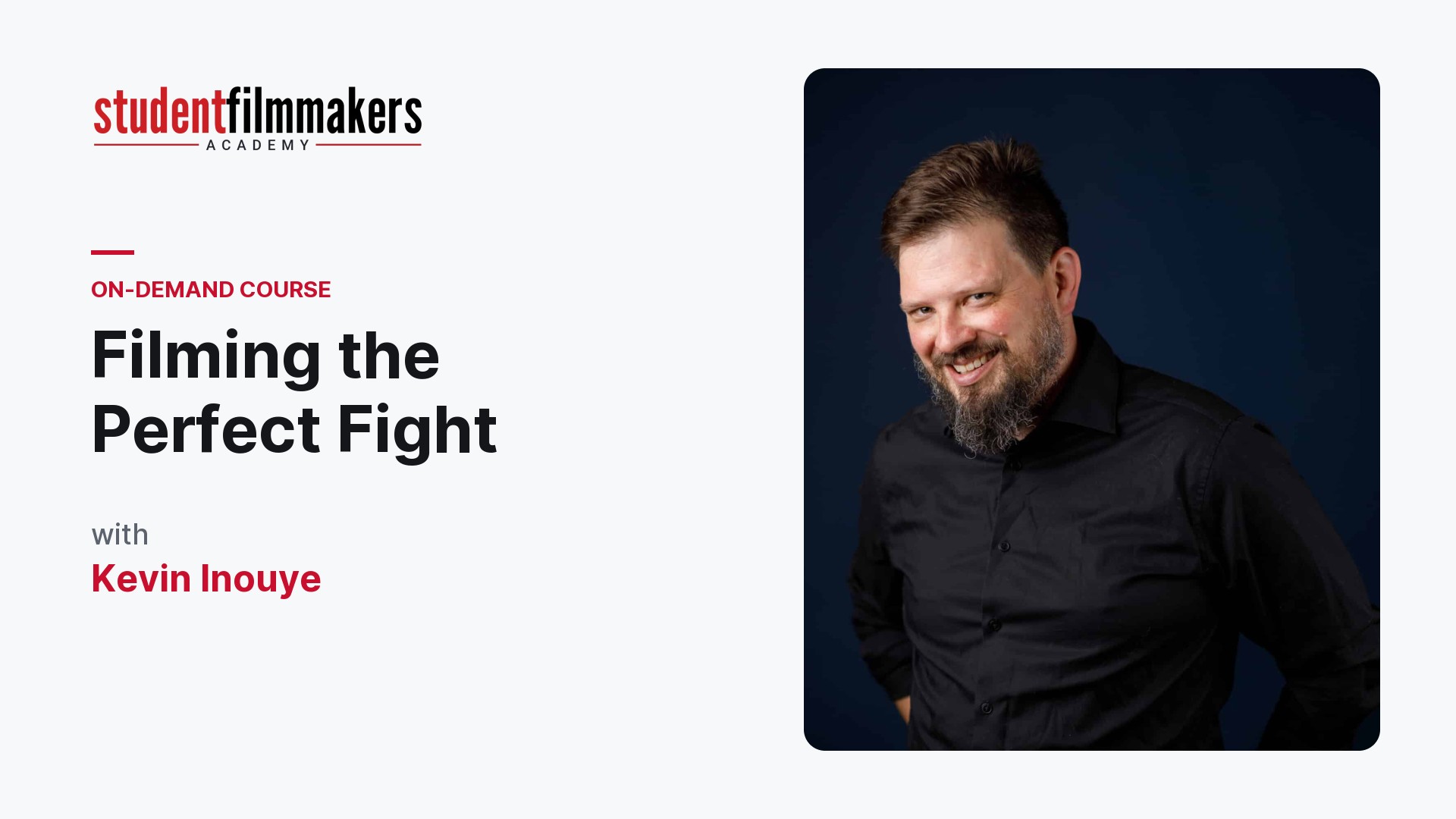
Kevin Inouye is a SAG-AFTRA stunt performer and fight coordinator and the author of The Screen Combat Handbook. Teaching a StudentFilmmakers class, he demonstrated how to film a fight scene so that punches which never land read as real hits, and why the story and the safety of your performers both come first. He ran it like a workshop, with a foam head named Bill Shakespeare as his demo partner and footage he shot with his own kids in the backyard.
Where should a fight scene start?
Not with moves. Inouye starts with the effect you want: should the audience think the fight is cool, feel the struggle, or be disturbed by it? Genre, rating and budget all shape that choice, and sometimes the strongest answer is to show less. A cut to someone watching, plus the sound of the blow, can hit harder than every move on screen.
“Just remember that filmmaking is art, it’s not documentation.”
Budget, to him, means more than money. It means time, trained people and a safe place to work. His rule for student shoots is short: “If you don’t have the budget to do it safely, you don’t have the budget to do it.”
Flexibility is part of safety. On one film, the production flew in an actor from New York who had never done screen work and was uneasy with any prop knife near his face. The grappling Inouye had planned became a fight with a jacket held at arm’s length. If talent does not feel safe, he says, you will see it on camera as hesitation.
How do you make a punch look like it connects?
Inouye’s core principle is that something in every violent moment has to be fake:
“There always needs to be at least one thing that’s fake when we’re dealing with violence.”
Most screen hits are non-contact. The camera, the weapon and the target sit on one line, so the lens flattens the gap. “We want to see that they occupy the same real estate at the same time,” he says. Depending on the lens and the performers’ experience, a miss of six inches to two feet can sell. Closer than six inches at full speed starts to worry him. He pointed to a well-known slip in Return of the Jedi, where a kick on the sail barge misses by a couple of feet and the stuntman reacts anyway.
That line works from either end: over the attacker’s shoulder or from behind the person being hit. From the side, the gap shows. It also works in three dimensions. If a shorter actor can’t kick to head height, put the kicker on the camera side with a low angle, and a kick to the chest reads as a kick to the face.
The catch: two cameras rarely sell the same non-contact hit. In one setup from his book, the low camera sees a kick to the face while the high master sees a kick to the chest that nobody reacts to. And somebody has to watch the monitor, because from beside the performers you cannot tell whether a hit sells.
What are the safe ways to cheat?
| Trick | How Inouye does it | Watch out for |
|---|---|---|
| Speed ramping | Shoot the action at half to three-quarter speed with light contact, then speed it up or slow it down. He learned it from Richard Ryan’s work on the Robert Downey Jr. Sherlock Holmes. | Walking, falling and jumping look like the Keystone Cops when sped up. About 10 percent faster is usually invisible. |
| Reversed footage | Start with the blade or fist at the face, then pull it away fast. Play the shot backward. | Best as a quick insert, not a long shot. |
| Pads and mats | Hide them under wardrobe or behind framing. He made green-screen covers for his own pads. | Each change needs its own setup. |
| Prop doubles | A dulled steel “hero” knife for close-ups, aluminum, 3D-printed or costume-shop versions for the fight, and a cut-off one to fake a stab. | Today a blade is often a short hilt with the rest added in CG, as on The Witcher. |
For the slower takes he often shoots in an iPhone’s slow-motion mode, which leaves room to slow things further in the edit.
How do you hide a cut inside a fight?
Whip pans are the workhorse, because fights already send eyes back and forth. People crossing the lens, the camera circling behind a back, or a muzzle flash that blows out a few frames all give an editor a hiding place. Inouye singled out the church fight in Kingsman as a good study. A Texas swap keeps rolling while something changes just out of frame, like a steel knife dropped and an aluminum one raised. In the Daredevil hallway fight, side rooms let Charlie Cox and his stunt double trade places during the take.
He also warns against long takes on a first shoot. The more non-contact hits in one shot, the more chances to blow it, and a mistake means starting over while tired actors get sloppy. Break the fight into short pieces. He builds choreography in “phrases” that work like paragraphs, with a beat between them for a look, a pose or a joke. Those beats are what audiences remember.
Keep the 180-degree rule so a punch doesn’t suddenly change direction, cut on motion, and keep the point of focus in the same part of the frame across cuts. He credits George Miller’s Mad Max: Fury Road as the model for that last one.
Where should the camera be?
Close enough to fill the frame. A punch thrown by a tiny figure in a wide shot crosses a few inches of screen; the same punch in a medium shot crosses all of it in the same time, so it feels faster. Inouye compares it to an airliner that looks slow high in the sky.
His favorite tool for this is a handheld Fig Rig with a big side monitor, which lets him react faster than a gimbal joystick. Two cautions:
“It’s easier to crop than it is to create something that was off the screen.”
Shaky camera is also easier to add in post than to remove. A small rotation on a head slam adds punch; Furious 7 took it to the extreme in the fight between Dwayne Johnson and Jason Statham, where the camera turns further than the actors do. Skip shallow focus. Fake hits depend on two things looking side by side, and bokeh shows they’re not. A spotter behind the operator keeps them from backing into the bar brawl.
What does sound add to a hit?
On set, playback can feel flat, because the crunch arrives later. Let actors grunt and breathe even on silent takes; people told to stay quiet tense up and look strange. In the edit, Inouye layers stock effects. One kick in his demo combined a golf hit slowed 50 percent, a football tackle, a body hit, a swing and a bone break, with the audio leading the picture in a J cut. Slowing a sound often makes it meatier. For more on building those layers, see why sound design matters.
What do stunt performers wish directors knew?
Repetition hurts. On The Gamers: Dorkness Rising, the first project he coordinated and performed in, he took a backward fall into mats eight or nine times and began to get a headache. There was no single hard impact, just the brain being jolted again and again. Let performers mark the big moves in camera rehearsal, and tell them when the take counts.
“Rehearsal time and training time is much cheaper and safer and easier than time on set when everyone else is standing around saying, we’re losing daylight, let’s go.”
Shoot inserts, cutaways and reaction shots too. A pile of short pieces gives the editor control over rhythm and a way to cover a hit that missed.
Inouye has written for StudentFilmmakers before. Read his screen combat interview and the guide to 15 things every action filmmaker should know about fight choreography.
In the full class, he plays his workshop and backyard footage frame by frame, including his Final Cut timeline for that layered kick.