By Kim E. Welch
Bill Klayer, director of photography on Law & Order, talks about shooting fast-paced TV drama on the streets of New York and his advice for camera crews.
Law & Order depicts the tough process of maintaining law and order in the streets of New York City. It is the most successful brand in primetime television. It is the 1997 Emmy Award winner for Outstanding Drama Series and the record holder for the most consecutive (11) nominations for a drama series.
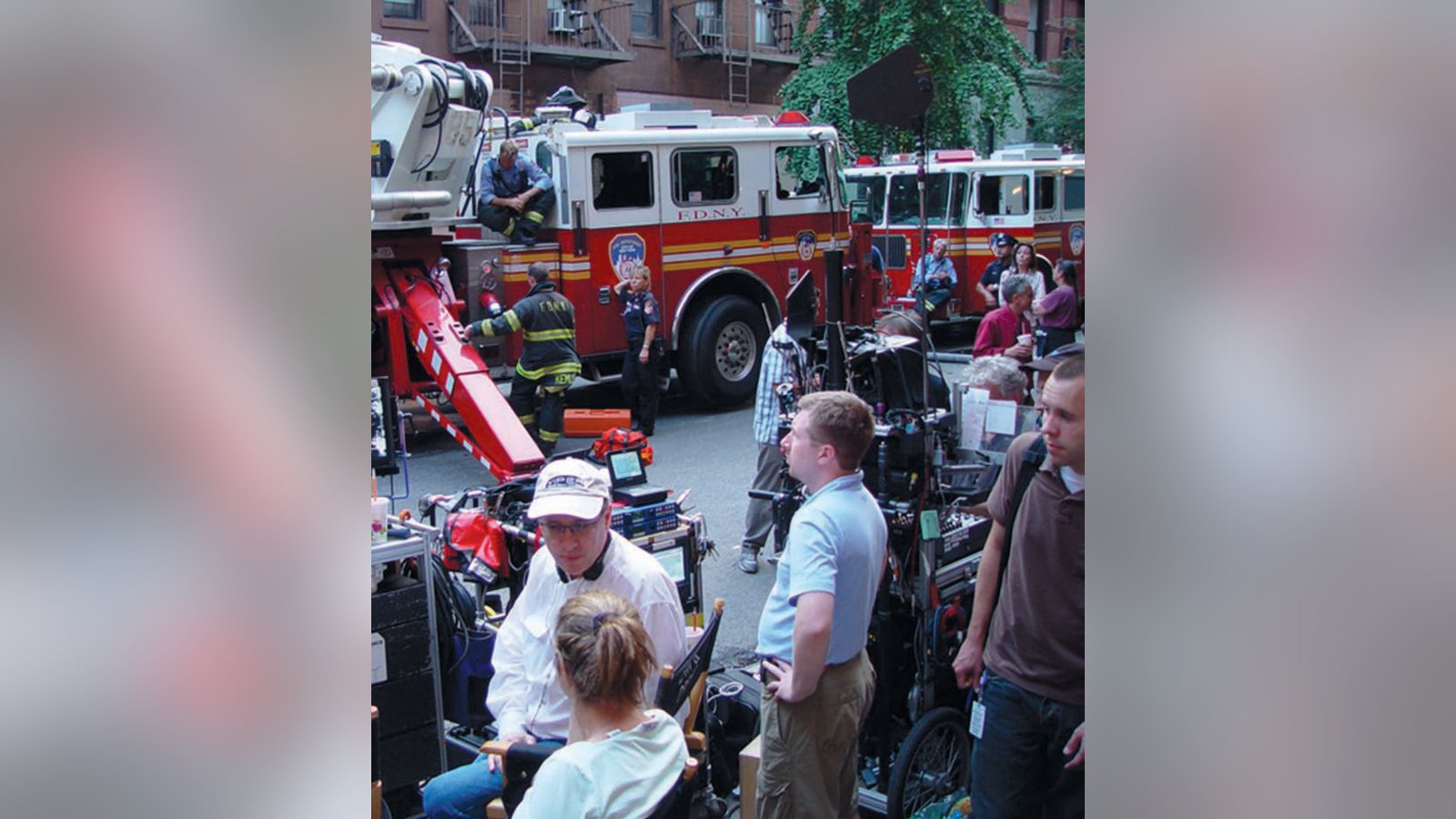
I had a chance to see the shooting of a scene from Law & Order. The episode is called Home Sweet and has a building falling down in it. I interviewed William Klayer the Director of Photography for Home Sweet.
What is your artistic background?
My artist background? I was a film student at Emerson College. I got a film production degree from Emerson College. I graduated from there in 1977, and then went to LA for a while to try to start a career in film, but friends of mine I’d gone to college with were making a film on the East Coast. Originally, I was going to be the Director of Photography for it. They were going to shoot a feature film, and it was going to be shot on 16mm, but they managed to get more money for it, so they bumped it to a 35mm project. They were able to hire a professional cameraman rather than an ex-student, and I had no problem with that, I just wanted to work on the film. I worked as a crewmember – it was a crew of six. They hired a Director of Photography, an Assistant Cameraman, a combination Grip/ Gaffer, and then the Sound man; and then I was the sixth guy. I was involved in all of the departments except for sound. I was working as an assistant cameraman, and when I wasn’t doing that I was gripping and electrician, and I just wanted to learn. And then that cameraman, based out of New York, said, “If you’re going to be in New York, I’ll hire you.”
So that was your break kind of, how you got started?
Yeah, it was a break, so I never went back to California.
What came after that, what was your first real job and when did you start getting paid to be a DP?
I ended up becoming a gaffer. You’re working to support yourself. I wanted to get involved in camera work, but I had a background in theatre lighting. When I was on a film set physically setting up lighting was like second nature to me. I ended up getting pulled into the gaffing area because it was just very easy for me, and I already knew what to do there. Then I’m trying to make a living in New York, so I ended up staying in the gaffing end, and I gaffed some really awful low budget films. I got fed up with that, and wanted to work on stuff with more money, I was an electrician/gaffer/ electrician for a while. And, then I stayed in the gaffing arena. When I got on Law & Order, I originally started as a third electric, and then became the second electric, and then became the gaffer, and I was the gaffer for years. Law & Order was the most wonderful place to be because they were always promoting people from within. So, Constantine Makris, who was the director of photography when I started the show in season two, became the Director, and there’s Chris Misiano (West Wing), he was DP for a while, and Richie Dobbs and they all became Directors of Photography, and then they all became Directors. And so the DP slot eventually opened up. A guy named John Beymer came in and I was gaffing. Then the company decided to initiate this thing where rather than having one DP do the whole season they decided to rotate DP’s because they realized they would actually save money if the DP’s were involved in prepping the episodes, so it became a money-saving thing. So it was wonderful.
How long have you been with the show?
I’ve been with the show since season two.
That’s 19 years? Episode, Home Sweet; shot on 84th St.
No, no, that’s actually 16 years. We’re on our 17th season.
People are always asking, should I go to film school, or should I just get a job. How do you answer this?
That is a very interesting question. I think it really depends on where you want to end up. School is a great place. I have nothing against film school or anything like that. But, in my case I think ultimately added to me actually getting employed. It’s that whole thing about being at the right place at the right time.
And then having the tenacity and passion and desire?
Yeah, but if you want to get into the technical end, you can certainly get there somewhat quicker if you have some experience that’s for sure. So, I wouldn’t knock film school at all. A good example is my son because my son had always talked about going to film school but he wasn’t always the best student. Then it just so happened that he ended up leaving high school and expressed a desire to work in the camera department, so he’s actually working as a film loader on film sets now, he’s in the union, and he’s on his third year now. Close to three years.
You shoot on film?
Yeah, we’ve always shot on film.
And you’ve never used any video, any digital, or HD?
The future is definitely formats like the Panavision Genesis. They’ve always talked about it. The producers in California had us shoot tests because they were thinking about switching to a different format. But the real decision maker is what kind of story do you need to tell. For our show, Law & Order has a very specific style, and the show is conceived visually as almost a documentary. It’s hand-held. We don’t do any steadicam work except in very specific rare occasions. I could literally count them on half a hand. Even though we’ve had operators who have been so good with hand-held work, I’ve had people look at shots and say, “oh what a great steadicam shot.” And you say, “no, that was not done on steadicam.”
So it was originally to have the look of a documentary?
Yes because the camera on Law & Order is rather than photographing a scene – it’s almost supposed to be another person who’s there with our characters watching the scene happen with them. And that’s not to say that every shot we do is handheld. We do a lot of stuff in the courtroom, and we’re on the dollies there, but if you watch it, if we’re doing the job right, the camera will never stop moving, the camera will never lock in anywhere, and if it does that means we weren’t paying attention because it’s really not supposed to do that. It’s always moving, even if it’s on a dolly. Your camera’s never locked and it always has a little floating motion and it’s supposed to feel like a handheld camera.
Now you said you did some test shots with HD. That’s a hot topic. Are there any comments you can make about that, about HD?
There was a show produced by Dick Wolf called Conviction that was being produced and they shot that on a Panavision Genesis. They sent me over for a week to watch them work. That show rarely did any handheld work. For the way we shoot our show, it just wouldn’t work. Not that there’s anything wrong with it. For the style, for the stories we tell, and how we tell them, it wasn’t the right tool. It would affect production schedule, it would affect locations. We do shots where we go in and out of doorways and into tiny little apartments. The Genesis camera is always tethered on a cable to a bank of monitors and for Law & Order it wasn’t the right way to go. It’s more than just the actual visual image, it’s more the physical limitations in regards to how we shoot and tell our stories. And I have to agree, when it’s all said and done, you could put two shots side by side, you could say which one was HD and which one was film, and maybe you can’t tell. But when you’re watching the story being told, I think film has this kind of magical quality that you can’t really describe with words. It’s something that your brain just perceives at more of a subconscious level. Film has a magical quality that you can’t beat.
Could you kind of walk me through what happened on the East 84th Street scene?
They give us a script. And the amazing thing about that script – that script came at us very late in our prep. And they also said there’s a building falling down. We literally had four days before we were supposed to start shooting. The main thing is finding a location– we’re looking in the city at any available space, and usually they’re building something on it. The first thing was we had to find an empty lot that didn’t have any construction going on at all. They sent out location scouts who found a lot that just beautifully fell into schedule. It was at a cleared lot with no construction going up on it yet. And, it was in a nice area. We looked at a bunch of lots but some of them were in very down-scale neighborhoods, but part of the story was in a very nice neighborhood. We just really got very lucky. We found this location. And Gary Weist, our director, did an amazing job of conceiving how to create this thing. We don’t have the luxury of having several days, like a feature film. In a feature film, they would spend a whole week shooting this one sequence. We literally had a whole day to shoot this entire sequence. In a single day, we have to shoot the scene that happens before the building falls down, we have to shoot the building falling down, and we have to shoot the scene that takes place after the building has fallen down. We also got some digital help which we don’t usually do, but they (the West Coast) actually wanted to see a building fall down. If you see the episode you will actually see a building in this empty lot which didn’t really exist, they had to put it in digitally, which we don’t normally do. In reality the director and I were hoping to avoid that. We had conceived a way of filming the sequence where you wouldn’t actually see the building – you would see a pile of rubble come out into the side walk. It was also because the story involved this little girl, who’s standing in the wrong spot, and she gets killed, and we didn’t want to lose the impact of that. But they asked us to shoot it in such a way that they could digitally put in a building. What you do in a TV show is a lot different than what you do in a movie. We have this tremendous amount of work, just page count work, just to get done in a single day. Because of the documentary look of our show, we don’t really necessarily do lighting on day exteriors. If anything, we try to avoid it. But this scene I had to because we were literally shooting this sequence until the last drop of sun was in the sky. So the last couple shots of that scene I did have some lights out there.
How did you collaborate on the East 84th St. shoot?
You have a prep team which involves the Director, Production Manager, the Assistant Directors, the Art Director, and Locations Manager, and we’ll get together in prep and we’ll do a preliminary scout and we’ll pick all our locations and since the directors kind of assemble them into doable days of work and the way you usually do it is you find that like that one day was an entire day in this vacant lot. Other days you kind of pick a location that’s important to the story, like an office, or someone’s home, and then you’ll find other locations that you can shoot in close proximity to that location, you kind of build days that way, the assistant directors and production manager figure that part out, how it can all work. We’re shooting entire episodes in an 8 day period. We do 8 days of prep and then 8 days of shooting on each episode.
So there are two teams working at the same time?
Well, yeah, there’s a team that’s shooting and one in prep – there’s an episode that’s being shot now, and I’m in prep for an episode that’s being shot next.
What is it like to have more than one Director for the series and does the Director of Photography have a lot to do with the style?
Each show has its style. And the style is part of how we chose to tell the story, and so yes, in that case, David Tuttman the other Director of Photography and I kind of become the watchdogs to make sure the show is visually staying true to itself. Most directors that come in are familiar with the show, but some directors come in and aren’t familiar with the style. It’s always a great chance to collaborate. Some directors are more visual than others, and David and I are there to support the ones who aren’t. It’s always a different experience and it’s always a great experience. It’s always a way to learn more and grow. And everyone here is always easy and nice to work with.
How many takes do you do on average?
3 or 4 takes on average.
Do you use a storyboard?
Rarely. We actually never ended up storyboarding the sequence in Home Sweet. But I’ve had other sequences – I did an episode where there was a train wreck in the beginning, and since we were doing stunts for that so we used story boards.
You pretty much know where you are going to shoot from without a storyboard, unless it’s a complicated scene with stunts?
Yeah we rarely use a storyboard and sometimes if it’s going to involve the sets and stunt work we will do a storyboard, and it just also helps with the communication with all the departments so everyone is kind of on board and knows ‘this is what we need to get on film in this days work.’ If you have a storyboard, and it’s something a little out of the box, you know, special effects, gun firing, cars, or something like that, a storyboard will always help keep everybody on track of what we’re doing now and what we need to do next.
Post production – what is that like with this particular 84th street shot? You said that they digitally put a building in, who did it?
Well, I’d love to tell you, but it’s all done in California. I’ve been out to do post production on one of my episodes once, and basically, I was able to sit in with the color timer, and I sat in on the color time session for an episode. But all the post production work is done in California. On the Home Sweet episode they had the man who was going to supervise the digital effects – he flew out and he was there with us on the day of filming and basically he was just there so he’d be familiar with what we were photographing. He didn’t really tell us how we had to film it; we just wanted to make sure he was going to get what he needed so he could do his work on the other end. And they actually had a still photographer go around and photograph fronts of buildings so he could find elements to use to create a building. He actually added extra rubble for us.
Specifically what kind of cameras do you use?
We shoot Panavision 35mm. We’re using the Millenniums, the XL’s right now, because they’re the lightest camera, and we do a lot of handheld work, so it saves our camera operators a lot of aggravation and pain because they are the lightest Panavision camera available and the best tool available for what we do.
Anything else interesting that happened on that episode that you can remember?
What made filming that particular sequence a pleasure was how friendly the neighborhood was. We were a little apprehensive about showing up on the Upper East Side and making a lot of noise and making a lot of dust and making a lot of dirt. We felt welcomed and the day went smoothly.
When you’re shooting a crime scene is there anything – to make an accurate, you know, to make a crime scene look like a crime scene?
All the scripts are read by a tech advisor and he gives us notes about what’s right and what’s wrong. Again, sometimes you kind of got to look the other way. We’re still doing dramatic storytelling. When the day is done, it’s still a fictitious story even if it’s based on some kind of current reality, news story, or something like that. Sometimes you do have to take dramatic liberties with the reality, and there are a lot of factors that go into it.
I saw an episode where the blood went in an unreal direction. What was happening there?
You can’t necessarily go into an existing location and throw blood on their walls because we’re going to have to be responsible to clean it up afterwards. We’re always worried about where the blood’s going to go.
Related filmmaking guides
Keep learning filmmaking
Want more lessons like this? Join StudentFilmmakers free for live webinars with working pros, and stream on-demand filmmaking classes in cinematography, directing, screenwriting, sound and post.