By Damian Horan
Damian Horan won the 2012 ASC Andrew Laszlo Student Heritage Award in the graduate category. He explains how he shot Josephine and the Roach.
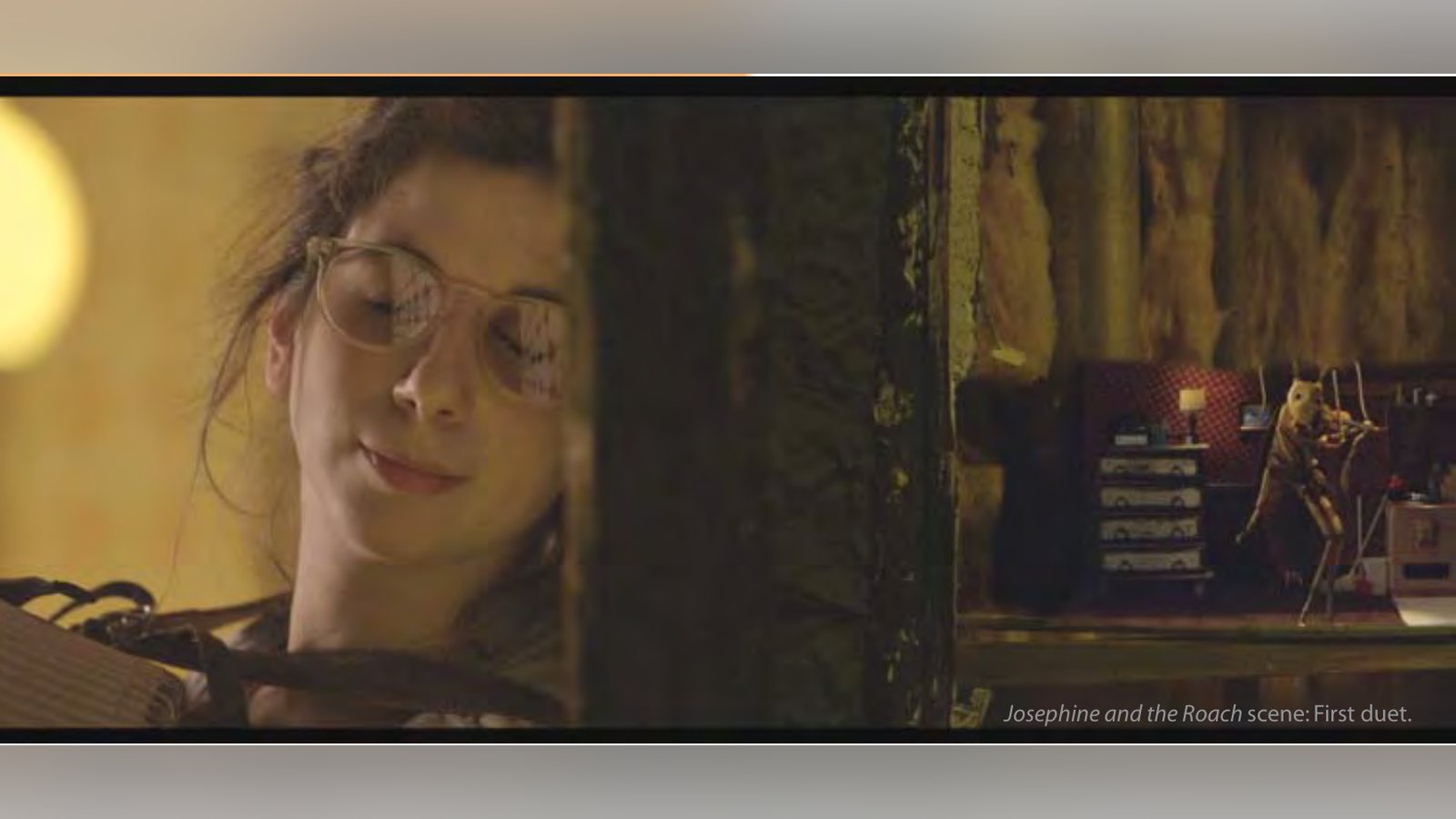
The American Society of Cinematographers (ASC) has chosen Damian Horan as the winner of the 2012 ASC Andrew Laszlo Student Heritage Award in the graduate category for “Josephine and the Roach,” a surreal, offbeat live-action short film about a cockroach who falls in love with the woman whose apartment he infests. Horan discusses capturing dramatic and comedic shots, lighting, and shooting scenes on the Genesis, Red One, and 7D.
How did you come together with Jonathan Langager for this project, and what were your initial feelings about the story and concept?
Damian Horan: Jon was a good friend of mine at USC, and I had shot a small project for him a while back entitled “Spleen.” It was about a bored young man who decided to get his spleen removed and subsequently dies from the procedure. It was very dark and twisted and bizarre, and then he one upped himself with a love story about a cockroach for “Josephine and the Roach”. I immediately loved the concept for “Josephine.” It was a very simple classic forbidden love story not so different from Romeo and Juliet, but told with a twist: a roach protagonist. Tell us about the film’s “look,” and key methods and techniques you used to create the “look”.
Damian Horan: I remember one of our first crew meetings, Jon had us all sit down and watch “Delicatessen” together. Jon is a big Jeunet fan, and wanted the look of “Josephine” to be inspired by “Delicatessen” and “Amelie,” (considered by many to be one of the most beautifully shot films in the last decade…a simple request for a student film [smiles]).
We wanted to create a very surrealistic, magical world where one could actually believe a woman could fall in love with a roach, so we had to create a sense of romanticism amidst a dreary backdrop of Josephine’s apartment, where love and hope had been replaced We decided to make very strong choices from everything to lens choice to camera movement to color of light. We used a mustard yellow that for some reason created a weird sense of comfort and homeyness for the kitchen, the place where Josephine and the Roach connect for the first time. To show Josephine’s isolation and despair, we decided to midnight blue/green look in her bedroom. And then we decided to primarily light the living room, where Josephine’s brutish husband primarily lives, with the Television set to further accentuate the isolation Josephine has from anything real in her life.
We had an incredible production designer, Giao-Chau Ly, who together with Jon created an incredible set and world to shoot on. It had such a unique yet old/timeless feel to it. It was pretty hard to not find a pretty shot wherever you pointed the camera.
What cameras and lenses did you shoot with and why?
Damian Horan: The majority of the shoot was shot on Panavision’s Genesis with a set of Primo Primes and a Primo Wide Angle Macro Zoom (provided very generously by Mike Dallatorre and the Panavision New Filmmaker Program). I absolutely loved the Primos, such a beautiful look, and we also really enjoyed playing with the Macro Zoom as it really allowed us to get up close in personal with our Roach on a wide angle lens while still maintaining a super shallow depth of field.
We decided to shoot the Roach’s miniature apartment set on the Red One because we wanted the extra resolution due to all the VFX work that was going to be required for the Roach. We also wanted to be able to shoot at 48-60fps to add a little weight to the Puppet, to make his movements feel a little more natural.
In addition to the Genesis and Red One, we also shot two commercials (“Blatt’s Beer” and “A Science Infomercial) on the 7D with super old Nikon still glass. The “Blatt’s Beer” Commercial might be my favorite thing I have ever shot. It’s a lot of fun. You can view it on the facebook page for “Josephine”: https://www.facebook.com/JosephineAndTheRoach
So in short, we definitely ran the gamut on digital cameras with “Josephine”.
What were some important benefits and reasons for your camera and lens selections for this project?
Damian Horan: Jon is a really fun director to work with because he is not afraid of making really strong choices. So from Day 1, we decided we didn’t want to play anything safe with “Josephine”, and we were only going to use extremely wide or extremely long lenses and avoid the standard 25mm and 50mm workhorse lenses that are so often used.
“Josephine” is a silent film for all intensive purposes, no dialogue, so the visuals really had to make a strong statement. They had to be unique and dynamic enough so that the audience would fall into the romanticism of this surreal world where a Roach and Woman could actually fall in love.
What was your favorite scene to light and why?
Damian Horan: I think my favorite scene to light was probably the scene where Josephine realizes the Roach has infested her husband’s brain. It was a wonderfully romantic scene where Josephine comes out of her bedroom and to find her Roach/ Husband playing their song by tapping on Blatt’s Beer bottles. The script called for a bustling romantic city outside Josephine’s apartment, but obviously since we were shooting on a stage at USC, all we had was blackness outside her window. So with my gaffer Phil Matarrese, we decided to hang bare light bulbs at differing levels and distances from the window with super saturated gels covering them, to try to create a sense of a romantic city outside. Is it super realistic? Probably not, but within the world we created, I think it portrayed the mood and romanticism of the scene pretty well.
Could you describe some of your camera techniques for capturing dramatic and comedic shots, POV, and scenes with camera movement?
Damian Horan: The movement of the camera was an integral part of telling Josephine’s story. Again, since there was no dialogue, the camera really had to push the audience into the direction and mood of the story. We lived on a Chapman Super PeeWeeII for the majority of the shoot, occasionally attached a stinger arm to it.
Again, following the Jeunet inspiration, we really utilized a lot of wide angle photography that sort of helped create a bit of a whimsical/humorous feel to many of our shots. I think my favorite shot of the film, is a shot where Josephine wakes up to find a heart-box full of chocolates next to her bedside table. We used the Primo Wide Angle Macro Zoom to place the heart-box in a very tight closeup in the foreground so that it looked pretty big, but as Josephine reaches for the box we boom up and follow the box to her face to reveal that it is a mini “Roach-size” box of chocolates. I really felt like this shot linked our two worlds (the live action and our miniature world) in a very effective/efficient way.
Also since the hero of our story was a 2-inch roach, we needed to find a way to get into his world and show his world. As such we decided to use Innovision Probe Lenses, which allowed us to stick the lens in very tight awkward corners, i.e., places where a roach might live.
Tell us about working with the puppet, working with green screen and the visual effects for the film.
Damian Horan: We had a wonderful puppet team on our shoot. It was headed up by Lino Stavole, who created the puppet using 3D Printing. It was a fantastic puppet, but since a roach has so many legs it actually turned out to be quite a challenge to find a way to light the puppet due to the fact that at times there were up to six puppeteers surrounding the puppet to give animation to all his limbs. (Where do you sneak a light in when there are six grown men surrounding a 2-foot puppet?)
Before you went to film school, were you already familiar with different cameras and production to post production workflows?
Damian Horan: No, I really didn’t know much at all about filmmaking prior to attending USC. I had always loved movies, and had always enjoyed trying to make them, but looking back I was pretty clueless on just about every basic fundamental of filmmaking.
Could you tell us a little bit about your educational background, your decision to go to film school, and your reasons and inspiration for studying film production in a traditional university setting?
Damian Horan: To be honest, I was deeply in love with a girl when I was deciding which undergrad institution to go to, and so I decided to follow her to a very conservative liberal arts school in Virginia, “Washington and Lee.” There was a wonderful communications department there, but no real opportunity to pursue filmmaking, so I decided to double major in business and communications. Upon graduation, I married the girl I followed there, and we moved back home to Houston, TX, where I began a career as a corporate banker. I worked my way up to Vice President, but along the way the big “C” word came for a visit and kind of shook me up for a bit, so I decided I would take one last shot at the filmmaking dream and apply to the top three graduate film school programs (or at least how I perceived them at the time). I received rejection letters from NYU and The University of Texas, and the last letter I received was from USC. I think it even came in a small envelope so I just assumed it was another rejection letter and tossed in a pile of mail to be opened at another time.
Would you recommend film school for others?
Damian Horan: Film school is an interesting bag. I definitely learned a lot and met a ton of incredible people, but I also spent a lot of money and many years of my life in doing so. So, no I don’t think film school is for everybody. As for me though, I know it was pretty invaluable because I would have had no clue how to break into the business without it. Even after graduating, 90% of my work comes from contacts I met while in film school.
What are you working on next?
Damian Horan: I just wrapped my first feature directed by another wonderful young film school graduate director, Rachel Goldenberg. The film stars Danica McKellar, Dustin Milligan, and Lea Thompson and is entitled “The Children’s Table.” It should air sometime this November on TV. I also just wrapped an incredibly fun music video for Ben Folds Five starring the Fraggles from Fraggle Rock, which was directed by yet another great USC director, Phil Hodges. You can see the video here: http://www.youtube.com/watch?v=mEyrfFwf3rI
If you could share some inspirational words or a piece of advice with filmmakers around the world, what would it be?
Damian Horan: I don’t have anything original to say, but one of my favorite quotes of all time is: “My father says almost the whole world is asleep; everyone you know; everybody you see. Everybody you talk to. He says that only a few people are awake, and they live in a state of constant total amazement.”
Related filmmaking guides
- What does a cinematographer do?
- How to become a cinematographer
- Camera angles in film: a beginner’s guide
Keep learning filmmaking
Want more lessons like this? Join StudentFilmmakers free for live webinars with working pros, and stream on-demand filmmaking classes in cinematography, directing, screenwriting, sound and post.