Neal Bell is a playwright, screenwriter and teacher whose thriller Two Small Bodies became a film, whose stage version of Thérèse Raquin became the movie In Secret, and whose mystery play Spatter Pattern won the 2005 Edgar Award. He won an Obie Award in 1992 for sustained achievement in playwriting, wrote for One Life to Live and All My Children, and teaches playwriting, screenwriting and a course on horror movies at Duke University. He has loved being scared since he was a small boy hiding under his seat during The Wizard of Oz.
Early life in Norfolk, Virginia
Neal C. Bell grew up in Norfolk, Virginia. As a small child he put on plays in his backyard. As a teenager he started going to the Norfolk Little Theatre, one of the theaters started by the Federal Theatre Project in the 1930s. A production there of Jean Anouilh’s Antigone got him very excited about the stage.
His love of horror started early, and with a scare. When he was about six, in the 1950s, his older brother, then nine, took him to see The Wizard of Oz at the Memrose Theatre in Norfolk. Neal remembers spending most of the movie under his seat. His parents kept a close watch on what he saw on TV. Another time his father took him to The Angry Red Planet. Neal wanted to leave after about half an hour, and his father made him stay to the end. His brother has his own theory about where the fears came from: Slovenly Peter, an old German children’s book of frightening poems with morals.
He earned a BA from Yale College in 1971 and an MFA from the University of Iowa in 1974. At Iowa there were only a handful of playwrights and plenty of directors, so nearly everything he wrote was staged, at least in a classroom. That is where he learned that what works on the page may not work on stage.
Getting started
After Iowa he spent a while, in his words, sending plays out and getting them rejected. The turn came at the Eugene O’Neill Theater Center’s National Playwrights Conference in Waterford, Connecticut, where a handful of writers each got three and a half days with New York directors and actors, then a book-in-hand reading. An agent saw his play there, and it was produced in New York the next fall.
Playwrights Horizons in New York became an early home. It staged Two Small Bodies, a two-character thriller, in 1977, and Breaking and Entering in 1978. Two Small Bodies went on to productions in Los Angeles, Denver, Chicago and elsewhere.
His first screenwriting job came through a theater director he knew who had been hired for his first movie. The script needed a rewrite, the director remembered Neal was a horror fan, and Neal flew to Toronto to see the sets. He had never written a screenplay. He had two weeks, worked through the night, and delivered a page-one rewrite, the fastest he has ever written anything. That job started his study of how screenplays work.
In the mid-1980s he also read scripts freelance for HBO, CBS/Fox Video and CBS Theatrical Films.
Plays, adaptations and daytime drama
Through the 1980s and 1990s his plays reached Off-Broadway and the big regional theaters. Operation Midnight Climax opened in New York in 1981. Raw Youth was read at the O’Neill in 1984 and produced at Playwrights Horizons in 1985. Cold Sweat played South Coast Repertory and Playwrights Horizons in 1987. On the Bum, commissioned by South Coast Repertory, opened Off-Broadway at Playwrights Horizons in 1992. Berkeley Repertory Theatre commissioned and produced his McTeague, and Actors Theatre of Louisville commissioned several of his plays.
Raw Youth taught him a hard lesson. The play held very personal material for him, and a harsh New York Times review closed the door on it after its limited run. He has said openly that a critic’s power over a play’s life is one of the toughest parts of the job.
His stage version of Émile Zola’s Thérèse Raquin began as a libretto for a musical with composer Michael John LaChiusa that never happened. A New York University student director, Edward Elefterion, asked him to turn it into a play. Michael Greif then staged it at the Williamstown Theatre Festival in 1993 and at La Jolla Playhouse. Director Charlie Stratton saw the published play, staged it in Los Angeles, bought the rights and wrote the screenplay for In Secret (2013), with Jessica Lange, Elizabeth Olsen and Tom Felton. Neal saw the finished film for the first time in Durham and called it “very definitely a movie, not a filmed play.”
Two Small Bodies became a film too. He co-wrote the screenplay with director Beth B, and the film, with Fred Ward and Suzy Amis, came out in 1993. His play Raw Youth was the basis for the 1991 film Undertow.
He also spent years in daytime television. He was a staff writer on ABC’s One Life to Live from 1991 to 1993 and again from 1995 to 1997, and on Port Charles from 1999 to 2000. He shared Writers Guild of America Awards for daytime serials with the writing teams of One Life to Live in 1993 and All My Children in 2002, and Daytime Emmy nominations with both teams. From 1999 to 2001 he was a script consultant for HBO.
Monster, his stage version of Frankenstein, was commissioned by La Jolla Playhouse and produced by Classic Stage Company in New York in 2002. Spatter Pattern (Or, How I Got Away With It) opened at Playwrights Horizons in October 2004 and won the Edgar Award for Best Play from the Mystery Writers of America in 2005. He built it from two true stories: a professor fired after a student’s murder despite no evidence against him, and a celebrated historian who told students about Vietnam service he never had.
Teaching at Duke
Neal joined Duke University’s Department of Theater Studies as Professor of the Practice in 2006, and in 2023 he was named the Mary D.B.T. and James H. Semans Professor of the Practice. He has been playwright-in-residence at the Yale School of Drama and has taught playwriting in New York. At Duke he teaches mostly seminars capped at 18 students, along with a horror film course he has called The Dramatic Monster.
That course led to his book How to Write a Horror Movie, published by Routledge’s Focal Press in 2020. Routledge first asked him to review another book, and he thought a how-to book of his own might be fun, even though, as he says, he is mainly a playwright. Duke continues to stage his new work: a reading of The Report from Planet X by Duke Players in 2019, and his Golem, which moves the legend from 16th-century Prague to New York after 9/11, on the Theater Studies main stage in November 2021.
Career timeline
| Year | Milestone |
|---|---|
| 1971 | BA, Yale College |
| 1974 | MFA, University of Iowa |
| 1977 | Two Small Bodies produced at Playwrights Horizons, New York |
| 1978 | Breaking and Entering produced at Playwrights Horizons |
| 1981 | Operation Midnight Climax opens in New York |
| 1983 to 1985 | Freelance script reader for HBO, CBS/Fox Video and CBS Theatrical Films |
| 1985 | Raw Youth produced at Playwrights Horizons; screen credits on Terminal Choice and Knots Landing |
| 1987 | Cold Sweat at South Coast Repertory and Playwrights Horizons |
| 1990 | Shares the Heideman Award for his ten-minute play Out the Window |
| 1991 | Joins One Life to Live as a staff writer; Undertow, based on Raw Youth, released |
| 1992 | Obie Award for sustained achievement in playwriting; On the Bum opens Off-Broadway; Daytime Emmy nomination with the One Life to Live writing team |
| 1993 | WGA Award, daytime serials, with the One Life to Live team; Thérèse Raquin at Williamstown Theatre Festival; film of Two Small Bodies, co-written with Beth B |
| 1999 | Staff writer on Port Charles (to 2000); script consultant for HBO (to 2001) |
| 2002 | Monster at Classic Stage Company, New York; WGA Award and Daytime Emmy nomination with the All My Children team |
| 2004 | Spatter Pattern opens at Playwrights Horizons |
| 2005 | Edgar Award for Best Play, Spatter Pattern |
| 2006 | Professor of the Practice, Theater Studies, Duke University |
| 2013 | In Secret, the film of his Thérèse Raquin, completed (released in the U.S. in 2014) |
| 2020 | How to Write a Horror Movie published by Focal Press/Routledge |
| 2021 | Golem on the Duke Theater Studies main stage |
| 2023 | Named Mary D.B.T. and James H. Semans Professor of the Practice; teaches our live webinar on horror storytelling |
He has also received fellowships and grants from the Guggenheim and Rockefeller Foundations and the National Endowment for the Arts.
People Neal Works With
- Playwrights Horizons, the New York theater that staged Two Small Bodies (1977), Breaking and Entering (1978), Raw Youth (1985), Cold Sweat (1987), On the Bum (1992) and Spatter Pattern (2004), and workshopped Somewhere in the Pacific and Thérèse Raquin.
- Director Michael Greif, who staged Thérèse Raquin at Williamstown and at La Jolla Playhouse. Neal names him among the incredible people he has been lucky to work with.
- Director Jody McAuliffe, his Duke colleague, who has directed six of his plays, including Golem (2021).
- Beth B, his co-writer on the film of Two Small Bodies (1993).
- Charlie Stratton, who staged Thérèse Raquin in Los Angeles and then adapted and directed it as In Secret (2013).
- The One Life to Live writing team, including Michael Malone and Josh Griffith, with whom he shared the 1993 WGA Award, and the All My Children team, including Agnes Nixon and Jean Passanante, with whom he shared the 2002 WGA Award. Craig Carlson was on both teams with him.
The films he loves
Neal’s favorite screenplay is Robert Towne’s Chinatown. In horror, he calls Rosemary’s Baby “almost unbearably suspenseful” and often returns to Let the Right One In. When he told us about recent favorites in 2020, he picked Don’t Breathe, Creep, Get Out, Hereditary and A Quiet Place. In 2021 he named five overlooked horror films for Duke: Kiyoshi Kurosawa’s Creepy, J.A. Bayona’s The Orphanage, Karyn Kusama’s The Invitation, Gareth Edwards’ Monsters and Babak Anvari’s Under the Shadow.
He has limits. He told our class there are a couple of films he will never watch, including Cannibal Holocaust, because animals were really killed in it. He thinks of fear the way some people think of roller coasters: something he loves and dreads at the same time. In class, he likes to ask his students to list ten things they are afraid of, because the most personal fears make the most lasting films.
In his own words
“I don’t think plays should answer questions. I think they should ask them and leave the audience to make up their own minds.” (The Chronicle, Duke University, 2019)
“I’ve always loved—and been afraid of—being scared, similar to the love-hate relationship some people have with roller coasters.” (Duke Today, 2020)
“Lesson learned: If you’re going to a scary movie, plan an exit strategy.” (Duke Today, 2020)
“Terror is hard to pull off on stage, but I thought it was worth a shot.” (Duke Theater Studies, 2021)
“The advice you often get, early on, is ‘Write what you know.’ I’d revise that to, ‘Write what scares you.'” (Student Filmmakers Magazine, 2020)
With StudentFilmmakers
Neal first appeared with us in August 2020, when associate publisher Jody Michelle Solis interviewed him about horror screenwriting. He talked about why audiences need to care about the characters, how to make the monster more than a monster, and the story of his first screenwriting job. In November 2022 he wrote “Writing Pandemic Horror” for Student Filmmakers Magazine.
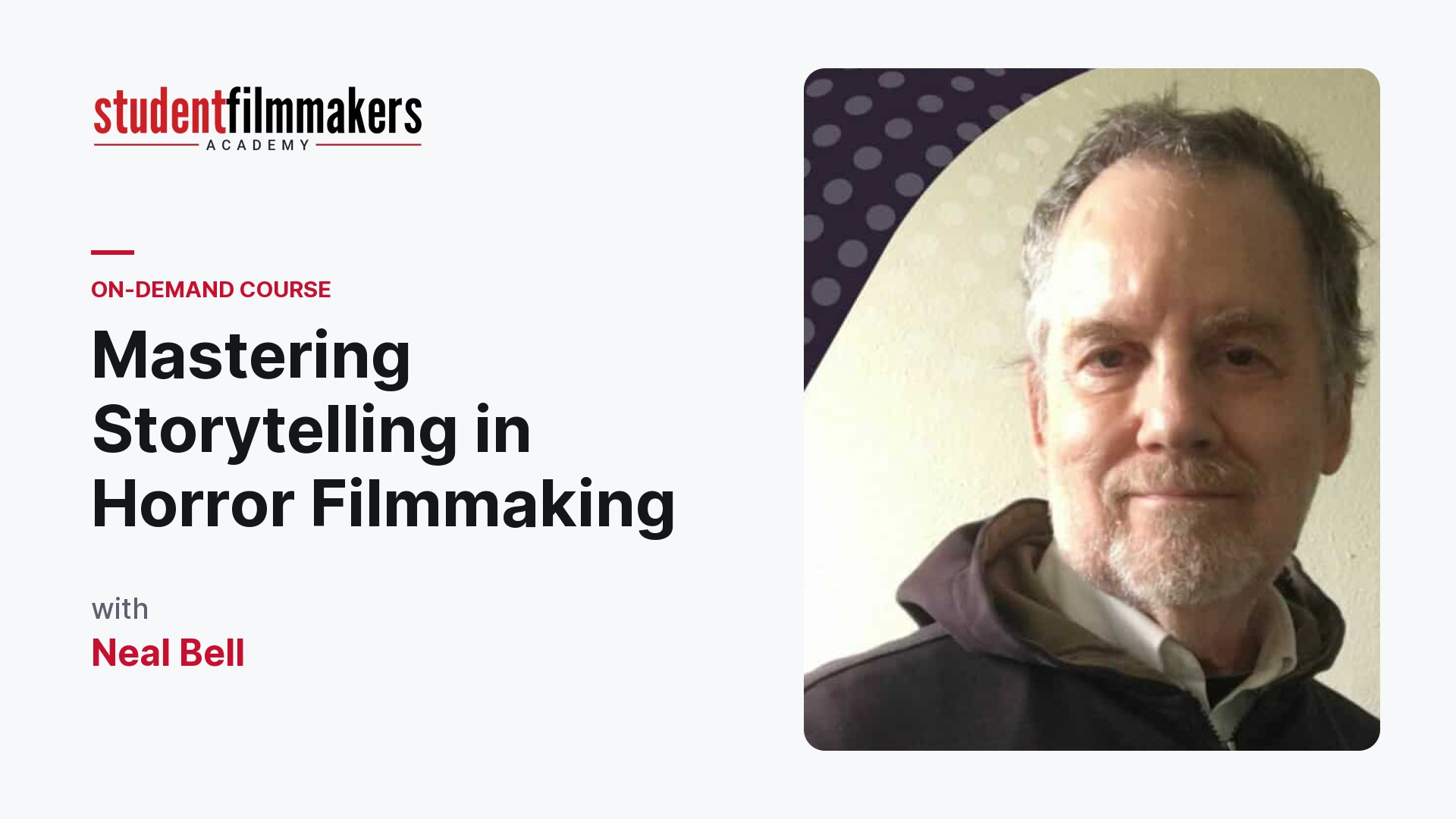
On June 21, 2023, he taught our live webinar “Mastering Storytelling in Horror Filmmaking,” on the politics hidden inside horror films, with Jody as host and publisher Kim Welch joining the Q&A. The class is now a course in the StudentFilmmakers Academy, and in November 2026 we published an article from it.
Current Productions
No current film, television or stage projects are publicly listed for Neal as of November 28, 2026. His most recent publicly announced premiere was Golem, at Duke in November 2021.
Complete credits
Screen credits newest first, from IMDb (checked November 28, 2026). Stage credits from Duke University’s faculty records, his publisher and press, as listed in our sources.
Writer (screen)
- 2013 | Cold Sweat | short | writer
- 2013 | In Secret | feature | based on his stage play Thérèse Raquin
- 2001 | All My Children | series | writer, 2 episodes
- 1999 | Port Charles | series | writer, 1 episode credited on IMDb (staff writer 1999 to 2000)
- 1992 to 1996 | One Life to Live | series | writer, 12 episodes (staff writer 1991 to 1993 and 1995 to 1997)
- 1993 | Two Small Bodies | feature | screenplay with Beth B, based on his play
- 1991 | Undertow | feature | based on his play Raw Youth
- 1985 | Terminal Choice | feature | original screenplay
- 1985 | Knots Landing | series | written by, 2 episodes
Playwright (first productions and publication)
- 2021 | Golem | play | Duke Theater Studies, Sheafer Theater
- 2019 | The Report from Planet X | play | staged reading, Duke Players
- 2013 | The Man Who Was Thursday | stage adaptation of G.K. Chesterton | Little Green Pig Theatrical Concern, Durham
- 2011 | Now You See Me | play | published by Broadway Play Publishing
- 2006 | Shadow of Himself | play | commissioned by the New York State Council on the Arts through The Civilians
- 2006 | Grand Guignol, A Sinister Scene | play
- 2004 | Spatter Pattern (Or, How I Got Away With It) | play | Playwrights Horizons; 2005 Edgar Award
- 2002 | Monster | play, from Frankenstein | commissioned by La Jolla Playhouse; Classic Stage Company
- 1995 | Somewhere in the Pacific | play | workshop, Playwrights Horizons; full production 1999, Manbites Dog Theater, Durham
- 1995 | Drive | ten-minute play | Actors Theatre of Louisville anthology
- 1993 | Thérèse Raquin | play, from Zola | Williamstown Theatre Festival; La Jolla Playhouse 1994 and 1997; Classic Stage Company
- 1992 | On the Bum | play | commissioned by South Coast Repertory; Playwrights Horizons
- 1992 | McTeague | play, from Frank Norris | commissioned and produced by Berkeley Repertory Theatre
- 1992 | A Time-Piece | play | published in Tough Acts to Follow
- 1991 | Ready for the River | play | Dramatists Play Service
- 1990 | Out the Window | ten-minute play | Actors Theatre of Louisville; shared 1990 Heideman Award (anthology 1992)
- 1990 | Ragged Dick | play | regional theater
- 1989 | Sleeping Dogs | play | New Arts Theatre, New York (workshop 1985, Mark Taper Forum)
- 1989 | The Open Boat | play | commissioned by Actors Theatre of Louisville; Ensemble Studio Theatre
- 1987 | Cold Sweat | play | South Coast Repertory; Playwrights Horizons
- 1986 | Voices in the Head | play | commissioned by Actors Theatre of Louisville
- 1985 | Raw Youth | play | Playwrights Horizons (O’Neill reading 1984)
- 1981 | Operation Midnight Climax | play | commissioned by Actors Theatre of Louisville; New York
- 1981 | Gradual Clearing | play | commissioned by the Phoenix Theatre, New York
- 1978 | Breaking and Entering | play | Playwrights Horizons
- 1977 | Two Small Bodies | play | Playwrights Horizons
Author
- 2020 | How to Write a Horror Movie | book | Focal Press/Routledge
Television (other)
- 1999 to 2001 | HBO | script consultant
- 1993 | Safekeeping | screenplay from the Gregory McDonald novel | unproduced
- 1983 to 1985 | HBO, CBS/Fox Video, CBS Theatrical Films | freelance script reader
Thanks
- 2018 | Fair Faults | short | special thanks
On StudentFilmmakers
Articles by, with and about Neal
- Horror Screenwriting Tips from Neal Bell (August 25, 2020)
- Screenwriting Insights | Writing Pandemic Horror (November 7, 2022)
- A Special ‘Thank You’ to Guest Speaker Neal Bell (June 29, 2023)
Other articles that mention him
- Horror Without Hiding in the Dark: Christopher Baffa, ASC on Lighting the American Horror Story Pilot (November 28, 2026)
His class in the StudentFilmmakers Academy
- Mastering Storytelling in Horror Filmmaking with Neal Bell, and our article from it: How to Write a Horror Movie That Says Something: Neal Bell on Psycho, Barbarian and Pulse (November 28, 2026)