#FlashbackFriday #FBF Do you remember our Community Spotlight with Adrian Picardi?
Picardi Makes Pro Level Actioner with Just One Camera
Color manipulation, artful scoring, and trial-and-error.
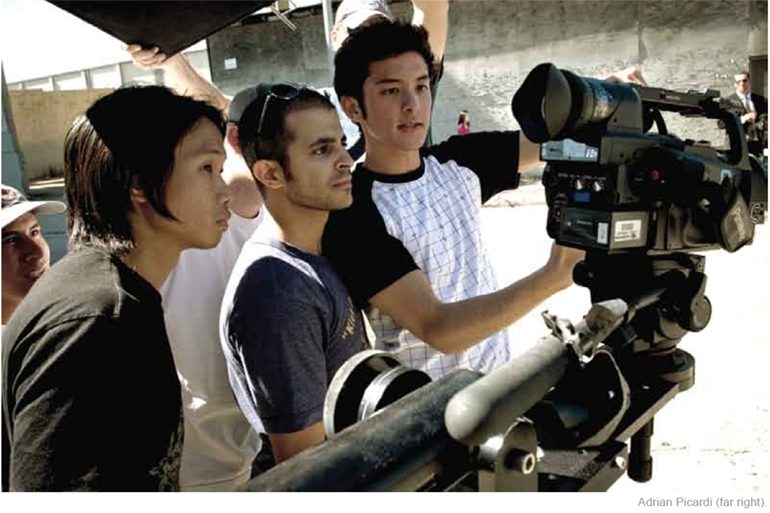
His Final Hit, the third place winner of The Edgewise Media and Panasonic Digital Media Film and Video Shorts 2008 Awards Competition featuring “AMQ,” is a short film telling a revenge tale about an assassin contemplating his past before making his final hit. Primarily filmed in California, the film was shot in two days and edited in about a day and a half. The film’s crew: Adrian Picardi (Director / Cinematographer / Editor / Writer), Justin Durban (Sound Composer), and Daniel Scruggs (Visual FX). Sunny Jain plays the main character, the Assassin.
Adrian Picardi, an Italian-Korean American filmmaker from Los Angeles, California talks about the lighting, effects, and camera techniques he used on his short film, His Final Hit.
How did the idea for your short film, His Final Hit, come about?
Adrian Picardi: Me and my long time friend, Sunny Jain, the actor in this film, we talked about what we wanted to do, and actually, we had been doing a bunch of short films here and there. He dropped the idea about doing something about a hit man going on a revenge mission. I thought the topic of the story would be a great idea to shoot. We decided to shoot it, and that’s how it came along.
The first fifteen seconds of His Final Hit is an attention grabber. Tell us about the opening sequence.
Adrian Picardi: I knew I had a short amount of time to tell a pretty complex story. I always love opening my films with something very vivid, something very interesting, so that [viewers online] don’t close the [browser window] because that’s so easy to do on the internet. I decided to start off in a dream sequence that the main character is having. And he’s remembering the explosion that killed his family. The glass pieces are a representation of the car exploding. The glass pieces – we created that in Maya. We shot it in my living room, actually. The white wall is a regular wall. We lit it with Home Depot fluorescent lights, something very simple. And then in After Effects, I made everything blown out, so we got that crisp, white look. And then with Maya, we composited the glass effects in slow motion.
You mentioned Home Depot. Could you tell us more about your lighting setups?
Adrian Picardi: Lighting setups – usually I’ll go with Kinoflo’s or HMI lighting, but we do not have resources to go with that kind of lighting. So, what we did was, we went to Home Depot and purchased the cheapest fluorescent lights because fluorescent lights – it runs at a color temperature of 4300K I believe, and the Kinoflo’s run at 5600K, so it’s close. So you get that cold feel, that cold look. So when you color balance your color temperature to a certain light, and you light in fluorescents, you get a really professional looking lighting system, which is really cool.
How did you come up with this kind of alternative solution? Do you experiment a lot?
Adrian Picardi: Yeah, film for me – you always find something new each time you shoot. There’s no one standard way you’re supposed to go about doing these things. What you do is you go, you start playing around, you look into your lens, and you see what’s good. And if it looks good, you’re doing something right. It’s a lot of trial and error, so there’s not one sort of technique that we use. It’s a bunch of stuff. It’s basically us doing a trial and error process, and we figure out what looks best.
What cameras did you use in your short film?
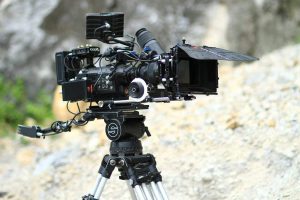
Adrian Picardi: We shot HD with the Panasonic P2 card. We shot with the HVX200. I absolutely love that camera. Especially when you’re [shooting for] the web. If you shoot correctly and you light correctly, it’s kind of hard to tell the difference if you shot 16mm or digital. A lot of people have asked if I used the mini 35 adapter, the PS Teknik’s, or the Brevis 35 – we did not use any of those adapters, so it was all stock lenses.
How many cameras did you use?
Adrian Picardi: Just one.
Could you talk a little bit about the camera work? What kinds of techniques did you use?
Adrian Picardi: We made a home- made dolly, which was comprised of PVC pipes, plywood, and skateboard wheels. We did a lot of dolly shots, and one shot in particular was the shot where the kid runs to his father in the airport lobby. We shot a lot of it on traditional sticks on a tripod to get that really professional look.
Could you talk about your use of color?
Adrian Picardi: Some of the colors I chose, it was hinting to the audience how to feel, but I think what really carried it was the score. I think music is 70% or 80% of the movie. Without good music or good sound in movies – it would seem amateurish. So with the color, tone, plus the music, I think it gives the audience a feeling we all wanted to portray, which is the cold feeling. For instance, where you see the character in the cemetery, we have that very washed out, cold feel for that character. And when it goes to that yellow, vibrant look, you feel the tension.
Did you use original music?
Adrian Picardi: I’ve been working with a composer for a while, and I really like his music. What we did was we put together some temp tracks that he did prior to the making of this film, and we used those as guidelines. Once the film was cut, we went over to his house, and he created something along the lines of what we chose from the temp tracks. But at the same time, we gave him our input, so we created a new feel off the temporary music we used beforehand and came up with a really cool soundtrack.
Why did you use slow motion and quicker cuts to tell the story?
Adrian Picardi: It just happens because it feels right. You can’t just say, ‘I’m using slow motion in this scene because we want to make people feel a certain way.’ It just kind of happens because it feels right. I know we got a couple of scenes where the main character is walking in slow motion, or where he sees his son in slow motion.
So these ideas come up in editing room, or did you have a mental blueprint of how you were going to do those scenes?
Adrian Picardi: Well, for short films, I like to sit and listen to music. And I get ideas from what I’m listening to. And, some of those ideas – you have to have a blueprint in your head. You really need to sit down, think about what you want, the way you’re going to shoot it at least – if you’re going to shoot in slow motion, if you’re going to shoot in fast motion. Because we actually did shoot those scenes on set slow motion at 60 frames per second. It wasn’t done in post.
Something that is quickly noticeable about your short film, His Final Hit is the production value. What was your budget for the film?
Adrian Picardi: A hundred and fifty dollars. [Working with that budget] is something that I’ve been doing a lot. I’m working on this new webisode series called The Resistance. We are shooting the web series in a similar fashion as His Final Hit, and so far, we have all been pleased with the final product.

Join the Filmmakers Network or Update Your Profile!
networking.studentfilmmakers.com
Subscribe to StudentFilmmakers Magazine
StudentFilmmakers Magazine: Each issue addresses the needs of the five distinct phases of film and video making.