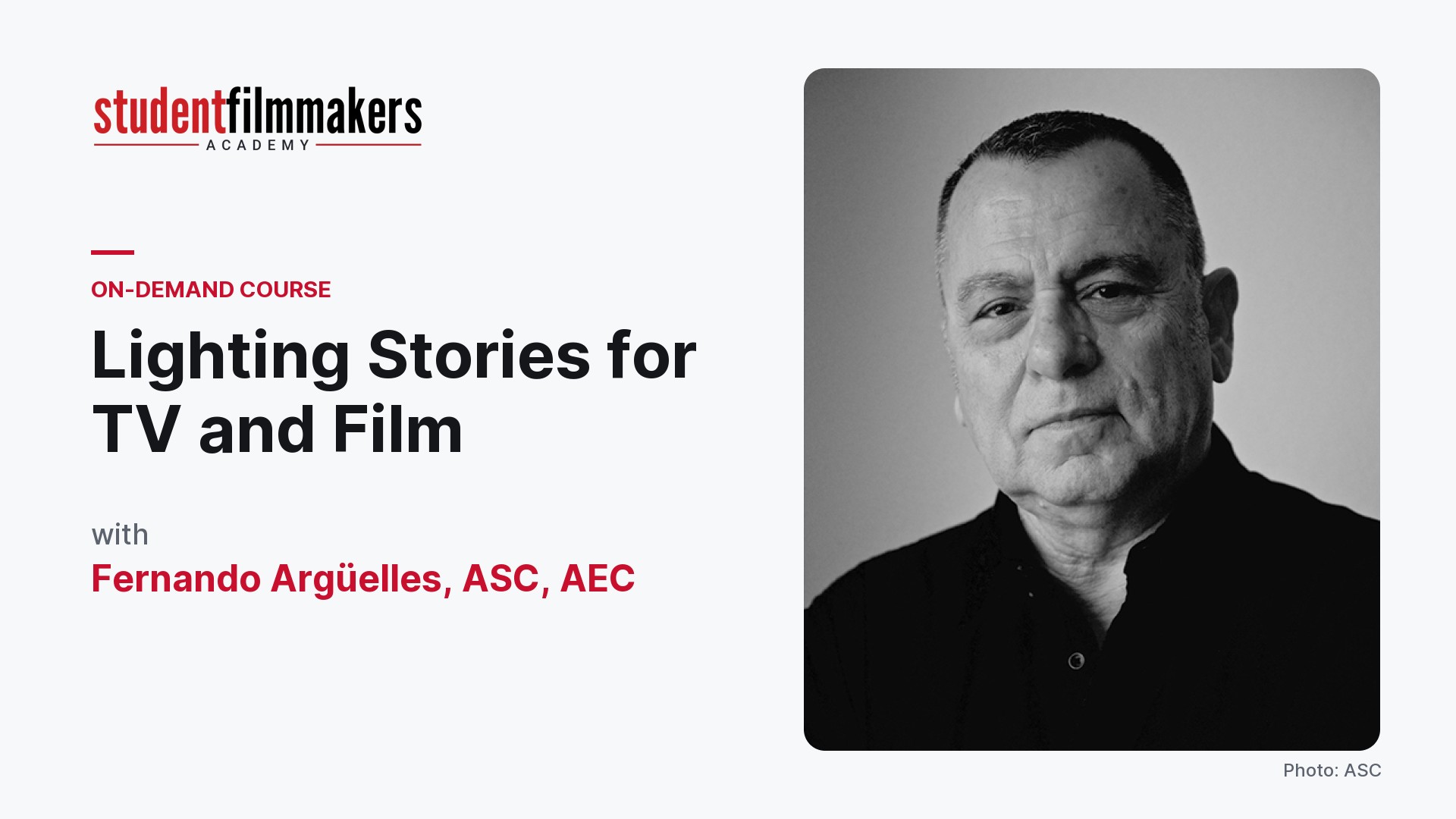
Fernando Argüelles, ASC, AEC shot Prison Break and has photographed episodes of Hemlock Grove, Swamp Thing and Fear the Walking Dead, plus the Netflix film The Princess Switch 3: Romancing the Star. Going through about 60 production stills from those shows, he kept returning to one belief: light and composition should say what the scene is about, even if that means you never see a face. Here is what he shared, show by show, with StudentFilmmakers.
Argüelles did not start in a film school. The one in Madrid was closed when he arrived at 18 or 19, and the university program he joined was all theory. So he co-founded a small company, Oasis Films, and served as DP on about 30 shorts with four friends before a Fulbright scholarship took him to AFI in Los Angeles. “I highly suggest anybody that starts is doing short films,” he said. “It was a tremendous practice.”
Why does Argüelles light for psychology, not realism?
He calls it his particular philosophy:
“Lighting and composition, they have to reflect what you want to communicate or what you want to say to the audience.”
On Prison Break, the message was simple: these men cannot escape. Each season had its own look. The first, in Chicago, ran cold. The Panama jail, built on a stage in Dallas, ran hot and high-contrast so the audience feels the sweat, though one face on the left of the frame still falls into shadow. Inmates entering the prison for the first time walk through cool, almost cyan window light from big HMIs with blue-green gels, while the interior lamps stay warm.
The cell block set had few walls that could move, and he came to see that as a gift. It forced wide lenses, which made the space feel cramped and distorted, “a nightmare to live like that.” Each cell had four 1K tungsten units on dimmers. This was around 2008 and 2009, before LED panels, and the show was shot on Kodak Vision 500T with Panavision cameras and Zeiss primes, often wide open, with Black Pro-Mist filtration and smoke.
What is his one-light theory?
“If I can use one light, it’s better for me than two, two better than three, and so on.”
He showed a close-up from Second Chance of a woman held hostage, lit by a single source. Some scenes need many units, he admits, but less is more whenever the story allows: “So don’t be afraid of one light only.” On Hemlock Grove, one scene used nothing but the practical lamps in the frame. There was no room to light except from behind the camera, which would have flattened it, so the team calibrated the camera to the practicals and shot.
He also welcomes accidents. On Prison Break, when the stand-in stepped in for the Panama jail boss, light from a mirror caught his eyes. Argüelles had not planned it and kept it. “They are happy accidents and they are beautiful.”
Do you always have to see the actors’ faces?
No. A brother and sister having a heavy talk on Second Chance are silhouetted against a bright window, and the frame is deliberately off balance. With a regular cast across 10 or 20 episodes, he said, a DP can take that freedom:
“You don’t have to see everything all the time.”
“Maybe we don’t have to see it there. Maybe this is very intimate,” he added. On Hemlock Grove, a policeman at magic hour is barely touched by car headlights, and the audience simply hears his voice over the picture.
The shows, the tools and the tricks
| Show | Look | Gear and method he described |
|---|---|---|
| Hemlock Grove | Scenes open very wide and low; one theme color repeats | 12 mm and 14 mm lenses to open scenes, Cooke glass; Gregory Crewdson photographs and Edward Hopper as references; an 18K HMI with orange gel as a late sun |
| Second Chance | Silhouettes, yellow accents, glass and mirrors | A Seattle skyline on a photographic cloth backdrop on stage, with trees and smoke in between; shot on Alexa |
| Swamp Thing | Moonlit fantasy that does not follow the real moon | A swamp about 140 by 120 feet built on a stage, water filtered around the clock, 279 individually controlled lights, a crane inside the stage |
| Princess Switch | High-key, warm, deep reds for a holiday rom-com | Alexa LF with Signature Primes at about T2 to T2.8; lights on cranes outside castle windows near Edinburgh |
| Fear the Walking Dead | A smoky, orange-red world after a nuclear blast; a bunker made from two buses | Alexa XT rated 800 ASA, ND to shoot around T2.5, cloth backdrops, low ground smoke, bare filament bulbs |
The swamp was built indoors for a practical reason: you cannot put an actor in a real one. “Alligators may be a problem, among other things.”
How do you hold daylight steady in a Scottish winter?
In the north of the UK in winter, he said, usable daylight runs from about 9 a.m. to 2 or 3 p.m. The Princess Switch script was full of cheerful day scenes inside huge castle rooms where no lights could hang. So the crew put units on cranes outside the windows. In the morning the cranes stood farther back. As the sun dropped, they moved closer and closer, until after dark the windows still looked the same as they had at nine.
Trace paper covered every window from top to bottom so no one could see the sky change. In front of it hung fabric the production designer had imported from India, which gave the windows texture instead of a blown-out white. That is a rule he repeats: put something in a window, drapes or anything, so it does not “blossom” with no detail.
For the mix of sources he gave exact numbers. Daylight at the windows ran about 5,500K, the tungsten inside about 2,800 to 3,200K, and he set the camera at 4,000K, between the two, because he knows how the camera responds there. For more on balancing the two kinds of light, see our primer on tungsten and daylight sources.
How did he light a bunker with bicycle power?
In the Fear the Walking Dead bunker, the story says the power comes from a dynamo on a bicycle charging an old battery. Argüelles wanted incandescent bulbs with visible filaments hanging in the frame, so almost all the light is practical. His gaffer worried it would be too dark. He trusted his meter, put the bulbs on dimmers and added Astera tubes right above the camera for a touch of fill.
The hardest part was seeing the filament while keeping the right ratio between faces and bulbs. His trick: in the color grade, draw a window around each bulb and pull it down until the filament shows. Practical lighting is a big subject on its own, and Lighting Practically is a good next read.
Which camera does he prefer?
He moved from 35mm film to the Panavision Genesis and a Sony F35 or F55 before falling for the ARRI Alexa around 2010, and has used it since, in the XT, Plus and LF versions. He recently shot with the Sony Venice 2 and was impressed by its tonal range. Resolution is not his measure:
“For a camera, the most important thing is the latitude, is the dynamic range.”
Asked whether the tungsten in the bunker was a conscious choice, he said, “Absolutely. 100%.” It sold the claustrophobia, it let him hang lights wherever the scene needed them, and to him tungsten from a practical is simply beautiful.