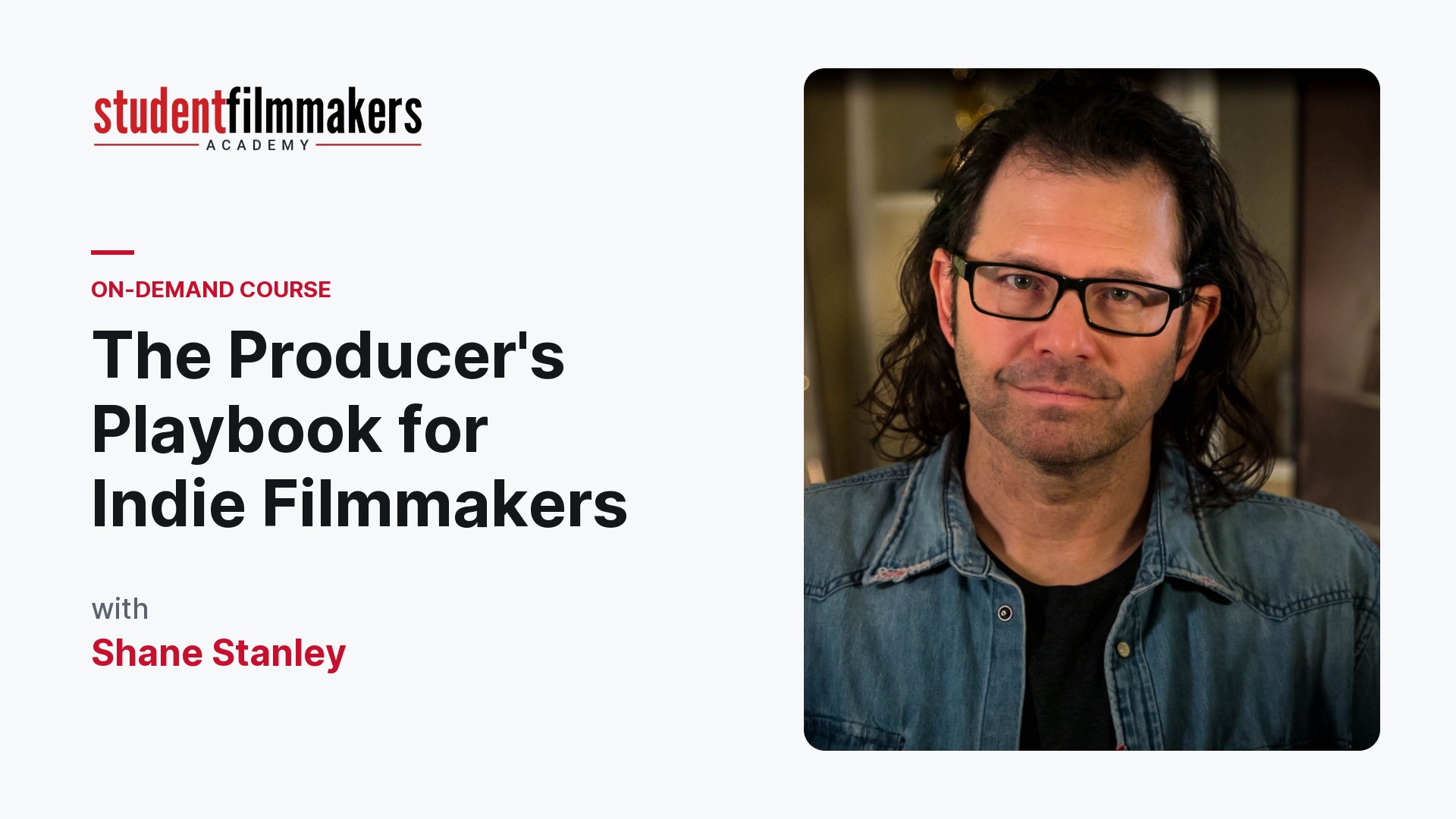
Shane Stanley has made films for 35 years, from executive producing Gridiron Gang to directing Night Train and Double Threat. Fresh off a Los Angeles shoot during the 2023 actors’ strike, the Emmy winner told StudentFilmmakers that indie filmmakers have to take the producer’s chair themselves, and that the work starts with picking a project the world can actually buy.
He had just spent seven weeks away from home on a music drama, his first film since late 2021. He said that in 35 years of making films he had never seen the business change so fast or so obviously. The strike didn’t break the shoot; the system around it nearly did.
What changed for indie producers after COVID and the strike?
Stanley had three months of prep, but no true green light until the SAG-AFTRA interim agreement arrived, four days before cameras rolled. On the first day of the interim process, he said, more than 850 films applied, and an understaffed union lost reps who couldn’t keep up. His paperwork was done early and still had to start from scratch.
Many agents treated the strike as a vacation, and some agencies cut a third of their roster, so he was left asking who even represented an actor now. Locations agreed to one thing and did another, because they knew a producer on an interim agreement had little leverage. Gas hit $7.99 a gallon while he ran two generators from call to wrap. Product placement partners had promised support, but after the Hawaii fires and a hurricane scare in Los Angeles three days before the shoot, a lot of those resources went, rightly, to people in need.
He described the climate as a free-for-all where everyone looks out for themselves. His point for students: the new normal is now simply normal, and the producer has to plan for it.
How do you choose the right indie film to produce?
Step back from the script you love and read the market. He is all for originality, but asks how long you want to push rocks uphill with a project that is hard to explain, hard to market and hard to release. His guide is what sells beyond your own country:
“There are 54 territories that we can sell our product to. Think about that. The United States and Canada is one territory.”
A hit in North America can open the doors to foreign buyers, but only if the film travels. Action sells globally. Comedy built on jokes and slapstick is hard to translate unless it is physical comedy. And money from Istanbul or the Benelux still pays back your investors: “your groceries don’t care where the money comes from.”
In the Q&A he went genre by genre:
- Drama is a harder sell after years of real-world drama, unless the cast is big. True stories are helping. A producer recently asked for his slate of true-story IP from 35 years of documentaries and began optioning titles.
- Faith-based films have a huge, proven audience, and studios know it.
- Documentaries are thriving but harder to clear and insure, and you need to know what a platform will really pay before you set the budget.
- Running time used to be 44 minutes or under for a short or at least 88 for a feature. A 60- to 75-minute idea might work better as a six-part series, and he said streamers now place one-hour pieces with few rules.
What if you have talent but no money?
That was Stanley’s own weak spot coming up:
“I knew actors, I knew good crew, I didn’t know anybody who could rub two nickels together.”
So instead of signing on people he felt comfortable with, he spent a couple of years meeting people connected to financing. He urges filmmakers to name their own gap honestly: is it money, recognizable talent, or a sales agent and distributor that money and actors will trust? Agents now ask straight away who the package is and whether anyone of note is attached. Before anyone writes a check, he said, they want to know who is in it.
He also wants you reaching above your level. A buddy with a DSLR and a bounce board from Home Depot is not the DP who will raise your career. Outside a great script, he named five pillars of a quality film: camera, actors, editor, locations and sound. Good DPs who cost no more than that buddy exist; you have to find them. And between a great talent with a bad attitude and a pleasant one, he picks pleasant every time, because a difficult person only gets worse when the pressure rises.
Who is in charge on an indie film?
One person. Too many indie projects have too many producers and too many voices on big decisions. “There has to be a leader.” Somebody has to tell the team plainly that they are in charge, and everyone else needs to know their place and job.
Stanley learned this the hard way. Six weeks before the shoot he lost his producing partner and friend of 24 years, the man beside him on 50 commercials and 11 features. He had to bring on five people to replace the work of one, and he said he felt like a first-time filmmaker. Some of those hires fit and some didn’t, and a producer has to make that call fast and without malice: does this person work, and do they fit?
How do sales agents shape casting and the script?
Bring one in early. A sales agent who believes in the project can flag a line that will sink a film in a key market. Stanley has seen actors’ favorite lines rewritten after an agent told him, in effect, that the joke would cost 40% of the film’s global revenue.
Fame is not the same as value, either. He has hired actors he had never heard of whose worldwide value shocked him, and household names who brought almost nothing. His test is stopping five or ten people on the street. He even casts small roles with care: some of his under-fives have more than 300 episodes of network television, and a face in syndication abroad can help a whole territory buy the film.
Is virtual production worth it on an indie budget?
On his last shoot, a planned scene fell apart piece by piece as availability, schedule and cost kept shifting. His team showed him on a laptop how to do it virtually. “And my question was, will it work or it can work?” When the answers wavered, he simplified the scene. With more training, he said, he would have taken the chance, and he plans to take virtual production classes.
What did work was a standard green screen car scene. He had sworn off green screen, but this time it was planned: front windshield removed, no PAs rocking the car, glass, reflections and streetlights all added later in layers. No $2,500-a-day car carrier, no actors driving in traffic, no ADR for sirens. Because it was planned properly, he said, the result looks amazing.
Should a micro-budget film go after distribution?
Yes. “Swing for the fences every time.” His first independent project cost $500, and he said it did more for his career than a number one box office hit at Sony, because the world saw it and it grew into a sequel and a third film. Even Tubi makes acquisition deals.
He ended on money that never reaches filmmakers. He held up a one-penny residual check for a $12 million studio film he wrote and produced that sold in nine territories, and he said Double Threat drew huge streaming numbers for seven weeks with returns he called despicable. Every actor contract he writes limits the use of image, likeness and voice to that one film.
For more on selling and casting, see our pieces on getting foreign distribution, casting smart on a low budget and the two main ways to finance a film for distribution.
The full class also covers streaming versus theatrical storytelling, attention spans, sci-fi and adult-themed content, and what Stanley expects from new SAG-AFTRA contracts.