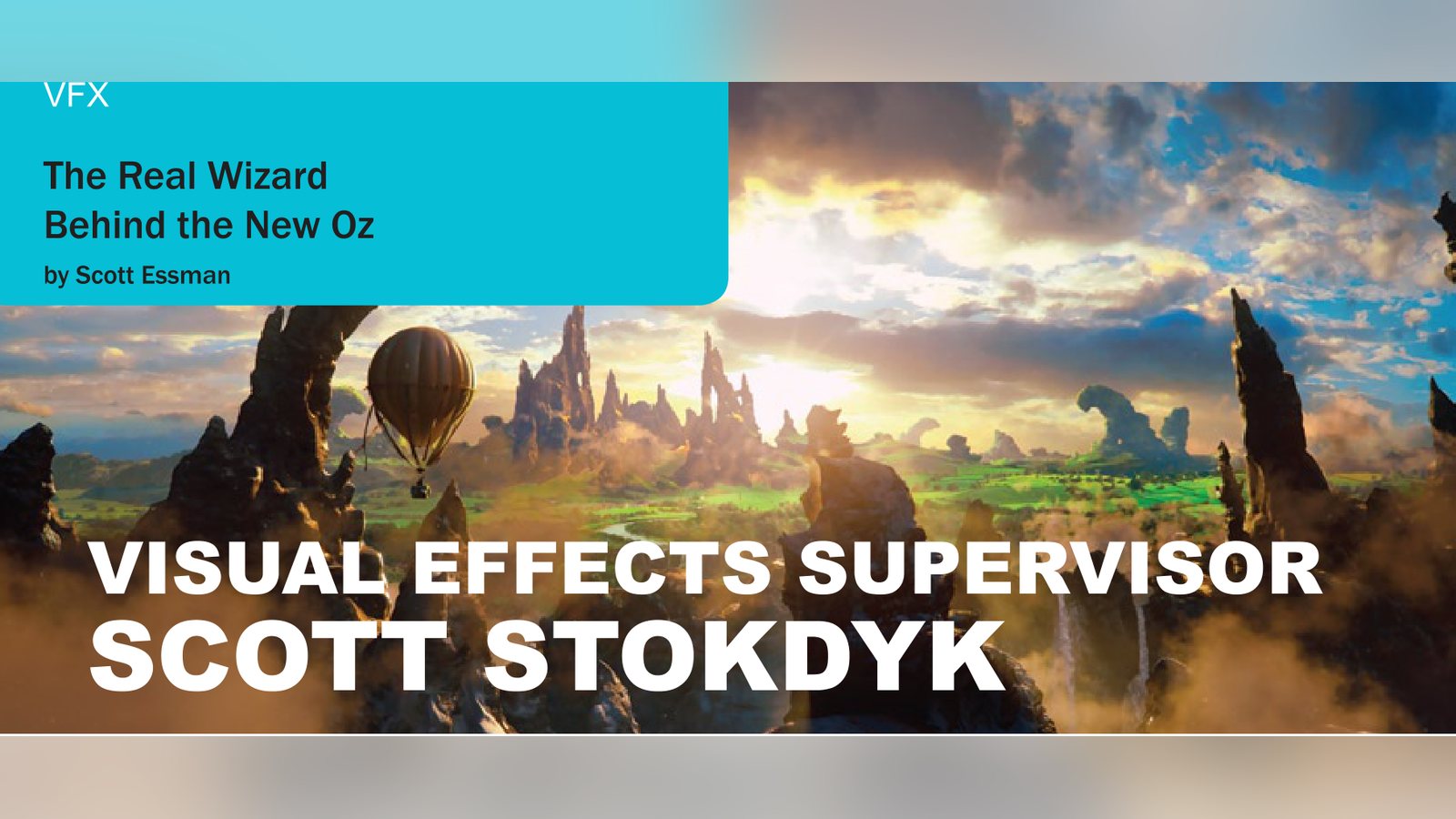
Senior VFX supervisor Scott Stokdyk explains how Sony Pictures Imageworks built the visual effects of Oz the Great and Powerful for director Sam Raimi.
Overseeing the Effects
Overseeing Raimi’s effects operations, as he had on the director’s three “Spider-Man” films was Scott Stokdyk, Sr. Visual Effects Supervisor at Sony Pictures Imageworks. Nine months before pre-production began, Stokdyk was already onboard, meeting with Raimi, then discussing the script with Raimi and production designer Robert Stromberg in the summer of 2010. “We talked about what we wanted out of the movie and the feel of the movie,” Stokdyk said. “In the fall of 2010, we’d do budget estimations with the visual effects producer, and got The Third Floor involved in previz. In 2011, we started to get into casting, locking down what sets would be built, and visual effects. There was a lot of shoot prep in spring to summer of 2011.” Going through the entire script prior to pre-production in into early pre-production, Stokdyk, Raimi, and Stromberg envisioned which of their respective departments would cover each aspect of each scene. “A typical conversation is Sam saying what his rough blocking would be – deciding how he was going to shoot the movie,” Stokdyk revealed. “Early in the process, it’s about composition. Robert wanted to make sure we had the depth of the scene. We wanted to fully contain the shots and commit to cover an angle that is visual effects. In non-visual effects, we were sacrificing 3D depth — we would have 20 to 50 feet. Shots with blue screen and open areas, we would see all the way through the Land of Oz. Every one of those decisions is about locking in VFX. We are constantly re-blocking and sacrificing.” Of course, there were always budgetary limitations given Disney’s allowances and taking into consideration that the film was shot in native stereo. “With a 3D movie, we’re going to have longer shots,” Stokdyk explained, as those are more pleasant to the eye. “You leverage a single set-up. A seven-second shot to a four-second shot isn’t a big deal for a VFX company. But you have 1500 shots instead of 700 shots. We are negotiating with Sam. Can you tell the story in this scene with fewer shots? Do you believe that edit can work? It definitely helps us keep the process inside the financial box.”
In going through the initial development of the film, regularly considering the film’s immutable budget, Stokdyk noted that Raimi was inventive in maneuvering the visual effects elements with his shooting schedule. “He is constantly re-inventing,” noted Stokdyk. “He is continually trying to adjust and make the movie better. What are more expensive or less expensive decisions? We can take a piece out of another area.”
Free for members
Sign up free to keep reading
It’s free and takes less than 30 seconds. You’ll also get our Interstellar issue free, and a community of filmmakers sharing their work.
No credit card. Continue with Google or your email.