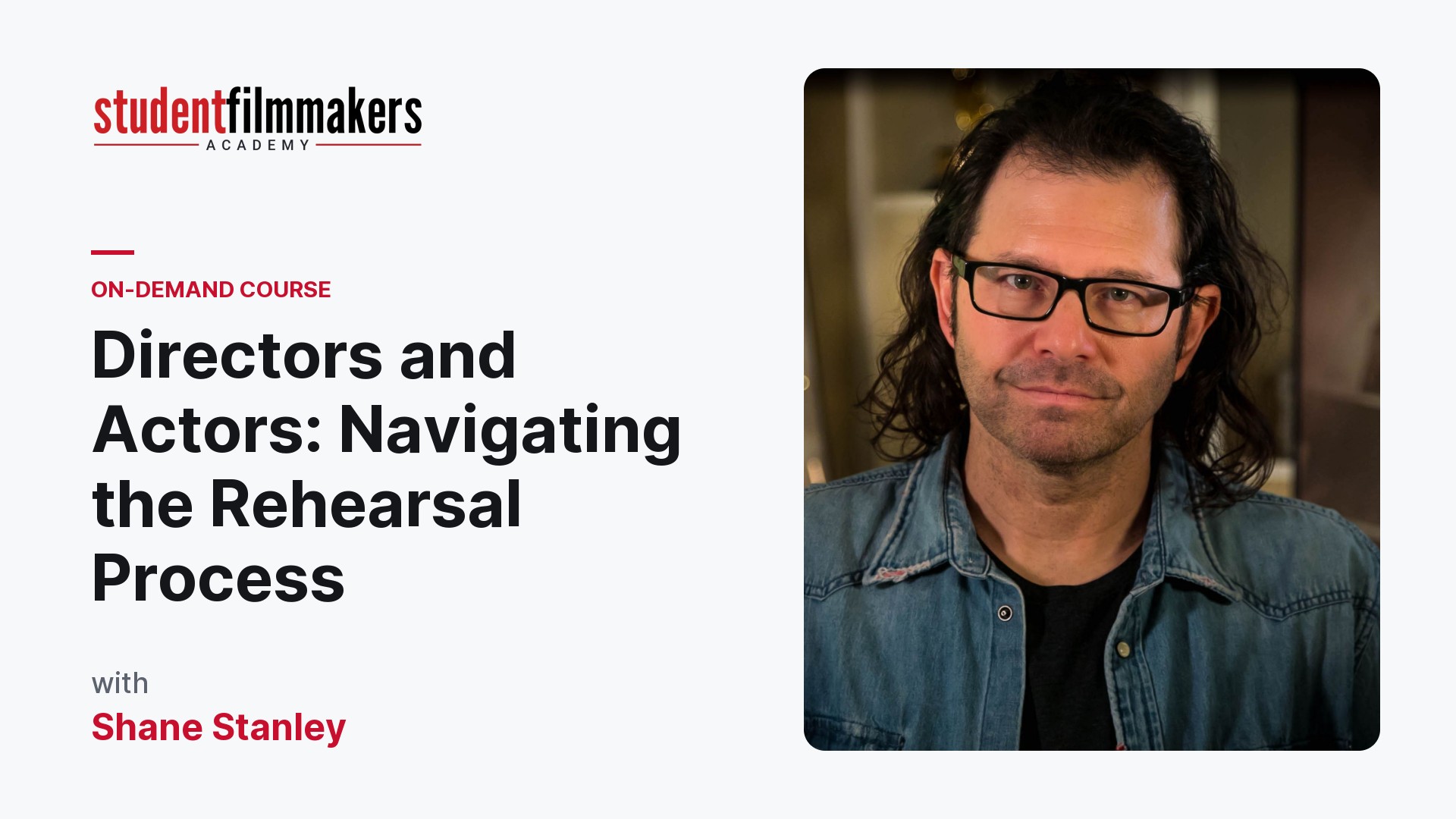
Director and editor Shane Stanley, whose credits include Night Train and executive producing Gridiron Gang, says most independent films get almost no paid rehearsal time, so directors have to build trust in other ways. Taking questions from filmmakers on a StudentFilmmakers webinar, he laid out what actually works: a meeting written into every offer, a table read, a short walkthrough on the morning of the shoot, and a director who knows when to step back.
How much rehearsal time do you really get?
Very little. On a SAG project done by the book, rehearsal time has to be paid and logged, and on a low budget that money is hard to find. Name actors are often booked for a few days at a fixed price, with steep daily overages and no rehearsal clause. Working actors on a series may be released to you only between certain dates, with a travel day eating into that.
Stanley has been producing and directing for over 35 years, and he said rehearsal in pre-production is close to a myth, even on bigger films with stars:
“I cannot think of one, not one, where there was rehearsal before we went shooting.”
Rehearsals happened on the day. Before Zoom, even a table read was hard to arrange, and the room was often filled with actors who weren’t in the film. Today you can at least read together online, swap drafts by email and talk on the phone, and SAG won’t charge you for any of it.
What should you put in the actor’s offer?
This was his strongest piece of advice. Write the first meeting into the deal:
“Put in your offer that you are able to at least have a Zoom meeting, cup of coffee, a lunch, or something with the actor that you want to hire.”
There are no agents or handlers in that room, just the director and the actor. If it goes well, the actor calls their agent to say they want the job. If it doesn’t, you both find out before anyone is on set. It also gives you something to fall back on later. When a working relationship sours, he looks for a good moment from that first meeting to pull on, the way a couple might remember why they fell for each other in the first place.
Good actors will reach out on their own. Steve Guttenberg, on a film with Stanley for about a day and four scenes, called ahead to ask what others would wear, what the vibe was, and who his scene partners were so he could study them. On Gridiron Gang, Dwayne Johnson asked to visit the real juvenile camp and have dinner with Sean Porter, the probation officer he played, to learn his mannerisms, while shooting another film at the time.
Why is the table read worth so much?
Stanley has never seen anything bad come out of a table read. On a recent film with co-writer Yvette, with Penelope Ann Miller and Dawn Olivieri in the cast, the read went well until one important scene. Everyone sensed they had only scratched the surface, so they set up a call the next day to dig in. They also asked whether another scene was needed at all, which could save a shooting day.
He likes actors who arrive with a backstory, pages of life before page one. Listen closely, he said, because a backstory can have a domino effect. If it changes how scene 33 or scene 61 plays, you need to rein it in early. Actors often focus on their own part and forget the scenes they’re not in. He also welcomes the personal touches they bring: a ring from a grandparent, a scarf from a first trip abroad, always with a reason.
His deal with every actor is a simple trade: deliver what the scene needs, and he will give you room to improvise and try variations once the story beats are hit.
What happens in the morning walkthrough?
Before hair, makeup or lighting, Stanley gathers the actors (coffee and bagels in hand are fine), camera, sound, production design and producers in the room you’re shooting. They read the pages and walk the scene once.
He doesn’t hand out blocking. He sets the situation, for example a character sewing at a table when a knock comes and visitors barge in before she can stand, and lets the actors play it while he and the DP watch. Then the scene turns practical: where the lights can hang, where the boom operator can stand so you don’t have to loop the whole day. Then everyone splits up to prepare, and actors often work on the scene together in the makeup chair.
How do you block a talky scene?
Give the actors a reason to move. Stanley learned this on his first feature from actor and acting coach Joel Brooks, who quietly suggested more life in a scene where a husband pours his wife a glass of wine: when your wife comes home, do you just stand against the wall? Stanley never forgot it, or how kindly it was said in front of the crew.
He sees the opposite in many student films at festivals: two people walk in, sit down, and the cutting goes back and forth with nobody moving. Unless your writing and acting are as strong as Tony’s scenes with his therapist in The Sopranos, he said, people need to move:
“Don’t make your audience dizzy. Don’t be self-conscious in your moves, but give people natural movement.”
Practical business does it: one actor starts a pot of coffee, another puts on a tea kettle, someone on a swivel chair turns away from a conversation they don’t like. On his last film, three women in a cramped kitchen needed more tension, so they invented a phone call to pull one of them out. It wasn’t in the script, but it set up the two-person showdown that followed. He also tells directors to hire stage actors when they can. Their continuity and instinct for blocking make them a joy to cut, and he has been an editor for decades.
How do you handle big emotional scenes?
Don’t spend them in rehearsal. In walkthroughs, actors read the words and mark the beats; the real emotion waits for the camera. Before a heavy scene, Stanley knocks on the trailer door and asks how the actor feels, how much they have in them today, and who they want the camera on first.
On Night Train, Joe Lando asked him to start coverage on his scene partner in a goodbye scene with his on-screen daughter, because he wanted to go somewhere he couldn’t spend early. He delivered something that wasn’t on the page. For two actors in a long crying scene on his latest film, Stanley simply waited 15 or 20 minutes between setups so they could collect themselves, rather than calling back to one. Reading the room matters most, he said, in emotional and intimate scenes.
And when an emotion won’t come, roll with it and never make the actor feel inferior. He once watched an actor rub chopped raw onion under his eyelids, with poor results. Talk it through, bring in the writer, and look for another way into the scene.
What should you never assume?
That an actor can do what they say they can. “Actors are trained to always say yes,” Stanley said. Ride a horse, play guitar, paddleboard: agents will confirm it, and on the day it’s often not true. On Break Even, two actors skipped a planned day of paddleboard and speedboat practice for a complex Steadicam shot, then couldn’t hold their line against the current. An actress who grew up in New York told him on the day that she had never driven, so he hid a driver in a car with tinted windows and shot low from the passenger side.
His fixes: write skills into the contract, such as being licensed and able to drive when asked, and test them before you need them.
What kind of set does Shane Stanley want to run?
A place people want to be. He admits to one planned meltdown per film, once walking off to wait at the bar after 11 unusable takes lost to the giggles, but he has no interest in a militant set. “The experience of making the film is more important to me than the success of the film,” he said. His hope is that cast and crew leave better off for having worked with you, whether the film is a hit or not.
For more on this subject, read inside the world of a rehearsal, our guide to directing actors for film, and the recap of Stanley’s class on directing actors and authentic performances.