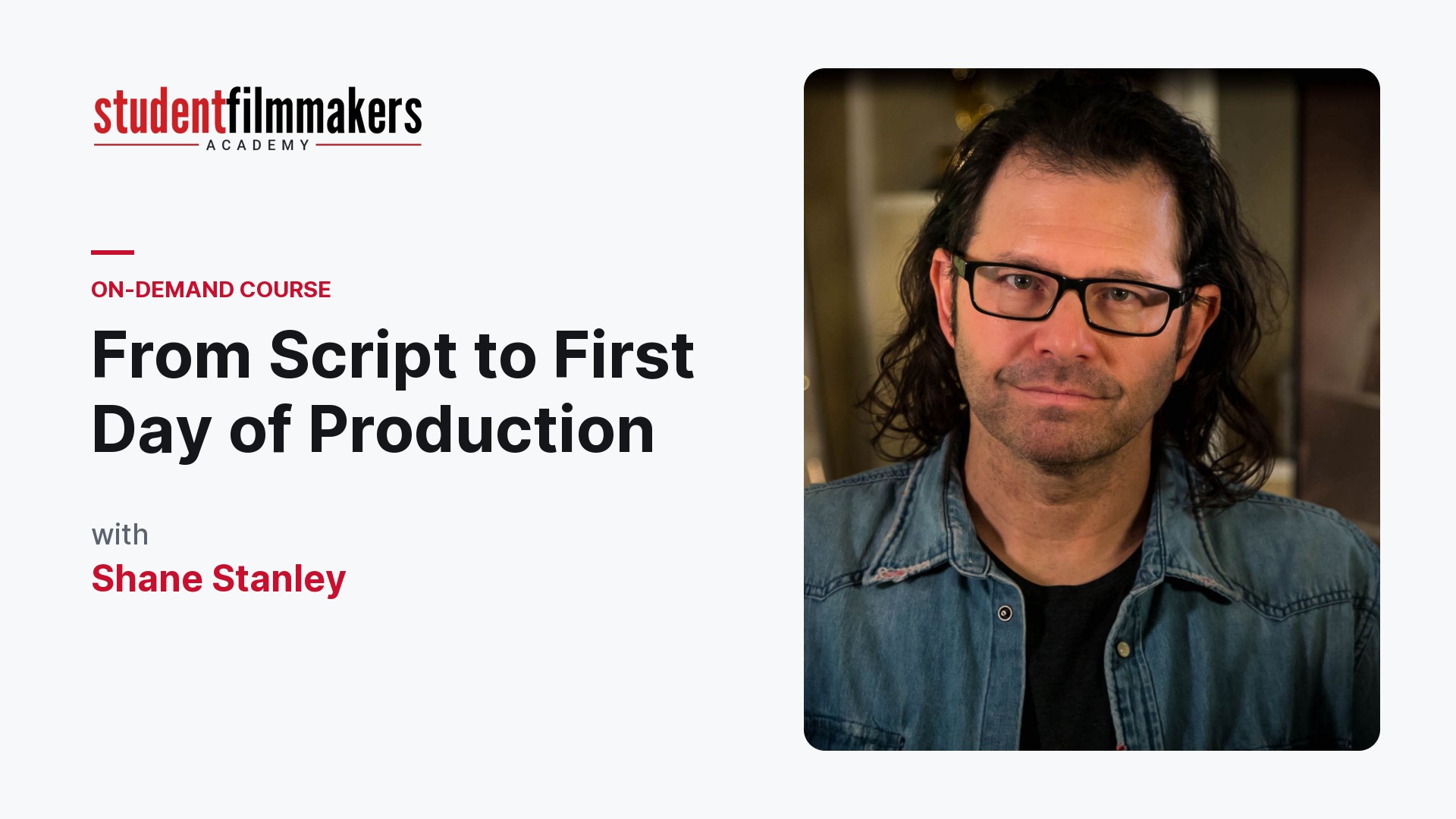
Every line of a screenplay turns into people, hours and money, and Shane Stanley reads scripts with a calculator in his head. The Emmy-winning producer and director of Night Train and Double Threat, and executive producer of Gridiron Gang, walked a class of writers and producers through what happens between the final draft and the first day of shooting. His message: write and schedule with production in mind, and the people who can green-light you will notice.
What does a producer look for when reading your script?
Stanley’s first sale taught him how much he didn’t know. He and a writing partner wrote a thriller about a press that manipulates the news, finished it in about four weeks, and turned it in to his agent at William Morris on a Friday. The next day, Princess Diana died after a press chase. By Monday a bidding war had pushed the price to $385,000. The movie was never made, but a producer who lost the bid hired him to write a $12 million film because the script showed he understood production limits.
On that job he kept cutting characters. Every actor in a script, he explained, comes with costs a new writer never sees:
“How many mouths am I feeding? How many deals am I making? How many trailers am I buying? How much per diem? How much hotels?”
He also warned about “most favored nations” language in contracts, which means everyone in the cast must get the same treatment on hotels, trailers, per diem and rental cars. Add one demanding actor and you may be upgrading the whole cast.
Cutting characters isn’t the only fix. Stanley urged writers to use Google Earth and Google Maps to study real places and to stage several scenes in one house: one couple’s front yard, entry and kitchen, another couple’s family room and backyard. That spares the producer a company move, which means packing the whole unit into trucks and driving it across town.
How does one page of script grow into a crew?
Stanley went through the numbers the way he would in prep. Here is what he said each choice on the page can trigger:
| On the page | What it means on set |
|---|---|
| A normal dialogue scene, two cameras | DP, two operators, two first ACs, at least one second AC, a DIT: about eight people in camera alone |
| A fancy restaurant instead of a basic house | Grip and electric can grow from eight or nine people to 15 or 20 |
| Nine characters who all speak | Nine microphones and full coverage on each; a two-page scene can eat a night |
| Shooting out of town | A $400-a-day grip can cost up to $650 once lodging and meals are added |
| A sunrise or sunset scene | A race against light, or a large lighting package to fake it |
The nine-speaker scene came from his first film with writer C.J. Walley. It looked short on paper, so the crew expected a few hours. Stanley moved call time to 4 p.m. and planned to work until dawn, because every speaking actor needed medium shots, close-ups and reverses.
A minute per page is a rough rule, not a law. In his action films, five pages can play as 30 seconds on screen.
Why are sunrise and sunset scenes risky on a small budget?
On Gridiron Gang, which he said had a budget of about $30 million, a scene of Dwayne Johnson talking to the kids on the field ran past magic hour. The crew brought out huge lights, and by Stanley’s estimate about 70 percent of that scene was shot after dark without anyone noticing. A small film doesn’t have that package. On Night Train, the sun dropped behind the mountains earlier than sunset, and a few cutaways in the final scene came out darker than he wanted.
His bigger worry is what rushing does to people. When a crew fights light, corners get cut, actors get rattled, and people get hurt.
How long should a shoot day be, and when does the crew eat?
Stanley aims for ten hours of shooting inside an eleven-hour structure: five hours of work, an hour for lunch, five more hours. Going past that means overtime, meal penalties and fringes, which means paying people extra to stand around. He mentioned two alternatives he doesn’t use. French hours rotate lunch by department, and a walking lunch keeps food out all day with no formal break. He has avoided French hours himself because he doesn’t want a mutiny.
On crew size, he refuses to give a formula. He made a 45-minute spec pilot for $500 in four days with a DP, an AC, a sound mixer, a couple of grips and PAs. Double Threat was shot during the pandemic under a ten-person limit that included the cast. “Some of the things that have cost the most money had a crew of 127 on them. It didn’t make them any better.” What matters is that each department head has the help the job needs, even if that means the director unloads C-stands at lunch.
How should you plan the first days of production?
Light. On a 15-to-30-day schedule, Stanley avoids company moves for the first couple of days so the crew can find a rhythm before the pressure arrives:
“Anybody who’s worked with me, I don’t do company moves. I try to avoid them the first couple of days. I just like everybody to get into a rhythm.”
Actors feel a nervous crew right away, he said, and it shows up in the performance. On Night Train, Diora Baird arrived around day eight, and her first day held her hardest scene, a cat-and-mouse conversation in a diner. Stanley shot a short sunrise gas-station scene and a phone call by 7:30 a.m., sent everyone back to the hotel to sleep until the diner opened to them in the afternoon, and then shot the big scene with a rested crew. He also talked it through with her beforehand to make sure she was comfortable.
What does your insurance company need to know?
Everything, in writing. Producers often assume the insurer read the script. Stanley laughed at that idea:
“You have to tell your insurance broker we are doing horse stunts, we’re doing fight scenes, we’re doing boat stunts, we’re doing car chases.”
The broker will want the exact dates of any precision driving, and if the schedule shifts, you must tell them again or you aren’t covered. Use licensed precision drivers. He has used airsoft guns for about a decade and adds muzzle flashes in post. In his view, real guns have no place on a set. (For a related step every location will ask about, see why you need a COI and how to get one.)
Should the writer be on set?
Stanley wants them there. Writers make the best continuity checkers, and problems come up every day. On Gridiron Gang, writer Jeff Maguire was in a trailer turning out new pages daily. Stanley’s writers often earn producer credits. He asks them to bring a collaborative attitude, though, because what you wrote can change.
How do you get a location like a bar?
Call ahead and ask when the owner or manager will be in. Expect them to quote what the business would earn that day. For Night Train his team shot at Dylan’s in Palm Springs on a Tuesday, the owner’s slowest day, starting late in the afternoon. The price was so fair that Stanley added $250 on his own. If you shoot somewhere without a permit, put a fresh card in the camera when you arrive, so a seized card costs you one location instead of the whole day.
What sets the tone on day one?
Respect, and good food. Stanley learns every crew member’s name and greets them each morning.
“Your PAs are just as important as your stars.”
His reminder to every filmmaker: “We’re not curing cancer. Guys, we’re making a movie.” What lasts is how people felt working on it. For practical help, read How to Feed the Crew on a Low-Budget Film Shoot and Money Makes the Film Go Round.
The full class also covers kill fees and pay-or-play deals, step deals for writers, table reads on a tight budget, and why Roger Corman passed on Waterworld.