
By Matthew Marshall
New York City is a great place to shoot. Matthew Marshall covers permits, the Mayor’s Office, locations, crews and rentals for filming in NYC on a budget.
Think that shooting in New York is difficult? … “Fuggetaboutit!”
New York City, having some of the most unique locations, world-class studios and sound stages, rental houses and first-rate production professionals, is an ideal place for all types of productions. Shooting in New York can also present some potential pitfalls. These can easily be avoided if you keep a few important key points in mind before undertaking a shoot in the Big Apple.
One of the greatest reasons to shoot in New York… Location, Location, Location! New York has some of the most dynamic exterior locations in the world, free of charge. Within the same city, you have access to locations as varied as a rural pastoral setting in Staten Island, to gritty streets of the East Village, to the bustle of Times Square. Both large and small budget productions appreciate New York’s mostly free, diverse exterior locations.
But for the low budget production, shooting interiors can break your bank. If you have a scene in your film that takes place inside a deli or bar, for instance, you have to know that New York will not be like Kansas, where the business owner will be “wowed” by the prospect of their business appearing in your film. In New York, even the smallest Mom and Pop business owners are very film savvy about what they can charge for their shop to be used as a location. Be prepared for well-informed and potentially expensive negotiations when dealing with local business owners.
Once, while scouting for a location, I asked the owner of a diner if I could shoot in his place. The diner had such a unique architectural character, and it turned out the place had been used in many shoots before. But much to my surprise, the owner had a standard film contract already made up for anyone wanting to use his diner for a shoot. … Only in New York!
The Mayor’s Office of Film, Theatre and Broadcasting is also a great resource for locations. Producers can browse through their extensive collection of photographs and descriptions of the wide variety of locations that are available to shoot within the five boroughs.
Many films shot in New York inevitably have scenes which take place in the subway. Permission to shoot in the subway must be obtained through the MTA (Metropolitan Transit Authority). Smaller productions will often “steal” scenes, either in a subway car or on a platform. I, myself, have done this on numerous occasions. Although it is not suggested to steal a scene, it is actually not illegal to shoot in the subway, if you are shooting hand-held and do not have a tripod set up. Otherwise, it’s a $25 ticket if you are caught. But be aware, things have changed since September 11, and anyone with a video camera in a public place is very likely to be approached by the police.
One of the true treasures of shooting in New York is the incredible pool of talented actors. In my experience, actors in New York take their work incredibly seriously and tend to view acting as an art form in the same manner as a painter views their craft. Because of this association to their craft, directors have an incredibly high caliber of actors to choose from. I have found that actors on the west coast are more inclined to view acting as more of a business, although this is certainly not always the case. Large productions will certainly have staff that is experienced in dealing with SAG (Screen Actors Guild), but for a small production, dealing with SAG can be a bit intimidating.
SAG exists to protect their clients from potential financial or time abuses, which often takes place on low budget shoots. SAG can be ruthless and unforgiving of smaller productions that are not in contact with them before a shoot, as well they should be. You will probably use actors that are both union and non-union performers. If you are working with an actor that you know is a member of the Screen Actors Guild, you must contact SAG before the shoot and negotiate a contract. Meet with SAG and layout all aspects of your shoot, and you will find them to be extremely helpful and supportive of your project. Depending on the size of your project, SAG has different contracts for lower budget films, (experimental and low budget contracts), which have different pay scales. One final note – never ask a SAG actor to not inform the union they are working on your project. It is both unethical and inappropriate to put the actor in that position.
And finally, here are a few suggestions from my personal experience of shooting in New York which can only be gained from experience. If you are making a low budget feature, it is imperative that you know if your production’s budget constitutes using a union or non-union crew. A low budget production under a million dollars, which may not require a union crew, will require a lot of equipment and will be very conspicuous. Once, while producing a non-union, low budget feature in New York, I was paid a “not-so-friendly visit” to the set by a union representative and his “friends”. They had seen our large grip and electric trucks on the street and wanted to be certain we weren’t trying to get away with anything by claiming a non-union, low budget status. Our production checked out fine with the union guys, but if it had not, we would have been shut down immediately. Union crews are some of the hardest working people in the film industry and are fully entitled to their fair earned opportunities and benefits. If you are producer who is uncertain if your budget warrants being a union shoot or not, meet with the union before hand, and check it out. You will be glad you did.
Pre-Production
A trip to the Mayor’s Office of Film, Theatre and Broadcasting must be, without question, everyone’s first stop if you want to shoot in New York. This office is the one-stop-shop for everything you will need to know. Whether you are shooting a multi-million dollar blockbuster or a no-budget indie-short with your friends, a trip to the MOFTB must be your first on your list. The MOFTB is there to support your project and ensure it runs as smoothly as possible. They want to see films of any size made in New York and are enthusiastically there to make that happen.
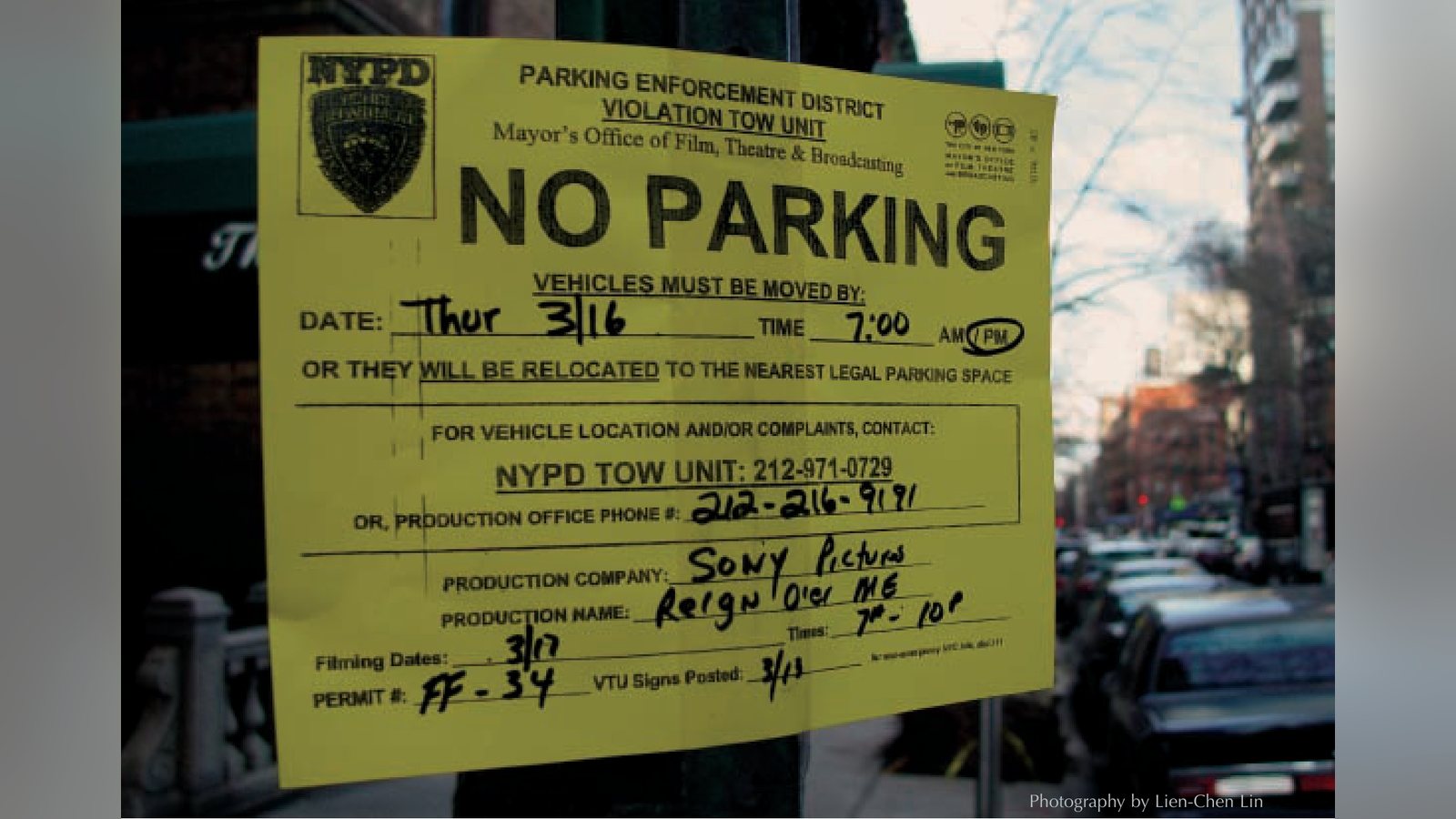
Shooting and parking permits are required for all projects shooting in New York and can be obtained at the MOFTB. A shooting permit allows you to shoot on almost any street in the five boroughs. Parking permits allow you parking of production vehicles in the vicinity of your shoot without fear of getting a ticket from New York’s finest – or worse, being towed. All permits are free of charge and can be obtained within 24 hours of their application. In order to receive a permit, you must submit an original certificate of insurance for your production. If you are shooting a student film, you must present a verification letter from your school, on letterhead, indicating the student’s name, the title of the production and shooting dates, along with a valid student ID. Permits are a must. No permit, no shoot.
Another important note about permits is to always keep them with you when shooting. Have your shooting permit on hand during production and always clearly post parking permits in the front window of all your production vehicles. If yours is a small production, I can almost guarantee a cop visiting your set and asking to see your permit. In my experience, New York City police seem to take great pleasure in shutting down small productions and student films without permits. Nothing brings a shoot to a screeching halt faster and kills the morale of a crew like having your grip truck towed in the middle of production. It will happen.
For large productions, you are required to give “Neighborhood Notification” well in advance to the neighborhoods in which shooting will take place. This is done by posting flyers with the title of the production and shooting dates. If your production has firearms or police vehicles in it, or if you have a need for crowd control, you must note this at the time you apply for your permit. You will be required to contact NYPD’s Movie and Television Unit, which can offer these services for a fee. The NYPD’s Movie and Television Unit is available for large-scale productions, as well as student films. The Mayor’s Office can put you in contact with this department.
Other resources available at the Mayor’s office are contacts to equipment rental houses, sound stages, production personal, insurance brokers, rehearsal space, carpenters, vehicle rental and nearly every other aspect that would be needed for production. This past year, the MOFTB has introduced an extremely enticing incentive program for productions called “Made in New York.” This program offers an astounding array of tax, financial, production and marketing incentives for productions that shoot 75% of their project in the New York area. So lucrative are the incentives of the Made in New York program that many productions are finding shooting in New York to be even more cost effective than shooting in Canada, which historically has had the lowest production costs.
It is no surprise that some of the most interesting films come out of New York. In addition to New York’s incredible resources, facilities, and locations, there is a unique energy and momentum to the city that seems to transfer itself into films shot here. Despite its size and complexity, shooting in New York can be an exciting and painless experience. Mayor’s Office of Film, Theater and Broadcasting
1697 Broadway Suite 602, New York, New York 10019. Phone: 212.489.6710 Fax: 212.307.6237
Screen Actors Guild
360 Madison Avenue, New York, New York 10017 Phone: 212.944.1030 Fax: 212.944.6774 Matthew Marshall is a director and writer based in New York City. His short narrative films have been nominated for the Academy Award in the student category and have won in festivals such as the Avignon Festival, Hampton Film Festival, and International Short Film Festival. His film awards include the Martin Scorcesse, Warner Brothers and Lew Wasserman Awards. His documentary work can be seen at the Smithsonian National Museum of the American Indian. He currently works as a videographer and editor in New York City.
Keep learning filmmaking
Want more lessons like this? Join StudentFilmmakers free for live webinars with working pros, and stream on-demand filmmaking classes in cinematography, directing, screenwriting, sound and post.






