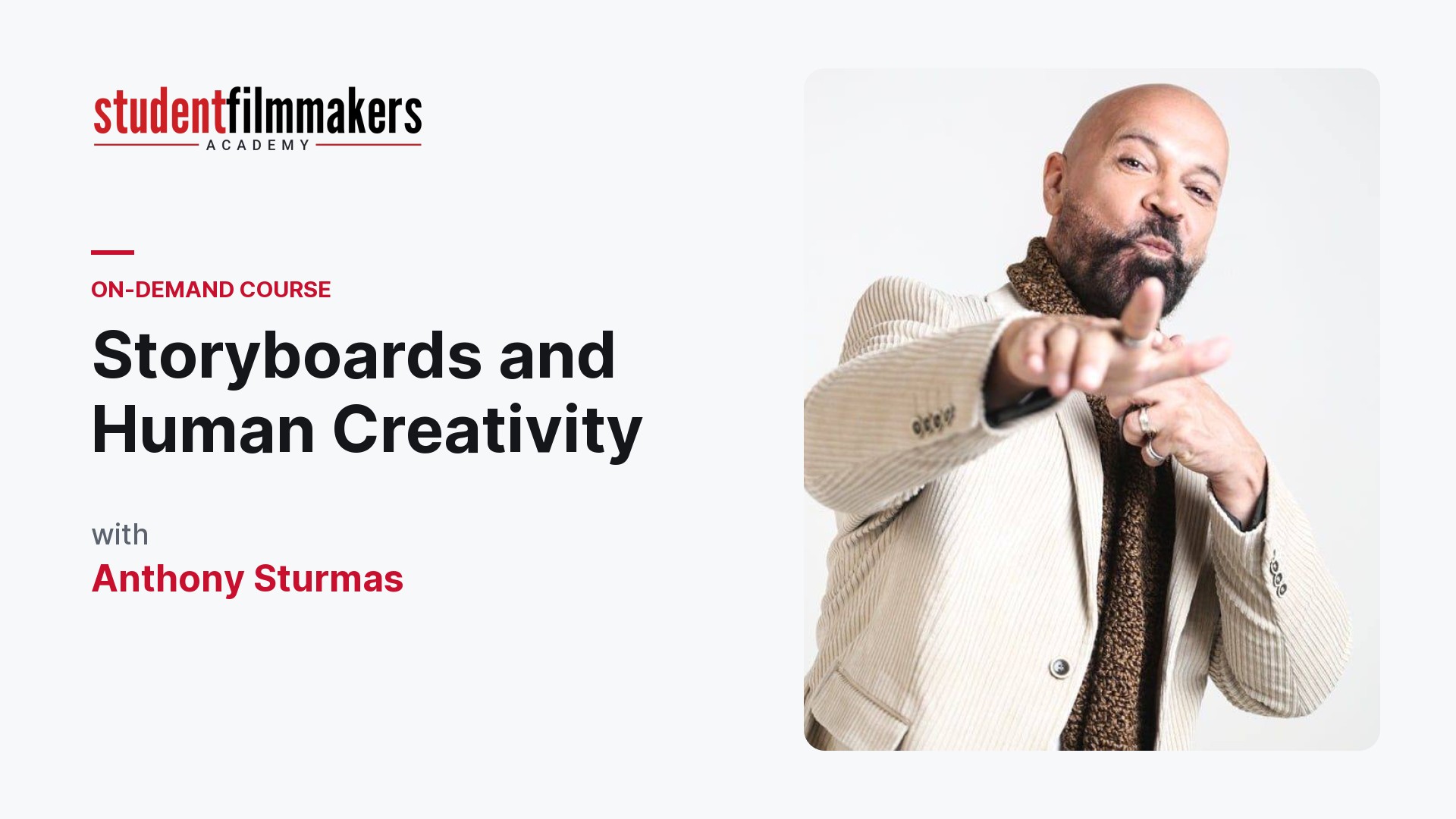
Anthony Sturmas has drawn storyboards for features, commercials and music videos for more than 25 years, including the Danny Trejo crime thriller Wages of Sin. His message to new board artists is that speed and a close working bond with the director matter more than polish, and that AI can help with a pitch image but cannot board a film. Before boards, he painted graffiti and murals around Southern California. In this live class with StudentFilmmakers he showed his own frames, side by side with AI versions, and walked through how a working board artist plans a week.
Can AI replace a storyboard artist?
An advertising creative director once called Sturmas and asked whether he was afraid of being replaced. He said no, and explained why:
“A storyboard AI is only a quick tool, but not the answer when you need specifics within your film or commercial.”
His main complaint is consistency. A director refines the same shot again and again, with the same hero, the same villain and the same street. Each time you prompt an image generator, it hands back a different face and a different place. A board artist can keep the character on model across hundreds of panels and still change the angle, the lens feel or the perspective on request.
He showed a motorcycle chase he boarded, set in South Central Los Angeles. The rider is tracked from behind, jumps into the oncoming lane, a car flips, the bike cuts across all three lanes and escapes down an off-ramp. Every panel carries stunt and timing information the director needs, and he says a generator simply cannot digest that. A rooftop escape, with the actor shot at, jumping through a window and seen from the ground, made the same point.
A director from the UK came to him two months before the class after trying AI boards on a sci-fi film in the spirit of Blade Runner. Some scenes would not generate at all, and the director told Sturmas he needed someone who could go in like a surgeon and make every frame flawless.
Where does AI actually save him time?
Pitch art. For posters and pitch decks, Sturmas now sketches a quick thumbnail, runs AI over it for the figures, then paints on top in Photoshop. He showed several of these: a New York cop surrounded by four men, a sniper, a mother putting her daughter to bed. On each he repainted faces, lips and eyes, changed a dress or hair, added jewelry or tattoos and reworked the background. Painting those in full photo-realism by hand would take far longer; this way, he says, he cuts the time roughly in half.
His view is practical. AI is useful early, to set a mood and help producers raise money. Once the film is funded, the job of drawing each scene with its dialogue and emotion belongs to a person working one-on-one with the director.
How many storyboard frames a day does a pro draw?
This was the number that stopped the room:
“In the business of storyboarding, the maximum storyboards per week is 120 frames in a five day week, and so you’re doing about 20, hopefully 20 to 25 storyboards a day in black and white.”
That count includes arrows, dialogue and a finished drawing, delivered to the director by Friday. Color takes much longer because of the detail. A feature can mean three months in the chair, and if you lose a couple of days, you work seven days a week, eight to ten hours a day, to catch up.
Speed is a skill you build. The first time Sturmas tried to finish 20 to 25 frames in a single day, he got up at one in the morning and did not finish until eight or nine at night. A student in his mentorship group was working up to about ten a day at the time of the class. Commercials reward the pace: he said a board artist who can turn out 25 to 30 frames a day in color can make close to $900 to $1,000 on one commercial job.
How does he break down a script?
Before drawing anything, he reads the script and marks it up paragraph by paragraph:
“I’ll normally check off each paragraph, how many storyboards it’s going to be and then generate kind of like an ETA how long it’s going to take and how much it’s going to cost.”
With that estimate in hand, he builds reference folders: fight scenes, fast action, location photos the director sends. During a 120-frame week there is no time to stop for an hour of research, so the images sit in tabs to the left and right of the drawing as he works. When a page of the script is one long fight, the references keep the rhythm going.
The first meetings matter too. On Wages of Sin, director Victor Rios had never worked with a storyboard artist and did not know where to begin, so the two met over Zoom scene by scene. One of those was the turning point of the film, where a man is framed by a police officer and sent to jail. Sturmas also talks with screenwriters when he can, because a writer sometimes has a feeling about a scene that the page does not fully show.
What tools does a storyboard artist need?
His kit is simple, and he kept the prices modest:
| Tool | What he uses or suggests |
|---|---|
| Drawing pad | XP-Pen Deco Pro XLW Gen 2, Bluetooth, about $250. Good pads run $100 to $250; compact ones travel to set more easily. |
| Software | Photoshop on a laptop, about $20 a month. |
| On set | Procreate on an iPad, with a $20 to $30 pen. No need for a $200 stylus while you learn. |
| Animatics | After Effects, which he has used for over 15 years. |
His layer order is fast and repeatable: a quick red line to place every character, a gray tone layer, then a black-and-white ink pass, then dialogue. He wears a drawing glove so his hand slides smoothly across the pad.
On animatics, he draws a line between mediums. In 2D animation they are essential for checking timing against the voice track. In live action he saves them for specific sequences, like a big fight or an opening before a battle, so the whole crew can feel the rhythm without animating the entire film.
Do storyboards need to be beautiful?
No. He pointed to the boards for Parasite as proof that rough drawings can carry a film:
“It can be simple drawings, but as long as it shows a visual and fluidity in storytelling, that’s what they want.”
What directors want is a clear shot, clear action and a sense of flow from panel to panel, not a gallery piece.
How do you get into storyboarding?
Asked for three things he would tell a beginner, Sturmas started with finding a mentor who already works in the field. Then he said something most art schools leave out: talent was not what got him hired. Chasing directors and jobs was.
“Somebody who’s aggressive and actually going after these jobs is going to get the jobs.”
The rest is drawing. He goes to movies with a notepad, since you cannot take photos in a theater, and sketches scenes as they play. He watches anime for fight choreography and draws people at the park, at the beach and at boxing and MMA fights to get comfortable with bodies in motion. He also warned anyone who is lukewarm about the work: “If you don’t love drawing, please do not get into storyboarding.”
And take breaks. When he has pushed through tired, the frames looked worse than the ones he drew on Monday, so he goes to the gym, rides his bike or goes hiking, and then catches a new release to see what other filmmakers are doing.
For more on the craft, read Storyboards: The Benefits to Production, Storyboarding with Giuseppe Cristiano and, for turning boards into a plan for the day, shot list basics.
In the full class, Sturmas answers filmmakers’ questions on screen-life projects, horizontal versus vertical pitch decks and turning down a script.