By Peter Kiwitt
From the 180-degree rule to matching and multiple coverage, Peter Kiwitt explains the ABCs of covering a scene so that it cuts together cleanly.
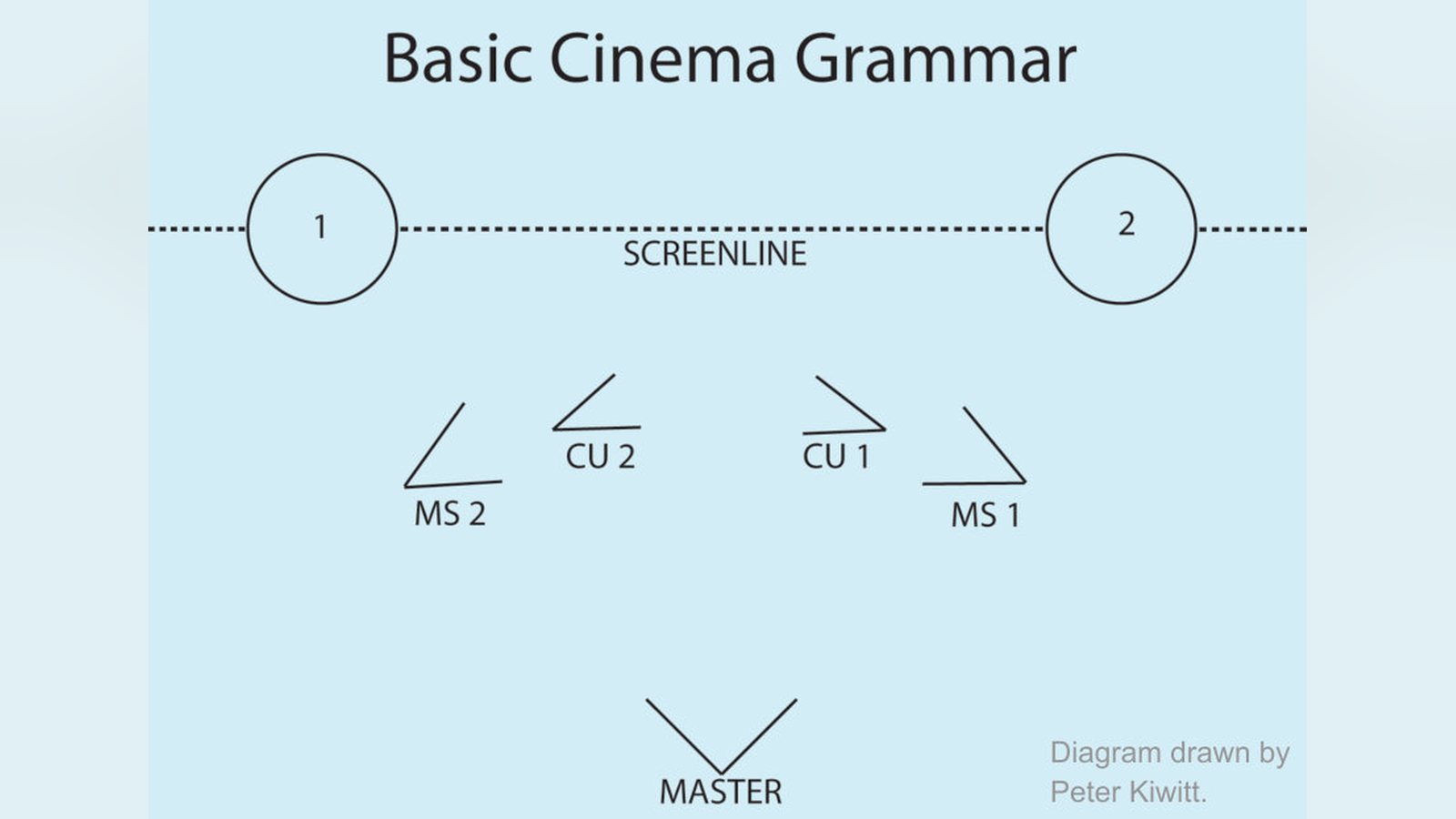
Anyone who has studied cinema has likely heard of the “180-Degree Rule.” Simply put, if you were to draw an imaginary line between two subjects in a scene (“screenline”), or the direction a subject looks (“eyeline”) or moves (“screen direction”), it is typically best to shoot all of your shots from one side of the line to keep the audience from becoming disoriented. While it might sound simple, anyone who has shot a scene with three or more subjects or with complex camera or actor “blocking” (e.g., movement) knows it can sometimes be a real brainteaser.
Frequently, in both cinema production and studies books, 180-Degree Rule is accompanied by the “30-Degree Rule.” In an early form, the 30-Degree Rule stated that if you were going to shoot a second shot of the same subject from a new angle, rather than just moving straight in (or out), the angle should change by at least 30 degrees to avoid the sensation of a “jump cut” (e.g., a jarring cut). Over time, many authors dropped the part about it being acceptable to move straight in, and that, too, began to be referred to as a jump cut.
However, while 180-Degree Rule is important and generally valid as taught, the 30-Degree Rule is inadequate at best and out-and-out wrong at worst. What the 30-Degree Rule meant to express is the simple, but important, idea that each shot should be different enough from other shots to justify its existence and to maximize cutting options. It was in the editing room that moviemakers discovered that if the size and/or angle did not change enough between connecting shots, the cut might be awkward; but this is actually more of a directing issue, since editors can only make choices from the material they are given.
While it is probable that in its original form the rule also called for a change in image size, and most may infer it, if you were to follow the rule as generally written and change the angle 30 degrees, or even more, without changing the size, you would likely have a very poor cut. There would still not be enough difference between shots. Image size matters more than angle in differentiating shots. A better guide (it’s generally best to avoid the idea of “rules” in moviemaking) for changing a shot is to increase the size by, say, 50+% (i.e., moving from a 50 mm lens to a 100 mm lens, from 10’ away to 5’, or, better still, some combination of lens and distance). Depending on the circumstances, a size change of this magnitude could be combined with an angle change of any degree that does not cross the screenline, including no angle change at all. (However, in practice, it is generally better to move closer to the screenline if you change the angle while moving in.)
More troubling, the evolution of calling moving straight in a jump cut, along with the negative connotation that can imply, is simply wrong. Like a child’s game of telephone, the erosion of the phrasing of the 30-Degree Rule came from it being repeated over and over without, at some crucial point, sufficient care or understanding. It is also related to confusing editing with directing. Often, when directing and shooting multiple shots of a single subject—say a medium shot (MS) and a close-up (CU)—one arguably should maintain the same angle, if possible. When such coverage is part of a shot/reverse-shot conversation, this helps make the cutting flow more seamlessly. When editing, the MS and CU of one subject will generally be separated by a MS or CU of the other subject but occasionally, for impact, the MS of one subject will cut directly to that same subject’s CU. This editing choice is a stronger cut that calls more attention to itself but, if there is sufficient size difference, it does not cross into the realm of a jump cut (unless there is a continuity mismatch, which is largely a different issue).
There is a usefulness and attraction to simple guidelines in moviemaking because, when all its different aspects are taken together, mass of even simple concepts can easily feel overwhelming. The 30-Degree Rule became widely accepted despite its shortcomings because of this attraction as well as its linking with the more valid 180-Degree Rule. So, let me offer a substitute to the 30-Degree Rule that is also simple in its compressed form, but which holds up to greater scrutiny. I call this the “ABCs of Coverage.” Simple stated they are:
A. Master to Coverage: Change Size and Angle.
B. Matching Coverage: Match Size and Angle.
C. Multiple Coverage: Change Size, Match Angle.
A. Master to Coverage: Since the ultimate goal is differentiating shots, changing both the angle and size (and lens) between shots will provide the greatest change. While size difference alone can allow two shots to cut, it does not do a very good job of masking the inevitable small continuity errors that can occur. Adding an angle change can provide a little extra cover. The more compelling reason, however, for changing angle is that many masters are shot more perpendicular to the screenline, which can distance the audience from the story. Changing the angle by moving the camera closer to the screenline helps bring the audience into the story.
B. Matching Coverage: When shooting shot/reverse-shot coverage, such as in a dialogue scene, the most seamless approach is to match the shots in all their particulars: size and angle, but also lens and camera movement (if any). Matching the angle refers to matching the relationship between the camera and the eye/screenline. Accordingly, if there is, say, 20 degrees between one subject’s eyeline and the camera, when the camera turns around and shoots the other subject, there should also be 20 degrees between that camera position and eyeline.
C. Multiple Coverage: As mentioned, when shooting a MS and a CU of one subject, it is often best to change the size without changing the angle. If multiple cameras are used to shoot both shots simultaneously, it will not be possible to match the angles exactly. In such case, it is typical to match angles as closely as possible, and place the camera getting the tighter shot closer to the screenline. However, mismatched angles (i.e., frontal and side angles), sometimes of similar size, have become more common with multiple camera production.
The ABCs of Coverage, along with the 180-Degree Rule, are basic elements of cinema grammar. Understanding them can help simplify learning the craft of continuity moviemaking. However, the art of directing is more elusive. It is not about fitting a story into a set pattern of shooting but, rather, adopting and sometimes ignoring grammar to organically create an approach perfectly suited to each scene.
Peter Kiwitt has a M.F.A. from the American Film
Institute and years of professional experience in “Hollywood” as a writer, producer, director, editor, and executive. He has worked in shorts, television movies and series, and features in the academic, independent, and studio worlds. He is a member of the Directors Guild of America and, as a cinema professor, developed original theories about cinema. For a little more on the ABCs of Coverage and the 180-Degree Rule, you can go to Peter’s website at: http://peterkiwitt.wordpress.com/abcs/.
Related filmmaking guides
- Film directing: getting good performances
- Coverage and the master shot
- Camera angles in film: a beginner’s guide
Keep learning filmmaking
Want more lessons like this? Join StudentFilmmakers free for live webinars with working pros, and stream on-demand filmmaking classes in cinematography, directing, screenwriting, sound and post.