
From animatronics to CGI, a look at how the creature effects of Jurassic Park came together and how they changed visual effects in cinema history.
As is often said, history is rarely acknowledged while it is being created, and cinema history might fall into similar territory. Thus, in 1976, when George Lucas asked Rick Baker to create additional creatures for the famed cantina sequence in “Star Wars”, few realized that the collection of artists that Baker recruited would become a “who’s who” of modern special effects masters that would blaze a trail until a landmark moment sixteen years later. In addition to Baker himself, who worked on several cantina creatures but was not present during shooting due to his commitments on “The Incredible Melting Man”, the young team included Jon Berg, Doug Beswick, Rob Bottin, Laine Liska, and Phil Tippett. This tightly-knit group, many of whom were stop-motion animators, and others from the “Star Wars” effects crew, went on to revolutionize the course of special creature effects in many of the landmark effects-oriented films of the past 35 years, leading the way to computer graphic imaging (CGI) and digital effects which “Jurassic Park” revolutionized now an amazing 20 years ago.
Not coincidentally, a sizable portion of “Star Wars'” special effects crew had worked together at fledgling production houses in Southern California during the late 1960s and early 1970s. Berg and Tippett had paid their dues at Cascade Pictures where they worked on TV commercials creating stop-motion animation with other luminaries including David Allen (who created new “King Kong” stop-motion animation for “Special Effects – Anything Can Happen,” a 1996 IMAX film), and future ILM visual effects impresario Dennis Muren. Meanwhile, Baker, Beswick, and future “Gremlins” animator Peter Kleinow worked at cross-county Clokey Productions, where they animated “Gumby” and “Davy and Goliath.” As Beswick remembers: “We were like a clique; we would all go to the beach or to a barbecue on weekends.” Baker remembers them being “young enthusiastic guys, thinking ‘someday maybe we can work on a real movie together.'” Shortly thereafter, Baker and Beswick created an amateur Neanderthal film and were hired to create the suit for the low-budget feature “Octaman”.
In the mid-1970s, Baker developed an unprecedented level of realistic primate work in John Landis’ “Schlock and Kentucky Fried Movie”, and in the 1976 remake of “King Kong”, before George Lucas called him that year about “Star Wars”.
Certainly, the team for “Star Wars” was recruited quickly and easily. Baker brought his team together from his old Clokey and Cascade peers, Liska among them, plus a young apprentice he had acquired named Rob Bottin. Originally, renowned creature designer Stuart Freeborn (“2001: A Space Odyssey”) had created characters that were shot in England for the scene, but Lucas felt more were required to give the cantina proper alien ambience. Hence, many of the noted creatures in the scene were shot as live-action inserts on a duplicate set in California in one day. By then, another Cascade staple, Dennis Muren, had joined the “Star Wars” crew as well. He worked on John Dykstra’s visual effects team with future Boss Films-founder Richard Edlund and a young mechanical equipment designer named Stuart Ziff.
Of course, the wild success of “Star Wars” simultaneously created both a new demand for effects and an industry to support it. Lucas immediately began production on “The Empire Strikes Back”, which included one of the most stirring stop-motion sequences of the era: the Imperial Walker battle on the ice planet, Hoth. Tippett, Berg and Beswick, all ILM fixtures, created the animation under the visual effects supervision of Muren and Edlund, who again enlisted Ziff, this time to manufacture the optical printer that coordinated the compositing of stop-motion and live-action elements. During the same period, Bottin became the most acclaimed young creature designer in the field with films like “The Howling”, “The Thing”, and “Legend”, giving Baker stiff competition despite his own makeup successes in “An American Werewolf in London” and “Greystoke”.
Then, in 1981, a breakthrough arrived when Ziff, working with Tippett at ILM, created the Go-Motion Figure Mover, a device that allowed Tippett’s animation to move more fluidly in “Dragonslayer”. According to Ziff, “the machine eliminated the strobing and jitter which [had previously characterized] stop motion animation.” The two again collaborated on the creature work in Jabba’s palace for “Return of The Jedi”. 400 miles from the Northern California locale of ILM, Richard Edlund had formed Boss Films after “Jedi”
to create the effects for “Ghostbusters”. He hired Ziff to head the “ghost shop” where he supervised a wealth of new creature designers, including animator Randall William Cook who created the stop-motion Terror Dogs. Tippett, still at ILM, created stop-motion creatures for Lucas “Ewok” TV movies and shot a stop-motion dinosaur film entitled, “Prehistoric Beast”, in his home garage. This project that would forecast a new wave of creature animation for the industry a decade later.
Soon after this, Beswick and Tippett brought stop-motion to a new level on several projects in the mid-1980s. James Cameron brought in Beswick for two successive projects: “The Terminator” and “Aliens”. Beswick had to match his Terminator “endoskeleton” designs and “Aliens'” “power loader” character movement to those of full-sized beings created by makeup/character artist Stan Winston. Having formed Tippett Studio in the wake of independent assignments, Tippett developed the stop-motion ED-209 for Paul Verhoeven’s “Robocop” and the multi-faceted “Robocop 2” for the sequel, again collaborating with “Star Wars” cantina designer Rob Bottin. At this time, Beswick built and stop-motion animated the Bat-Gremlin from designs by Rick Baker for Joe Dante’s sequel, “Gremlins 2: The New Batch”, and Stuart Ziff sided with Bottin, creating mechanics for Bottin’s robotic designs in Verhoeven’s “Total Recall”.
As the 1980s ended, at ILM, Dennis Muren’s groundbreaking CGI water tentacle in Cameron’s “The Abyss” was a portent of things to come. Most notably, Cameron’s “T2: Judgment Day” expanded on the concept of computer animation and changed the face of cinema thereafter. But one more project would vault CGI into the limelight even more exponentially than “T2”. When Michael Crichton’s science-fiction novel “Jurassic Park” was still an unpublished galley, Amblin Entertainment acquired the property for Steve Spielberg to direct. A longtime fan of dinosaurs, Spielberg endeavored to create photorealistic creatures onscreen and knew he had to recruit the best in the business to accomplish the feat. This group eventually included longtime Spielberg collaborator Muren, plus stop/go-motion animator Tippett, practical creature creator Stan Winston, and physical effects artist Michael Lantieri.
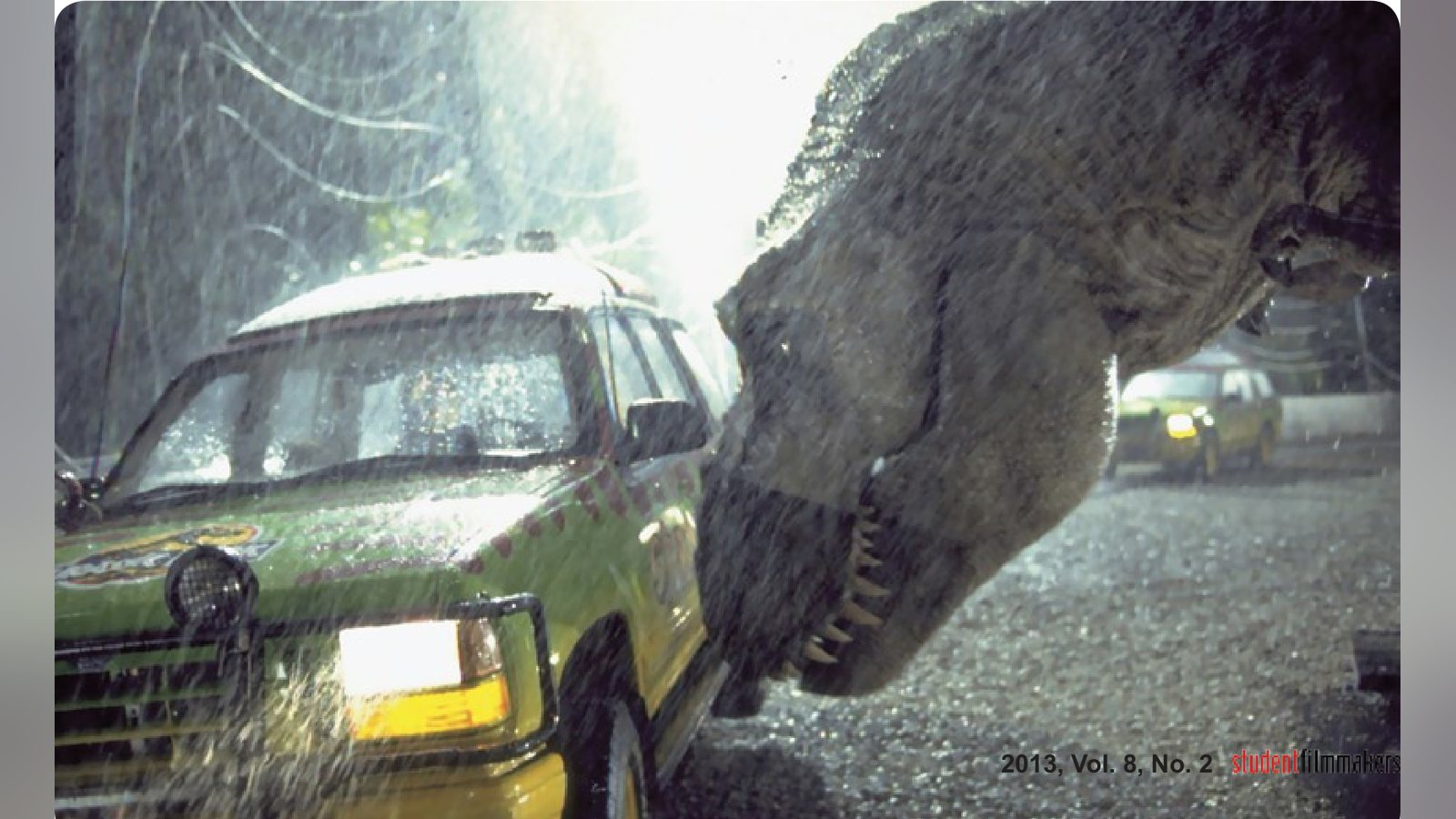
Among the first to be approached by Spielberg’s key operatives, who at the time included producers Frank Marshall and Kathleen Kennedy, was Tippett. Based on his lasting interest in animating dinosaurs, after rounds of meetings, Tippett created test stop-motion footage for “Jurassic Park”, detailed treatments of the kitchen sequence with the velociraptors and the attack sequence on the road with the Tyrannosaurus Rex rampaging around the Ford Explorer vehicles. His work was comprised of stop-motion reference puppetry mixed with storyboards and resembled the animation in “Prehistoric Beast”.
After Spielberg saw the footage, he inked Tippett to create go-motion dinosaur animations to match Stan Winston’s live-action mechanical beasts. Then Muren and ILM developed CGI dinosaur tests (originally meant for only a few shots) that were so convincing, it was obvious that they would eliminate the need for any of Tippett’s go-motion work. Simultaneously, for Winston’s group, it was a total of a two-year process of dinosaur design, construction and shooting. In cinema history, “Avatar” was the only other film that has had a longer complete end-to-end production period.
Naturally, with Muren’s team generating material that replaced all potential go-motion animation, Tippett felt as if he were becoming “extinct,” (a line which made it into the film), but Spielberg was attached enough to Tippett’s eye to retain him as “dinosaur supervisor.” In fact, Tippett’s original animation in the two stop-motion test sequences was replicated by ILM’s computer animators, in many cases identically. To achieve this, Stuart Ziff was again brought on board, in this instance to create a “dinosaur input device” (or DID). Ziff explains that, “63 encoders were wired on each of two 2.5-foot-long DID puppets to input the position of the puppet’s joints in a computer. The positions were then used to animate the computer-generated dinosaurs in the film.” The collaboration between Ziff, Tippett and Muren’s team at ILM produced among the most memorable material in the finished film.
Surely, though, design is always king and for “Jurassic Park”, it started with Stan Winston who lobbied Spielberg for the job. As Shane Mahan, a key effects artist at Stan Winston Studios at the time explained, “We developed all the sculptures and physical looks of the dinosaurs. Stan Winston Studios created every species look. They were replicated by ILM.” Surely, though ILM created animation throughout production and post-production, Winston’s team had to achieve all of their animatronic dinosaur movements on set in real time.
As history has shown, the centerpiece of the film is the Tyrannosaurus Rex. In the finished film, the T-Rex is seen in both a full-size animatronic version and a computer-generated counterpart. For the full-size T-Rex, the final clay sculpture created at Stan Winston Studios was a 36-foot long 18-feet tall beast. On set, the final fabricated T-Rex was mounted onto a motion base typically used for aircraft simulations. Stan Winston’s lieutenant John Rosengrant explained that the T-Rex had to perform without a cinematic precedent. “The T-Rex had a huge influence,” he said. “A year before we were designing, that was the marching order – to be the most realistic dinosaurs that had ever been onscreen and incorporate the newest paleontology information.”
After finishing work on the film, Tippett knew that they had created something special. “You never know what you were going to end up with, but the confidence level was very high,” he stated. “At the end, we set a new high water mark. Dennis [Muren] and I went to Amblin and Kathy [Kennedy] ran the first answer print. There was a tremendous amount of relief once you see it.”
The impact of “Jurassic Park” decidedly influenced other stop-motion animators. Doug Beswick, with partners Kevin O’Neill and Kevin Kutchaver, set up Flat Earth, a production company dedicated to computer animation. At his Burbank facility, Beswick, O’Neill, and Kutchaver supervised a team of six who built computer models, rendered them, and performed 2-D and 3-D computer animation for 1990s TV shows such as “Hercules” and “Xena.” Richard Edlund’s Boss Films made use of motion-control camera equipment similar to that used on “Star Wars” even though much of his Marina Del Ray studio in the 1990s was given over to digital computer effects for films such as “Multiplicity”.
Inevitably, the success of CGI in “Jurassic Park” was not lost on Phil Tippett himself. Not one to become “extinct,” Tippett acquired an additional building for his Berkeley complex, housing over 100 workstations for the 80+ computer animators he hired for 1997’s “Starship Troopers”, directed by Tippett collaborator Paul Verhoeven. Proving his competency with full-motion creatures in “Tremors 2”, Tippett went all-out for what promised to be the next level of CGI capabilities. Where “Jurassic Park” featured some 50 CGI shots, “Troopers” required nearly 200 CGI shots.
Nevertheless, Tippett predicts he will someday complete a stop-motion swan song when the time and situation are appropriate.
Even in 2013, considering the level of sophistication in its animated characters, its economy of shot selection, and its blend of multiple techniques to realize its vision, “Jurassic Park” still might not have been aesthetically surpassed 20 years onward.
Keep learning filmmaking
Want more lessons like this? Join StudentFilmmakers free for live webinars with working pros, and stream on-demand filmmaking classes in cinematography, directing, screenwriting, sound and post.






