By Todd Debreceni
Makeup effects artist Todd Debreceni shows how he turned an actress into Gertrude Stein, from life casting and molds to prosthetic appliances and paint.
Denver playwright Melissa Lucero McCarl was commissioned about Gertrude Stein for the Mizel Center for Arts and Culture. The result was Poignant Irritations – about Stein and her lifelong relationship with Alice B. Toklas – and it made its world premiere at the Mizel Center under the direction of Wilson, and portrayed by two Denver actors: Billie McBride and Erica Sarzin-Borrillo.
Billie and I have worked together on a number of theatre productions together which she directed, but for Poignant Irritations she was acting, and was concerned about the physical differences between her and Gertrude Stein, which are numerous. Billie is petite, thin and very Irish/Scottish in her appearance, with a button nose and square chin.
Gertrude was a fairly large woman (later in life), with a pointed chin and a bit of a beak for a nose. Billie is an outstanding actor, so why be concerned about physical differences when finding the truth in a character is what really matters for creating a believable performance?
Design Tips for Creating Believable Makeup FX & Appliances for Close-Up Work
Writer and director David Mamet (Spartan 2004, Heist 2001) said that everything an actor needs to create a character can be found in the words of the writer; anything else is just ‘funny voices.’ A prosthetic nose and chin is no different than affecting an accent as a character manifestation. Or is it? If a physical transformation can provide an actor with the ability to be more ‘in the moment’ than if no physical change is present, why not go for it? Bottom line, it’s not about the makeup, the wardrobe, or the set… It’s about the performance, and if the audience’s suspension of disbelief is improved by an actor’s wearing of a makeup effect, isn’t that what’s most important? Yes. The answer is yes!
Would Robin William’s performance as Mrs. Doubtfire have worked without the makeup effects? Unlikely. Dustin Hoffman’s ancient Jack Crabb in Little Big Man? Probably not. Mike Meyers as Fat Bastard in Austin Powers? Nope. Some characterizations can’t be pulled off without external physicalizations. Could Billie McBride have become Gertrude Stein without the benefits of prosthetic makeup? Absolutely. So what is the point?
The point is the actor playing the character wanted makeup effects in order to complete the transformation… to become Gertrude Stein. Being that the makeup was for theatre is also significant because the show couldn’t be stopped to make touch-ups. Being that the audience was within touching distance of the actors is significant because they could see the seams of the appliances if the makeup wasn’t applied well. It’s one thing to see enormous bat ears on the character of the Bat Boy in Bat Boy, The Musical – of course they’re phony… they’re huge! But they’re believable as long as you can’t tell they aren’t actually part of the Bat Boy’s actual head. Again, it’s not about the makeup. It should never be about the makeup. It’s about the performance, and if the performance can be improved with the application of makeup effects, then that’s what should happen.
What is also significant is if you can create believable makeup for a theatre production in an intimate environment, then you can most definitely create believable makeup for film or video.
How do you create a believable appliance for close up work? The answer is the same as for someone asking how to get to Carnegie Hall: “Practice.”
Here are some design tips, in no particular order of importance.
- If you’re just starting out, keep your design simple. This will help you create early successes, and build your confidence level. Getting ambitious too soon may leave you discouraged, and inhibit the learning process.
- Research, research, research. Learn human anatomy.
- Think of your characters as fully 3-dimensional, which of course, they are. Design your character by keeping in mind that the finished piece will be viewed from many angles.
- Seriously consider designing your appliance in more than one piece. This will make each piece of the appliance more manageable when applying it, rather than trying to apply one large piece. The potential for difficulty in applying one large piece versus two or three smaller pieces is much greater.
- Always use some sort of reference material to aid your design ideas. If you are going to create an age makeup, get your hands on photos of people the age you want to create.
- If your character isn’t going to be reality-based, you’ll have to create an artificial structural anatomy. That is, alien bone structure, which then dictates alien muscle shapes, which
in turn dictates surface or skin texture. Remember, you are creating an illusion. The better you become at creating the elements above, the better your illusion. The better the illusion, the more believable your makeup becomes. Also, keep in mind that if you’re creating a fantasy or non-human character, realism isn’t your primary consideration, but believability is.
So, once the research material was gathered, and the lifecast of the actor had been made, the sculpture was ready to begin. Since the nose and chin appliances were cast in silicone, the clay used for the sculpt was critical. The clay cannot have any sulfur in it or the silicone cure will be inhibited, and there will be a gooey, sticky, and awful mess to clean up later. Don’t ask me how I know that. Don’t wear latex gloves, either. Wear either vinyl or nitril gloves.
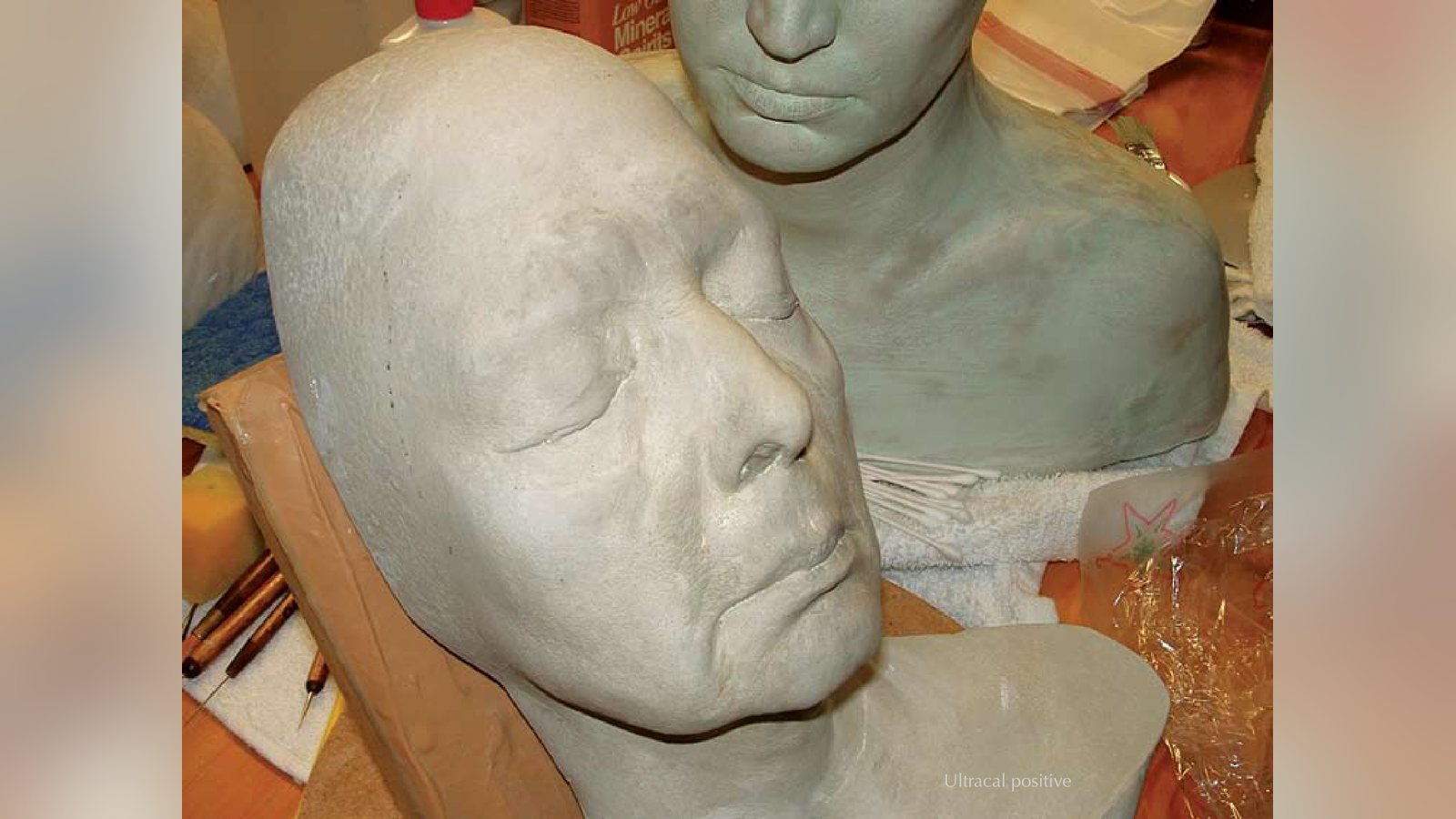
The clay used to sculpt this makeup is an oil-based plasteline (it never dries out). It comes in a 10 lb brick which will last quite a while – a little bit of clay goes a long way. It is a hard clay, which is preferable for this kind of work because you can Ultracal positive Digital Compositing for Film and Video Second Edition Steve Wright Producing and Directing the Short Film and Video Third Edition Rea Working with HDV Shoot, Edit, and Deliver Your High Definition Video Pescatore Changing Direction: A Practical Approach to Directing Actors in Film and Theatre Foreword by Ang Lee Documentary Storytelling Making Stronger and More Dramatic Nonfiction Films Second Edition Portable Video ENG & EFP Fifth Edition J. Fink press skin texture stamps into it without fear of damaging the sculpt. It also remains pretty hard in warm working conditions. Getting the shape of the nose and chin roughed in was easy, but creating matching skin textures for Billie’s face required more attention to detail so that the edges of the appliances would blend correctly into her face when applied.
That was done by using stamps made from casts of actual skin of other lifecasts, as well as from press-and-seal plastic wrap, believe it or not. The texture of it is marvelous, and coupled with hand-dimpled texturing with a small clay burnishing tool, the results can be quite remarkable.
After the sculpture was completed, the nose and chin were carefully lifted off of the stone positive by soaking it in water overnight; the stone positive had been lightly coated with Al-Cote, a dental separator. The nose and chin were then carefully repositioned on new casts made from the original, and the edges blended off very thin. Nose and chin roughed in on positive.
Nose and chin placed on new molds before cleanup. Keys were drilled into the new molds with a round router bit so when a stone negative would be made, the two halves would fit together perfectly. After the new negative was made for each appliance, all traces of clay were removed from both the positive and the negative, and an injection hole and overflow holes were drilled in the positive.
A silicone release agent was brushed into both halves of the mold, and the two halves were then pressed together, clamped tight, and the silicone was prepared. These particular appliances were made using a platinum cure silicone made by Polytek called Platsil Gel-10. It has a very fast kick – about 15 minutes, is strong, and so easy to mix and use. It is mixed 1:1 by volume; for these appliances, it was colored intrinsically with flocking from two sources, Factor II, Inc., and The Motion Picture F/X Co. By coloring the silicone intrinsically, it takes on the translucency characteristics of human skin, and can then be airbrushed once it has been applied, to further blend it with the actor’s skin.
For silicone appliances there are a number of adhesives that will be sufficient; for Gertrude we used Telesis 5 silicone adhesive from Premiere Products, Inc. As it was mentioned earlier, during a play you can’t yell ‘cut’ in the middle of a scene and go touch up an appliance that’s coming loose at the edges. Telesis adhesives were developed for use by medical prosthetists so people who have suffered catastrophic injuries can wear a facial prosthetic all day long – go shopping, go out to dinner – and not be worried that people will notice them.
So, on went the nose and chin, a little airbrush makeup and hand-stippled color was applied, and someone called, “Places!” Todd Debreceni began his career at PBS and has worked for TBS, 20th Century-Fox Television, Warner Bros. and Disney. His credits include “Contact” and “My Favorite Martian.” Todd has created makeup effects for numerous theatre productions, and also conducts regular seminars, workshops and private classes in special makeup effects for film, television and theatre. Todd and is an adjunct professor at the Art Institute of Colorado in Denver. Positive and negative nose mold Billie as Gertrude Finished pieces ready for application
Related filmmaking guides
Keep learning filmmaking
Want more lessons like this? Join StudentFilmmakers free for live webinars with working pros, and stream on-demand filmmaking classes in cinematography, directing, screenwriting, sound and post.