The House at the Edge of the Galaxy is an allegorical short about the here and now. A look at how it was made, from casting to post-production.
The House at the Edge of the Galaxy is an allegorical short film about the beauty and significance of the here and now, versus the quest for the bigger and better world perpetually beyond our grasp. This cosmic tale takes place at a desolate outpost where a lonely boy is taught by a passing Cosmonaut how to plant a “star” to transform his existence. In the process of yearning for the heavens, he discovers that paradise instead resides in his own backyard.
“I am drawn to the concept of perpetual cycle, psychological barriers, illusion of entrapment and inevitability, and how people project their own emotions of disillusion into attempts to escape themselves.
In the allegorical search to escape, The House at the Edge of the Galaxy explores that the exit can be found through its recognition, and that the cycle can be broken from within.
The theme of longing to escape, either physical or psychological, is woven through my work. While trying to escape, a trapped child meets a lonely traveler who teaches the child how to plant a ‘star’.
I am interested in the arc of relationship between father and son and old and young that develops from the rejection of the own psyche to the renewal of tight bonds that exist internally, but begin to disintegrate. I use simple allegory to reveal the cyclical pattern in the complex reality of people’s lives.” ~ Gleb Osatinski
Gleb has carried an image of an old house in his mind with him since childhood. Growing up in Russia, he would see old wooden houses in remote areas of the country. The idea of frozen time in a universe that exists inside such a house greatly attracted Gleb. Time stopped in the house, but life around it had progressed, and Gleb has always been drawn to the concept of the reality that coexists with the present. An instance of memory or subconsciousness may exist somewhere else, and he thought an old house would be the perfect setting to support this concept. When writing the script, he had a house like this in mind.
While location scouting at the Blossom Hill Farm in Alum Bank, Western Pennsylvania, the filmmakers discovered the physical form of Gleb’s vision. The home appeared completely lost and abandoned, surrounded by the forest. It had been locked up and neglected since 1954. It had no electricity, running water, or any roads or passes that led to it. When Gleb stepped inside, he was submerged with the internal world that waited to be explored.
To prep the interior of the house for shooting, a local carpenter was hired to shore up the home’s collapsing foundation. The walls and ceiling were secured, and the porch was supported with additional beams. Rubble was also partially removed from the second floor.
A temporary wooden bridge was built across the small creek that surrounded the house to allow the crew to carry equipment and lights. To stay true to the director’s vision, dolly shots were needed to avoid using a handheld camera. The bridge was essential to bring the dolly, tracks and equipment to the set.
The main hero of the story is a seven-year-old boy who prefers to just be himself in front of the camera. Gleb decided to cast the actors himself, and met with many young actors for the role of The Boy before discovering Grayson Sides. In fifteen minutes during the casting session, Grayson was able to demonstrate a wide range of emotions and exhibit deep involvement in the story. He was not afraid of the camera and the hard work ahead of him. His parents Todd and Tamara were extremely supportive. When Gleb mentioned that the film would be filmed in an old, dilapidated house, they were excited. Todd and Tamara said that Grayson would love to play the child – he loves exploring. Grayson Sides was a perfect fit for the role. It started as an adventure, and never ceased to be one from the day he and Gleb met.
This is Gleb’s second film with Richard Manichello. Their first collaboration was Pisces of an Unconscious Mind where Richard acted as a fisherman and therapist. This time, Richard became the director’s inspiration yet again.
When Gleb was ready to make another film, he called Richard and invited him for coffee to brainstorm the next script. Suddenly, Gleb saw Richard in the Cosmonaut suit, and that triggered the whole story.
There is something in Richard’s performance that allows the creation of complex characters that Gleb uses in his story. He combines elements of surrealism and drama as well as bits of satire that Richard unmistakably brings in with his performance. This combination and tones was exactly what Gleb was looking for the Cosmonaut in his film.
The Creative Production Team
Once the script was written, Gleb began the search for an experienced cinematographer to shoot the film. After watching hundreds of reels on-line, he was struck by the beauty of light, angles and camera film radiating from Jarin Blaschke’s work (The Tell-Tale Heart, Babygirl, Fray), and instantly knew he was the one. Gleb sent Jarin a note asking if he would be interested in this collaboration. Once he read the script, Jarin fell in love the story and the two began working together. It was a deeply creative process. What Gleb loves about working with Jarin is his attention to the tiniest details and his drive to execute the most complex shots with the highest possible quality.
To round out the creative team, Gleb began the search for a Production Designer. Jarin introduced Gleb to Robert Eggers. Jarin and Robert had worked together on The Tell-Tale Heart and The Five Stages of Grief. When Robert read the script, he also loved the material, and agreed to come on board. Robert is a walking encyclopedia of facts about architecture, costumes, and styles. Robert helped tremendously to solidify the vision of the story, and brilliantly created the world inside of the house the Director had envisioned.
The Physical Production Team
Once the team got closer to the shoot, Gleb met with Line Producer David Ross (The Circus Animals, The Whithering Winters), who agreed to help with physical production. David was very enthusiastic about the film, and demonstrated a can-do attitude from day one. David organized equipment requirements, contracts and all necessary details to make the shoot happen.
In the meantime, while attending the 2012 Woods Hole Film Festival for a screening of Pisces of an Unconscious Mind that took place July 29th, Gleb was less then four weeks out from shooting. Here, he met Executive Producer Gavin Behrman who was in attendance for the screening of his short film, Admissions.
After spending time together at the film festival, Gavin and Gleb realized they shared many common ideas about filmmaking. Gleb soon offered Gavin a spot on the team, and he agreed to come on board. While David continued to prep from New York, Gavin offered a wide range of assistance while he was working on another project in Toronto. He helped with the crew and equipment. When the deal for the generator suddenly fell through a few days before shooting, Gavin tapped his relationship with David Haddad of Haddad’s Inc. to secure a new one, and the production was saved. Two weeks before the shoot, Gleb discovered Assistant Director Eric LaFranchi (Hypothermia, Yelling to the Sky). Eric and Gleb clicked immediately – both shared their love of Andrey Tarkovsky. It felt like they could spend hours just talking about him. Eric loved the ideas contained in the script, and jumped in. In just a few days, Eric put the shooting schedule together. They were ready to shoot.
The film was shot in six days from August 24th to August 30th, 2012. Most of scenes were exteriors, and five days of shooting required favorable weather. As luck would have it, rain only fell on August 26th – the exact day Eric scheduled working indoors.
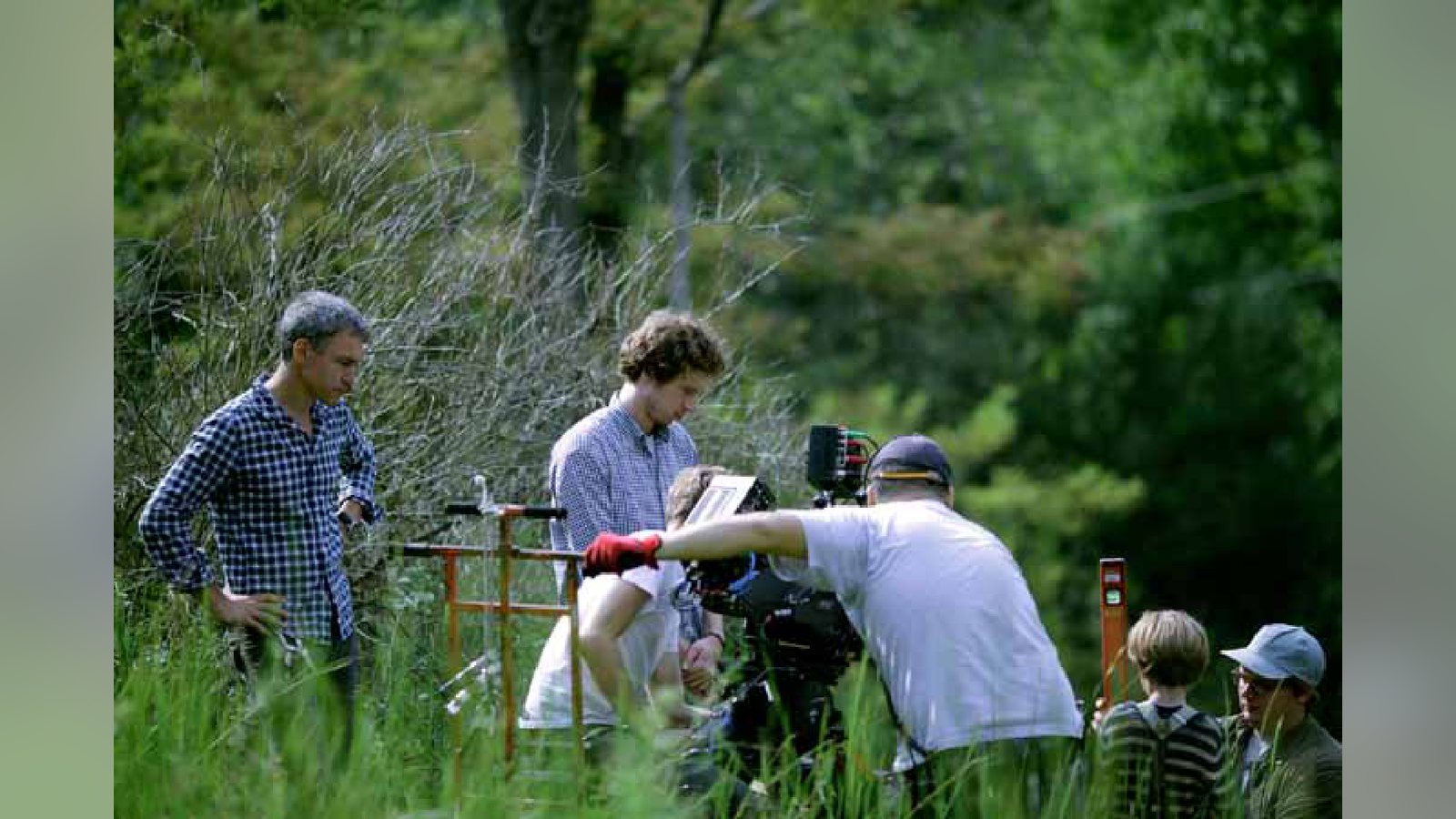
The mountainous terrain at the Blossom Hill Farm made the shoot challenging. Extensive set up time was needed to level track for the dolly shots on the hills that surrounded the house. Time ran short, necessitating rewrites of the script to make the schedule.
Shooting the house interiors provided its own degree of difficulty. Due to the condition of the house, only six people could work on the second floor at any given time for fear of the floor collapsing. Assistant Director Eric LaFranchi did an excellent job making sure this part of the shoot was handled in a safe, effective manner. Finding the right editor for a project is an integral part of the filmmaking process. Gleb was recommended to contact Laura Israel (Fishing With John, Windfall). She read the script, and loved the footage. It was an intense and fruitful process cutting with Laura. She always found tiny gestures, moves in the eyes of actors, or a camera move which may be hidden at first, but are then revealed with a single mouse click. Laura’s editing is accurate, intricate and subtle – her work elevated the film to the next level.
This is Gleb’s second project working with Romain Collin (Pisces of an Unconscious Mind). The two met just before the film was shot, and Gleb gave Romain the script so he could start thinking about themes for the score. Romain loved the script, and was excited to be a part of the team. Once the film picture was locked, Gleb and Romain began their creative process.
Gleb wanted the music to carry an idea of a ballad, sounding something like an old, dusty record that was found in an attic. The music should have a soul of its own, and carry this soul to the viewer when they see the story about a small child. The score was recorded on Romain’s piano and later mixed at Jeremy Loucas’ (Pisces of an Unconscious Mind, Lino Tagliapietra, Glass Musician) studio.
To create the desired mood, the score was converted from digital to an analog tape, and then back to digital.
Post Production Sound
Laura Israel introduced Gleb to the Emmy nominated sound editing team Margaret Crimmins (Short Cuts, Welcome to the Dollhouse) and Greg Smith (Jesus Camp, Taxi to the Dark Side) of Dog Bark Sound. Gleb listened to their work online, and was instantly impressed. He could not wait to meet them. Working with Margaret and Greg was another incredible collaboration for Gleb. Their idea about the sound design is that it should open a separate dimension when the audience sees the house. The director wanted to be sure the film’s visuals were expanded into another world – the world of sound. Margaret and Greg created this world, which exists inside of the film, and will stay there forever.
A Few Words About Financing
Crowd financing has become a popular method of raising funds for short films. The filmmakers used the funding resources of RocketHub.com, and were able to cover a portion of the production budget. 91 very generous people came together to help us raise over $10,000.
Here is the link to the fundraising site for the film:
http://www.rockethub.com/projects/9414-the-house-at-the-edge-of-the-galaxy
The rest of film was financed with Gleb’s credit cards and some of his family’s savings.
Related filmmaking guides
Keep learning filmmaking
Want more lessons like this? Join StudentFilmmakers free for live webinars with working pros, and stream on-demand filmmaking classes in cinematography, directing, screenwriting, sound and post.