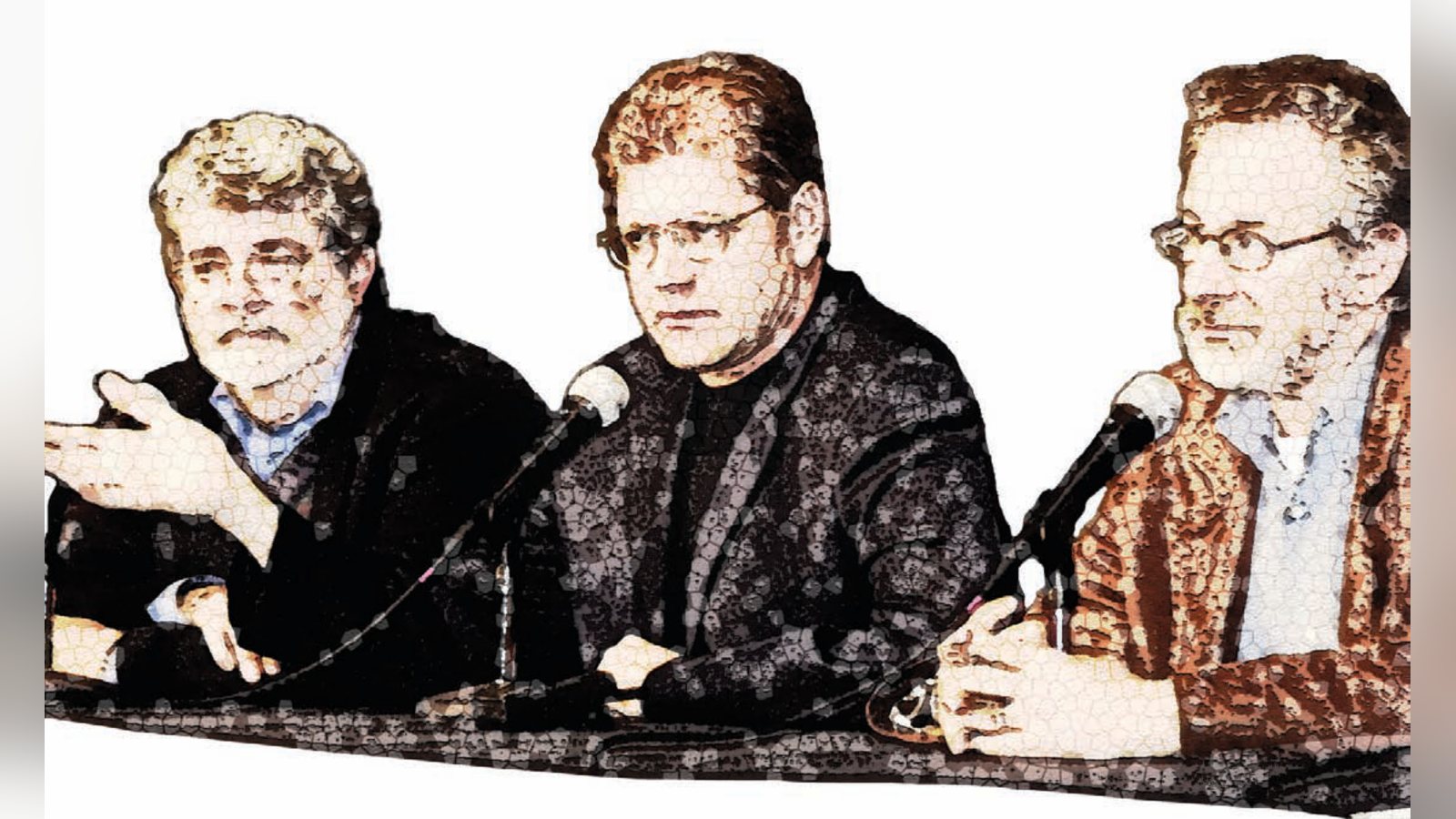
George Lucas, Steven Spielberg and Robert Zemeckis discuss digital filmmaking and how new technology is changing the way movies are made and seen.
Perhaps more than any three directors in the history of cinema, the names George Lucas, Steven Spielberg, and Robert Zemeckis conjure the era of blockbuster successes in mainstream Hollywood. From the Star Wars films to fare as diverse as E.T. and Saving Private Ryan to the Back to the Future films and Forrest Gump, the creative power and box office tallies that the three men muster is undeniably staggering. Recently, all three moviemaking deities were in attendance at the Zemeckis Center for Digital Arts at a refurbished outbuilding just off of the main University of Southern California Los Angeles campus to discuss the future of digital filmmaking.
Steven Spielberg: Technology has always been out there as a danger for upstaging a story. I mean, technology was out there as a danger in the old days when they had to pull mattes the old-fashioned way, without any kind of digital enhancements or digital tools. So the same rules apply. Same storytelling rules still apply. This doesn’t alter that. This simply makes your imagination easier to capture and present. And actually, when you think about it, more economical to present an impossible idea that ten years ago nobody would pay for it to put it up on the screen. Today, with this technology, you can pretty much explore the depths of your imagination and express yourself any way you’d like.
Capture awe-inspiring full HD video and 10.6-megapixel stills with the new AG-HMC40 – the camcorder that elegantly combines both high-performance capabilities. The dual-use HMC40 maximizes your creative potential and business opportunities by recording on inexpensive SD cards. Featuring full HD resolution imagers, the HMC40 records for up to 12 hours of AVCHD video on a single 32GB SD card or, in its 24Mbps PH mode, up to 3 hours of 1920 x 1080 or 1280 x 720 video, delivering images far superior to HDV. And, unlike HDV tapes, SD cards can be randomly accessed and immediately played back on affordable consumer playback devices. The less than 2.2-lbs HMC40 has no moving parts in its solid-state recording system, so you’ll spend less time cleaning heads and more time focusing on your content. And you’ll enjoy a fast, file-based workflow and professional features such as time/date stamp, pre-record, interval recording, manual focus and optical image stabilization.
Simplify your equipment list and maximize your capabilities with the AG-HMC40. Two professional cameras in one powerful package.
Learn more at panasonic.com/avccam.
George Lucas: Is film more powerful than a word processor? What is your ethical concern in using a word processor? Those ethics course has to do with all art and all communications. The technology has nothing to do with it.
Robert Zemeckis: It’s like when they invented the printing press. And someone said, “Wow, this is great! We can print the Bible.” And someone else said, “Yeah, this is great! We can also print laws.” So you know, the information that we use to ultimately to do great things for humanity, can also be abused, and I think that the thing that we’re going to realize is like – nobody believes everything that they read in the newspaper just because it’s written. Now, you can’t believe in imagery just because it’s moving. But everyone has to be educated in that regard.
The Ethics of Digital
Robert Zemeckis: The ethics really has to do with editing.
I mean, you don’t need the technology at all. It doesn’t have anything to do with technology. Because technology doesn’t contain anything real original. As the ethics come in — on news shows every single day, when they edit out important information, that they don’t want the public to hear about.
George Lucas: See, it’s a problem with all students. It’s not just film students. It’s all students, especially with writing students, students in the English classes, creative writing classes, especially if they get enamored of words. One of my biggest problems in my creative class was my teacher saying to me, “Don’t get in love with your words. Don’t just go over and over and write a lot of words. You have to be saying something.” And when I was in film school, it was the same issue. Students wanted to do great camera angles. They wanted to do fantastic shots. They wanted to do all kinds of things. And again, this is a school of communicating through using the moving image. And they’re just as concerned with what you’re communicating as they are with how you’re doing it. That’s why it’s a graduate school, and they’re very prone to accept kids who got their bachelor’s degree in fields outside cinema or theatre arts or any of those kinds of things.
Steven Spielberg: One more thing about ethics is that you have to understand that most universities are still analog and this university has gone digital simply because film students come here with all their dreams on their sleeve, but you must have training. You must learn your craft. A lot of filmmakers don’t go to film school, but they still make it. But it’s very important to have a handle on your craft. And with everyone going digital throughout the world, it’s very important that these kids don’t come into a world, a real world, without the tools and the knowledge of how to apply their talent inside a world that’s rapidly changing technologically.
Digital vs. Film
Steven Spielberg: I will always shoot a movie on film – you’d better believe it, buddy. I use digital every single day, with George and ILM, in the achievement of all of our effects, and I am part of a company that makes digital movies. Where I want to stay analog, is I just like to know that there’s film going through my camera when I’m physically directing. When I’m producing and the director comes over and says, “I want my movie in digital,” when the technology is there, and the quality is there, I’m not going to stand in that director’s way. But only thinking for myself, I love film. I love the smell of it. And I’m an old-fashioned person in that sense, and I’m going to stay with it until George forces me to throw it away.
The issue is not a contest. This is a thing of who’s going to be who, and what’s going to take over what. People still like to watch silent movies. Some people still make silent movies. Some people like black and white movies, and some people still make black and white movies. This is not about digital taking over and film disappearing. This is simply adding a new medium, a new range to the cinematic experience. And what’s cinema? What we’re really talking about here is cinema: the moving image. Communicating with the moving image. And there’s a lot of different ways to do that. Digital is one. Film is one. There’s a lot of different ways to do that. And there’s going to be more as time progresses. So it’s not about a particular medium that you’re working in. We’re not going to stand up here and argue about the fact that Steve likes to do frescoes, and I like to do oil paints. That doesn’t mean the oil paints are better than the frescoes. It just means that I prefer the medium.
Robert Zemeckis: You just have to deal with it because it’s happening. When I did my last three movies, part of the process of what we do with every single actor, is in one of their rehearsal days, they go in and they get cyberscanned, just in case we need it. And on Forrest Gump, Tom Hanks said, “I don’t know if I like this. What can you do with this information?” I said, “Well, it’s very expensive now, but I can animate you if I decided to do it.” So Tom said, “I don’t know if I like that idea.”
Well, the problem is you have the same issues you have when a stunt double comes on the set. And the way you use those cyber characters now is usually for stunts and things, or wanting the actor do something that is really impossible to do. The press makes a giant deal of the notion that they’re going to have cyber actors. And that just shows an extremely naive approach or idea of what acting really is. Acting is an art. It’s a human art. It’s not something you can program into a computer — at least not at this point. The human is too complex in the way that he expresses his emotions. And acting is about emotion. It’s not about recreating a face. It’s about emotions, and how you deal with those emotions, and how you express those emotions. And an actor’s quality is based on his ability to express those emotions, and express them in the context of the story he’s telling. That is something a computer can’t do. At ILM, we’ve created completely perfect, lifelike reproductions of actors that you cannot tell from real actors. But we need the actor to do the voice. We need the actor to do the acting. And then on top of that, we need about a dozen animators who also have studied the acting craft, know how to act, act in front of a mirror, to carry that performance. You need about thirteen people to do one performance that right now an actor can do. Digital acting is animation. And you’re never going to replace your actor, the human element in that process. It just is not going to happen. Because people relate to people. They don’t relate to machines.
Robert Zemeckis: I agree completely with George. And I think if you look at, I think what’s going to happen in the image is what happened in music. You can digitally create any sound that a musical instrument can make, but we still have not replaced musicians. You always have to have the human emotional warmth of the performance to start with. But, if you needed to extend that oboe phrase another three seconds, you can do that digitally. But you at least have the basis of that performance. And I think that’s what’s going to happen with the human performance as far as acting is concerned as well.
Steven Spielberg: I think it’s all about individual choices.
And there’s all these technology advances, where people are going to have a choice to make a movie with actors, or to make a movie with digital representations, albeit the performances of the actors as to their vocal talents, much the same way as animation is done today. I personally would choose, if I had the choice between a living, breathing actor and a digital actor, I would choose the living actor, and I would see no reason to digitize people while there are actors available for movies. But there are certain extenuating circumstances, for instance, if there is a movie you are making with an entire cast of live actors, but there is one digital element in the film.
George Lucas: Again, you’re dealing with human beings.
And in directing, you’re dealing with them in a very intimate way on a very emotional, high-charged, nervous, intense kind of situation, and you have to be standing next to them. Because once in a while, they need a hug. That’s the only way they’re going to get through the scene. The big thing that I think actors want in directors is when you go to talk to an actor, they will tell you what they feel about the way directors work on a sound stage or on location today. Those actors will tell you they would rather have a director like King Vidor, and George Cukor, and John Ford, and all the directors of old, standing next to the camera, making eye contact with the actor, as opposed to being thirty yards away in a monitor tent.
Robert Zemeckis: It’s been my experience that one of the things that doing movies with effects shots in them has taught me as a director, in the old days of doing optical effects, what you had to do was you had to keep the actor from feeling like a prop. Because all of a sudden, all the ILM guys came in, and had to set up these monitors and they all had these conferences, and here’s the actor standing in front of this blue screen. And it’s like, “Well, can you have him do that. And have him do that. And maybe he should…” And talked to him like a dog was acting in these movies. And so what you had to learn was that was debilitating for the actor, because it strips away everything that can help them through their performance, and it’s very, very still. And it took a lot of movies to finally understand that you must bring the actor into the process. I think actors are, in the future, are going to be just as sophisticated about this stuff as the filmmakers are, so it’s going to be like an extension of the set.
George Lucas: Also the technology has advance to the point now, where it’s much easier to do these things – especially blue screen. Used to be that you had people from Technicolor and all these places – it was a huge mess. Now you can basically walk around and shoot like normal and don’t think so much about it. And with the new system that Steve’s been using, you guys can simulate the backgrounds and the environments that are going on as we’re actually shooting it. So the actor can actually look at the environment he’s in, and what he’s doing and what is going on. It’s making it much more friendly for the actor to work in the medium than it was ten years ago.
Shooting the Movie
Robert Zemeckis: My feeling about it is, it’s just more tools to do things that make the stories better. It shouldn’t change shooting movies that much. I mean, every time a new piece of equipment comes to the movie business, it’s abused. And then it settles down. And then it becomes a tool. When Steadicam was invented, every movie had to have fist fights, people running up and down staircases, and cameras spinning around the room at 360 degrees. Now you can’t see the shots, because filmmakers have learned how to use the tools to make it invisible. You know when digital editing came into being, there were all these movies that had cuts for no reason, just because they could be done. And so now it’s just a tool. It’s an important tool, but it becomes invisible after we get it out of our system.
George Lucas: I have to shoot the film, then I have to animate the film, so I have to do like two movies which takes a lot longer. I plan for it: first, I shoot like 80 percent of my movie. Then I plan with the actors, and the budget and the scheduling and everything to go back and shoot another two or three weeks about nine months later. And then I come back another six months later, and do some more shooting. It’s not like you shoot in one big bit and then it’s all over with. You sort of spread it out over a period of time. And it’s much more like animation which is you can watch the movie come together. As it comes together, you can make decisions about things you want to change or alterations you want to make in the story.
Robert Zemeckis: Production, for me, hasn’t changed that much. I’ve been doing optical effects in just about every movie. Same sort of elements have to be shot and the prep has to be shot. What’s changed for me is in post production, where we have these wonderful tools now, where we can temp shots. If you have an actor in a blue screen element, you can very quickly, in the paint box, put together an idea of what the shot’s going to look like. So you can have your visual effects shots rendered very low-res immediately. And it’s done now in the editing suite. And you can even scan those out if you have to, and take them to preview. Whereas before, you had to have a piece of leader cut in there, and until like a week before the movie was released, you never knew what that shot was going to look like. So it’s really changed the most dramatically for me in post-production.
Steven Spielberg: Just remember, these are only advanced tools that we’re talking about here. We’re not talking about inventing the wheel. And we’re not talking about a breakthrough of a new kind of narrative storytelling. The stories will be told the way they’ve always been told. This will have no affect on them. This simply will free people’s imaginations, and be able to use their imaginations to tell even further out stories. Digital technology did not change the way I shot AI, and it has no effect at all on how we shoot the pictures.
George Lucas: It’s like everything else. It just makes your life easier. You don’t have to fly around as much. You don’t have to drive as much. You can do more things in the same day because things are on your desk in front of you.
Scott Essman has been writing about crafts and craftspeople in the entertainment business since 1995. His book, Tim Burton – An American Original is due in 2010 from Praeger Publishing.
Related filmmaking guides
Keep learning filmmaking
Want more lessons like this? Join StudentFilmmakers free for live webinars with working pros, and stream on-demand filmmaking classes in cinematography, directing, screenwriting, sound and post.