Patrick Reis shares how he visualized and shot the black-and-white music video The Man That Got Away, with multicam setups and live audio recording.
Three hand-held DSLRs, one lighting setup, and shooting while recording live audio.
Patrick Reis shares his experience shooting the new music video, “The Man That Got Away,” for New York-based performance artist Jonathan Tuzo. Reis describes the setup for the three hand-held DSLRs (one 7D and two 60Ds), provides a few camera tips, and talks about the aspect of recording live audio in the studio during the one-day music video shoot.
StudentFilmmakers Magazine: Could you tell us a little bit about the music video’s concept and look?
Patrick Reis: The concept and look was taken from some of the music documentaries from the 1960’s, specifically Andy Warhol’s documentaries and the doc on Bob Dylan, Don’t Look Back. Those movies were often shot on 16mm black and white film. The camera work was hand-held and often they seemed more interested in just getting the shot than making it look polished.
SFM: Whose idea was the concept?
Patrick Reis: The concept started with the director and my friend, Daniel Lugo. He knew the artist, Jonathan Tuzo, since kindergarten and had been wanting to make a music video for him for quite a while. Dan and I discussed some ideas over coffee one day and then we asked to meet with Jonathan to pitch the idea.
SFM: What are some tips for visualizing and shooting for B&W using DSLRs?
Patrick Reis: Shooting black and white wasn’t accepted right away on our set. The other camera operators asked me several times if I was sure that I wanted to shoot it this way instead of introducing black and white in post. If you decide to shoot this way, look at how different colors react in black and white. You might think that a shirt can be separated from the wall but in black and white they might both look like the same shade of gray.
SFM: What cameras did you shoot with and why?
Patrick Reis: We had one 7D and two 60Ds. This was for cost purposes. The rental of a 60D is less than a 7D, and I knew that I wasn’t going to use the additional features that the 7D offers. I just needed video from APS-C sensors.
SFM: Tell us about the lighting and camera settings for the three cameras.
Patrick Reis: Our lighting and camera settings were quite unusual for this video. All cameras are designed to shoot sharp, well-defined images. We needed the video to look soft and grainy to mimic those documentaries so we needed to push the lighting and cameras into the opposite direction of what they are used for. To start with we needed to bump up the ISO to give us that grainy look. Then we needed to pump in a lot of light to blow out the white walls to give us the contrast that we wanted. Finally this allowed us to stop down the aperture to mimic the deep focus that 16mm has. Often the DLSRs are used for shallow depth of field but we wanted the opposite. The only other setting that we manipulated was the color and filter settings. We shot in the monochrome setting and added a red filter to help with contrast.
SFM: What are some special do’s and don’ts for a music video shoot like this where you’re working with three cameras?
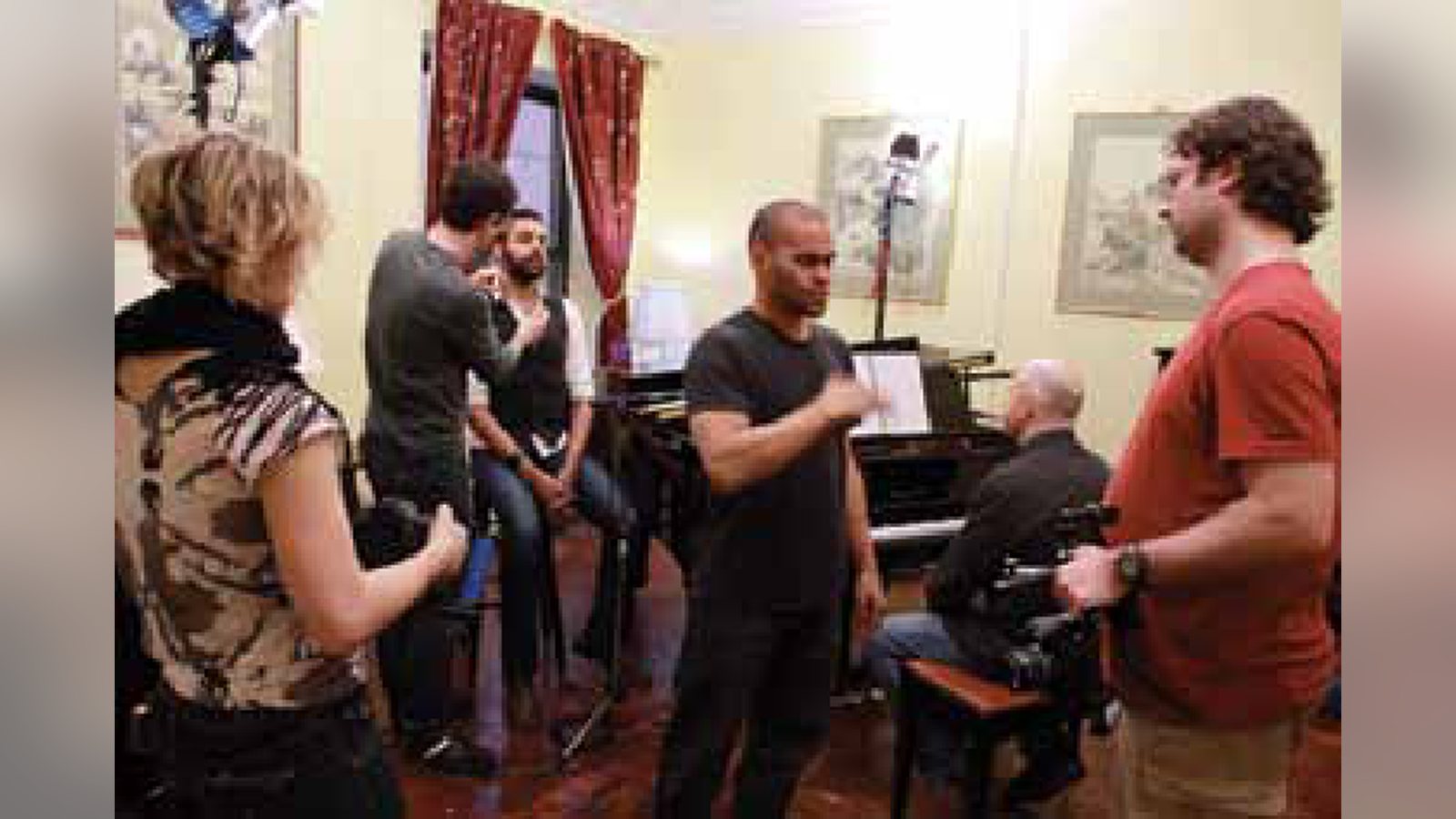
Patrick Reis: One thing we had to do with our multi-camera setups was rehearse. Each camera was handheld, and I wanted to give them a little freedom to move so we had to run through it a couple of times so each of us knew where the other cameras were.
SFM: What did you find to be one of the most unique aspects of this music video shoot and why?
Patrick Reis: Besides the live recording aspect, one of the most unique aspects was the genre. You don’t see a lot of music videos for this type of music so we had to change our thinking a little. For many of my other music videos I would shoot knowing that we wouldn’t be using shots in the edit for more than three seconds. For this type of music, you want to hold on each shot for a longer period of time.
SFM: What are some special do’s and don’ts for a music video shoot like this where you’re recording live in a studio?
Patrick Reis: I haven’t met anyone else that has shot a music video that is recording live in a studio like we did. Obviously you have to be quiet when the sound is rolling but even more so than that is you’ve only got one shot. In traditional music videos we use playback so you can do multiple takes but since we don’t have the ability to playback, you are married to one take. This is why I had three cameras recording. If I wanted to be able to cut and stay in sync, I had to use multiple cameras.
SFM: Did you experience Murphy’s Law on the set?
Patrick Reis: I’ve had many run-ins with Murphy but this time he didn’t visit our set. Dan and I work really well together and we’re both big pre-production people so we had everything mapped out by the time our shoot day arrived. Dan and I even shot a short movie with lights and audio in a studio once on a lunch break so we are good at keeping Murphy away.
SFM: Would never have guessed that you used a manual slider versus a motorized slider. Could you share with us some tips for working with DSLR sliders?
Patrick Reis: DSLR sliders are lots of fun! My biggest tip for using a manual slider is to relax and take deep breaths. It’s all about keeping it steady and smooth. And again, rehearse the move. You might find that as you move the lighting changes or there is someone or something that comes into the frame that wasn’t there when you started. You can see some of the equipment in the reflection of the piano in my shot but Dan and I wanted to see a little of the magic behind the scenes. Hence the opening shot of the video.
SFM: What are some of the next projects you’re shooting on DSLR?
Patrick Reis: I’ve got two projects that I’m really excited about. One is a firefighter themed obstacle race called Hero Rush. We don’t have any race video yet so our first shoot will be a promotional spot that hopefully will tease and pump up the audience. The other project that I’m thrilled to be a part of is a narrative short called Piercing Love. Everyone that reads the script loves it and the director, Farley Whitfield, is very generous with ideas and trying new things. We’re planning on pushing the envelope a little with this short.
SFM: If you could share a piece of advice with filmmakers, videographers, and storytellers around the world, what would it be?
Patrick Reis: My advice to all of the storytellers out there whether they shoot film, video, use a big camera or a small camera is to shoot more. Don’t’ let technology slow you down. You tell the story, not the tools.
Related filmmaking guides
- What does a cinematographer do?
- How to become a cinematographer
- Camera angles in film: a beginner’s guide
Keep learning filmmaking
Want more lessons like this? Join StudentFilmmakers free for live webinars with working pros, and stream on-demand filmmaking classes in cinematography, directing, screenwriting, sound and post.