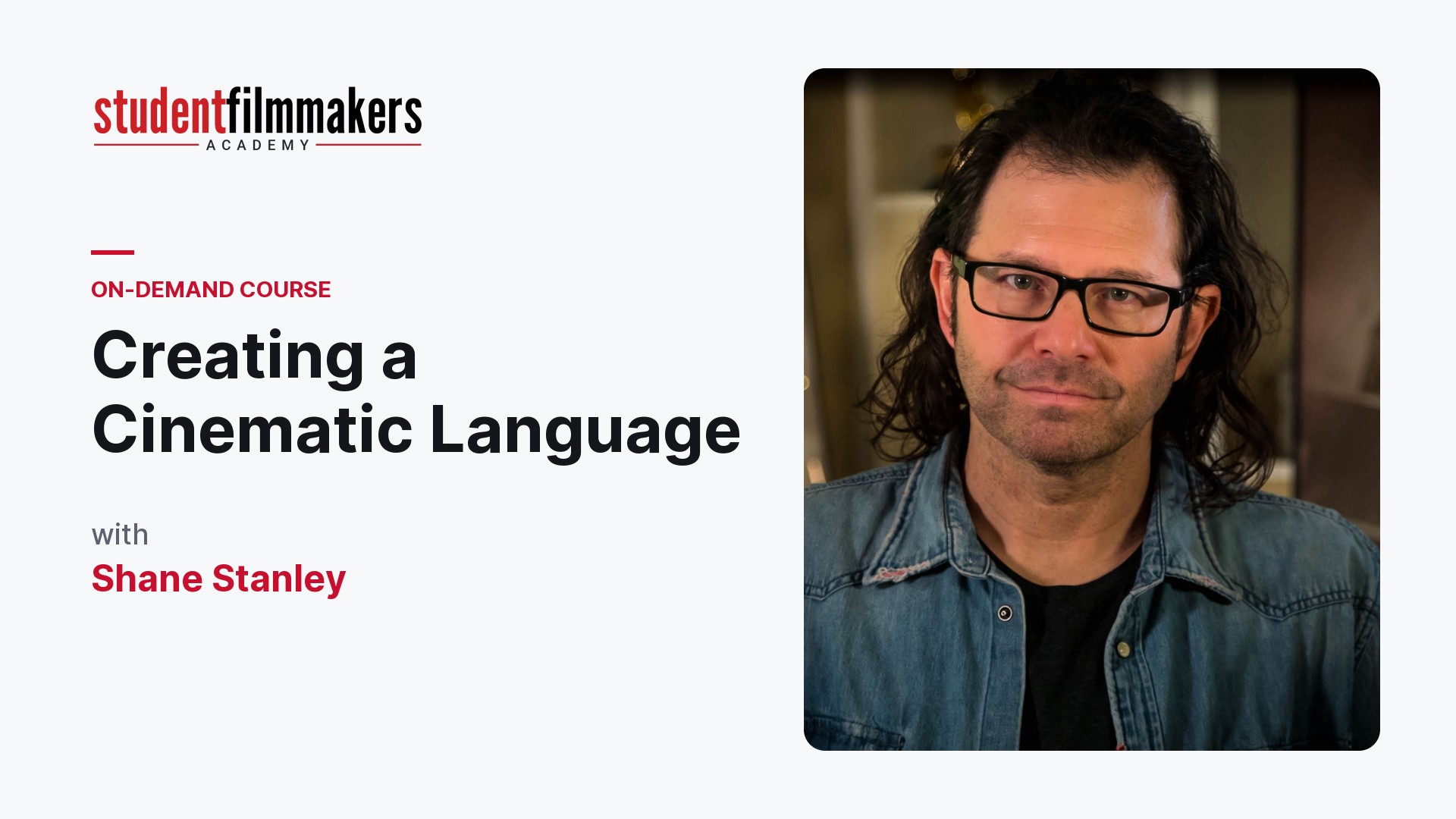
Shane Stanley has directed Night Train and Double Threat, won Emmys early in his career, and carries an executive producer credit on Gridiron Gang. He believes every film needs one visual idea that everything else grows from. On Night Train, that idea was a beat-up pickup truck. In this class he showed how independent filmmakers can pick a look, hold on to it, and get it on screen without a studio budget.
Stanley calls himself an “indie rat” and a “plug in and play kind of guy.” He falls in love with real locations instead of building sets, and he shoots on gear a small crew can carry. That makes his advice practical for anyone making a first or second feature.
What gives a film its visual language?
Sometimes it is a story, sometimes a place, sometimes a single object. A filmmaker in the class asked where the first driver of a film’s language comes from, and Stanley answered with Night Train, the story of a single mom and female teamster who buys black-market medicine to keep her sick son alive.
The team first dreamed of building the biggest, baddest dually truck ever filmed. Then they looked at who the character was: a woman in the gig economy, living hand to mouth. Her truck had to look like the hot rod of someone in that world, with maybe 180,000 miles on it and black tape holding it together where you couldn’t see it.
“In telling the story and basically creating our cinematic language for Night Train, it all came back to the truck.”
On Break Even, the key was a person. The lead character, Jack, was based on a late friend of his, and the team spent three months looking for the right actor. Once they cast Tasya Teles, he said, the casting set the tone of the whole film.
Why should you study a genre’s look, not just its stories?
Because buyers and audiences recognize a look before they know your name. Stanley pointed to Lifetime and Hallmark, which each have a specific brand. He has heard from many filmmakers who said they were doing a Hallmark movie that never got near the network. If you are making it on spec and miss that style, with the sweaters, the hot chocolate, the dog and the snow, it will be very hard to sell there.
The same goes for horror, rom-coms or thrillers. Look at the lighting, texture, wardrobe and houses in the films you admire, not only the plots. Stanley is preparing a psychological thriller for producer Mario Kassar, a genre new to him, so he is studying how those films keep the camera moving as they build to a scare.
That doesn’t mean copying. He grew up on Hal Needham’s car movies. At seven, he snuck out of another movie into The Cannonball Run next door and watched a Lamborghini tear across the desert at 140 miles an hour, tracked by a helicopter. He has never copied that shot, but “when we sit down and do one of my actions, it’s all Hal Needham.” You have to find a way to make it your own.
How do production design and locations carry the look?
Stanley worked for years with Zalman King, creator of Red Shoe Diaries, and remembers him worrying more about the shade of maroon on a wall, or curtains that would only ever be soft in the background, than almost anything else. He compared it to walking into a chain store: you know exactly where you are the moment you step inside. That consistency is what you want on screen.
Locations are among the five things he says separate an independent film from the pack, along with cinematography, editing, actors and sound. His classic warning for new filmmakers is the night campfire scene:
“Don’t do a scene by a campfire at night. That’s like the go to no budget film way to tell a story.”
A group around a small fire against a black sky and black ground gives an audience very little to look at for three or four minutes. If the scene matters, shoot it at another time of day, or find a location that offers more.
What should a DP bring to the first meeting?
A look book. After reading the script and hearing what the director wants, a cinematographer should present images of how the film could look. Simply telling the director to go watch another movie and light it like that is, in Stanley’s words, “a little bit of a cop out.”
When you choose a DP, he suggests checking with directors and producers they have worked with, not just watching finished work. Ask whether they are fast, whether they hold up production, and how involved they get before the shoot. He compares the director-DP bond to a marriage: you will butt heads and annoy each other, and that is part of a healthy working life together.
When does the camera get in the way?
When the audience feels it. In the edit bays he came up in, the terms were “self-conscious” and “unjustifiable” camera moves. A pan that starts before the actor moves, or one that lags behind, pulls viewers out. So can a lens choice that makes a serious moment play as comedy. Dollies, sliders and sticks suit a calm rom-com; a fight or a moment of panic may call for handheld close to the actors. Underneath it all is an old rule he repeats:
“You don’t want to tell them how they’re supposed to feel. You want to be able to show them how they’re supposed to feel.”
What camera does Shane Stanley shoot with?
He keeps a Canon C70 on his desk. Night Train was shot entirely on two of them, most of Double Threat too, and part of Break Even. He likes that it avoids the glossy look of many new cameras, shoots raw, and doesn’t need a big camera team or truck. He said used ones turn up for around $2,500.
But his bigger point was about glass. On his first film, he worried about impressing cinematographer Adam Kane with the right camera. Kane’s reply stuck with him: “Shoot it on a Fisher-Price. I don’t care. It’s all about the glass.” Rocky’s gloomy Philadelphia, Stanley added, came from locations, lenses and camera placement, not the camera body.
Can a tiny budget still show what you can do?
Stanley’s proof is a film he is not proud of. He was given $20,000 for My Trip Back to the Dark Side, a sequel to an earlier spec pilot, and ended up with about $12,000 after SAG costs. They shot it on early Canon DSLRs that overheated and broke down, but with good Zeiss lenses, money spent on production design, and actors willing to work for $100 a day while everyone brought their own lunch.
It reached Sumner Redstone at Viacom, who thought it looked like a couple of million dollars. Within three days Stanley was meeting people at Paramount. “That film did more for my career than anything,” he said, more than Gridiron Gang.
One habit to borrow
His high school drama teacher, actor John Kilpatrick, gave him a rule he still uses:
Think up three ways to play a moment, then throw them out and use a fourth. The first idea has probably been done. Pushing past the second and third is where a fresh image tends to appear. He lives by it himself: a week before this class, he shot some second unit footage for his new film that looked bad in the edit. He went back to the same spot with a different lens and a new camera position, and it was “gold.”
For more ways to tell a story with images, see Telling a Story with the Camera and Visual Storytelling Lessons from “Don’t Move”. If money is tight, Cinematic Magic on a Shoestring is worth your time.
The full class also covers how writers can describe camera ideas in a script, breaking the fourth wall, using sound to build tension, and making montages work.