By Dean Yamada
Film teacher Dean Yamada goes behind the scenes of East of Berlin and Persimmon, two films that show how new tools level the field for film schools.
Filmed in Berlin and Tokyo on a Canon 7D and RED One
Teaching film over the past six years has allowed me stay current on the technologies that are leveling the playing field amongst films schools across the nation. When I was a film student at USC ten years ago, only a handful of grad students were shooting their thesis films digitally. If these projects weren’t being shot on film stock, mini-DV seemed to be the digital format of choice. Now with DSLRs and the RED, film students can shoot low budget projects that have the potential to screen at the biggest film festivals around the world.
Two years ago, I made a little film with my students called Jitensha (Bicycle) that was shot on the Panasonic HVX and selected to screen at the Venice Film Festival and Clermont-Ferrand Short Film Festival. It’s amazing to consider how far technology has come since that time. In two short years, the camera of choice has become a DSLR such as Canon’s 7D, or if you’re lucky enough to get your hands on one, the RED One or Epic.
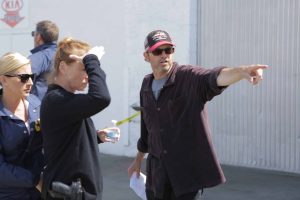
At the university where I teach film production, we have the RED One as well as several 7Ds. We have also developed a film course that allows our students to travel overseas for two weeks to shoot a short narrative film with a professor. In the past year and a half, I have taken a team of 12 students to Berlin and a team of 13 students to Tokyo.
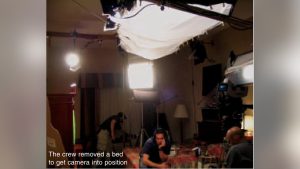
Our film East of Berlin is the story of a Vietnamese illegal immigrant who is forced to sell cigarettes on the black market. The Vietnamese population is the largest of all the Asian groups in Germany; many arrive in Berlin with the hopes of starting a better life. Because we were shooting in a run and gun style, using non-actors in the lead roles, we chose to shoot with the Canon 7D. It’s obviously a smaller camera that would allow us to be inconspicuous while giving us the quality we need. Much of the film was shot using a monopod, which supported the 7D with rail and follow-focus assistance. We had a second 7D to shoot B-roll around Berlin, whose geometric shapes make it a very photogenic city.
We were given access into the lives of many Vietnamese illegal immigrants who sell black market cigarettes around the train stations in Berlin. Nine of them lived together in a tiny, squalid apartment with only one official renter. With these types of situations, it would have been unrealistic to tell our story with a camera as lumbering as the RED.
On the other hand, when we traveled to Tokyo to shoot a quiet story called Persimmon, we chose to use the RED. It was no small feat packing up the camera (along with about twenty other pieces of lighting/grip equipment) and traveling overseas with 13 students. Since this was our third project in Japan, we felt comfortable raising the bar in terms of production value and image quality. The RED gave us the cleanest image, which was important for the lyrical story we were hoping to tell. The film is about a caregiver who learns that he can neither control how quickly a persimmon dries or how slow a man dies.
Many of our shots were locked down. If there was camera movement, it was in the form of a slow dolly. One of our scenes took place on the second story of a modern Japanese house. Our grip and electric crew had to carry the Fisher dolly up a steep set of stairs that was barely wider than the dolly itself. Thankfully, the homeowners allowed us to break custom and wear shoes in their house as the crew carried it back down those same stairs.
Since we were traveling far from home for both projects, we brought three hard drives with us. Our media was dumped onto the first drive as needed on location. At the end of each day, we would back up our dailies onto the other two drives. For extra security at the end of the shoot, we distributed those three drives to various crew members who were leaving on different flights back to Los Angeles.
The films were then edited back in the US. The workflow for both RED and 7D were very similar for us. ProRes 422 HQ files were brought into Final Cut Pro and then exported back out after picture-lock in the same format. Color was done at Local Hero Post in Santa Monica and output onto HDCAM stock for our festivals runs. Since HDCAM was the highest resolution our films would ever be screened in, we never had to go back to the original RED files to take advantage of the 2k or 4k resolution.
We live in an incredible time for telling visual stories. Shooting high quality images has never been more affordable. Now it’s up to you to decide which format is going to help tell your story in the most effective way. Ultimately, story is king, and we need to pick the right tools to serve the story.
Dean Yamada received his MFA from USC and is an associate professor at Biola University, where he specializes in production and post-production classes. “Jitensha” (www.jitenshamovie.com) has won multiple awards including Best of Fest at the Broadcast Educators Association Festival of Media Arts Festival of Media Arts (2010); Best of Show at the Imago Film Festival (2010); and Best Dramatic Short at the Windsong Film Festival (2010).
Related filmmaking guides
Keep learning filmmaking
Want more lessons like this? Join StudentFilmmakers free for live webinars with working pros, and stream on-demand filmmaking classes in cinematography, directing, screenwriting, sound and post.