By Zachary Steven Houp and Sean D. Gaston
When a class project in Sean Gaston’s TV and media classroom was budgeted at $10,000, students knew it was no ordinary film. The making of Misa’s Fugue.
When the cost of an ambitious class project in Sean Gaston’s TV/Media classroom is estimated at $10,000, students begin to realize they aren’t completing ordinary class work; they are creating a piece of art that is growing more vast and intricate by the day.
Misa’s Fugue is the first full-length documentary produced by Tiger TV Films, a fictitious class-based production company out of Fleetwood Area High School in Fleetwood, Pennsylvania. When it was released [April 2012], spectators witnessed a labor of love for nine faculty members in seven different departments, voluntary contributions from numerous industry professionals and five international organizations, and the efforts of more than 100 current and former high school students.
Frank “Misa” Grunwald, the subject of the documentary, was the keynote speaker at the 2010 Arthur and Rochelle Belfer Conference Education in Indianapolis, Indiana. Gaston, a fifteen-year veteran of the film industry who made the transition to teaching in 2007, was there to hear Grunwald’s tale.
“This was a truly extraordinary story of survival,” Gaston said. “When I heard it, the filmmaker inside me just took over.” Grunwald is a Czech native whose childhood was filled with the art and culture of early-twentieth century Prague. When the Nazis invaded, his entire family was transported through some of the most notorious concentration camps of World War II. In Auschwitz-Birkenau, Grunwald witnessed firsthand the selection process of the infamous Dr. Josef Mengele, but he was spared at the last minute because of an unlikely friendship with fellow prisoner and renowned artist Dina Babbit. Grunwald’s mother and older brother were not as fortunate. Grunwald and his father survived the war and emigrated to The United States, but both were haunted by the memories of Nazi cruelty for the rest of their lives. Gaston’s inner filmmaker imagined a collaborative film project uniting education professionals with active high school students to produce a meaningful work of art. Although Gaston is well-versed in both film production and Holocaust history, his first recourse after envisioning the project was to enlist Jennifer Goss, a colleague and Holocaust expert at Fleetwood Area High School. Because of Goss’s involvement in the education community, her participation was an essential component of the fundraising process.
“We want to create something for our students, for all students, for the Holocaust community, and for Frank,” Goss said. “We want people to see how a series of events in history completely disrupted the lives of a very normal family.”
The first step was to record Grunwald telling his story. Gaston and a small film crew consisting of Goss and director of photography James Hollenbaugh visited Grunwald in his Indiana home over Labor Day weekend of 2010. Using a JVC ProHD camera owned by the Fleetwood Area School District, the crew acquired more than five hours of narration detailing the Holocaust survivor’s life story. Gaston and his students translated those five hours into a 116-page transcript that was turned over to English teacher and screenwriter Zachary Houp.
“I literally destroyed the transcript, cutting it up and rearranging it on the floor of my office until there was no room to walk,” Houp said. “My carpet became the timeline for Frank Grunwald’s life story.”
Houp organized the screenplay into thirteen chapters divided by the most significant events in Grunwald’s life. Using free Celtx® screenwriting software, Gaston and Houp fashioned an audio/ video screenplay with visual information detailed on the left side of the page and audio on the right. Meanwhile, Goss undertook an ITS search for primary source documents related to Frank’s life; this permitted the filmmaking team to situate Grunwald’s personal story within a historical context.
“There really weren’t any defined pre-production, production, and post-production stages,” Gaston said. “Every day a new resource or idea would send the film in a whole new direction.”
As Grunwald’s narration developed the audio component of the screenplay, Gaston began to incorporate images and stock footage gathered from Holocaust archives such as the Steven Spielberg Film and Video Archive at the United States Holocaust Memorial Museum in Washington, D.C., Yad Vashem, The Auschwitz-Birkenau Museum, and USC Shoah Foundation. When existing imagery was missing, Gaston turned to Fleetwood students to fill in the gaps.
Fleetwood art teachers Diane Chisdak and Elaine Hilbert commissioned students to produce original artwork depicting important events Grunwald’s life. The final cut of the film will be a layered realization not only of one survivor’s story but also of how education and art can create meaning out of extreme tragedy.
Gaston, Goss, and Houp held roundtable discussions to identify the presiding themes of Grunwald’s life as well as the specific historical events relevant to his story.
“We had to identify the one thing that made Frank’s story unique,” Houp said. “That turned out to be how music and art enabled Frank to survive the atrocities of the Holocaust.”
A “fugue” is a type of musical composition that builds by adding layer after layer of instrumentation, but the term also possesses a clinical definition relating to a loss of identity or memory. The filmmakers stumbled on the latter denotation by accident.
“We want the film to visually depict a fugue,” Gaston said. “If you examine the parallels of Frank’s story, it’s like all these different melodies are woven together.”
Justin Reinert, a 2010 Fleetwood graduate with ancestry that includes both victims and a grandfather who was among the first to “discover” Auschwitz after the war, entered the project to compose fugue-like underscore for the film.
“The fact that [Frank] shares common ground with my ancestors makes it even more significant to me that I am a part of this project,” Reinert said.
While Gaston and his students edited Grunwald’s narration using Final Cut® Pro Studio and a bank of nine Macintosh® computers, Fleetwood music teachers Charles Ebersole, Catharine Williamson, and Sara Hughes rehearsed Reinert’s original music with students. Reinert then recorded the students’ performances and performed preliminary post-production sound mixing.
“I wanted to make sure this music tears at the heart, softens the soul, and provides relief and comfort at the right times,” Reinert said.
When principle photography concluded, Gaston returned to Indiana on two other occasions to acquire additional footage of Grunwald, his Holocaust-inspired artwork, and B-roll footage.
“We did lots of experimental one-light lighting to get some very dark, emotional shots that played with shadows,”
Fleetwood graduate Zachary Strine said. “We also got a lot of interesting shots that played with panning and focusing and close-ups of [Frank’s] hands.”
Gaston, Goss, and special effects artist Andrew Valentino also received special permission to film in The United State Holocaust Memorial Museum. Valentino, one more Fleetwood graduate enlisted to the project, is using Motion® to construct illustrated maps and other special effects involving student-produced artwork.
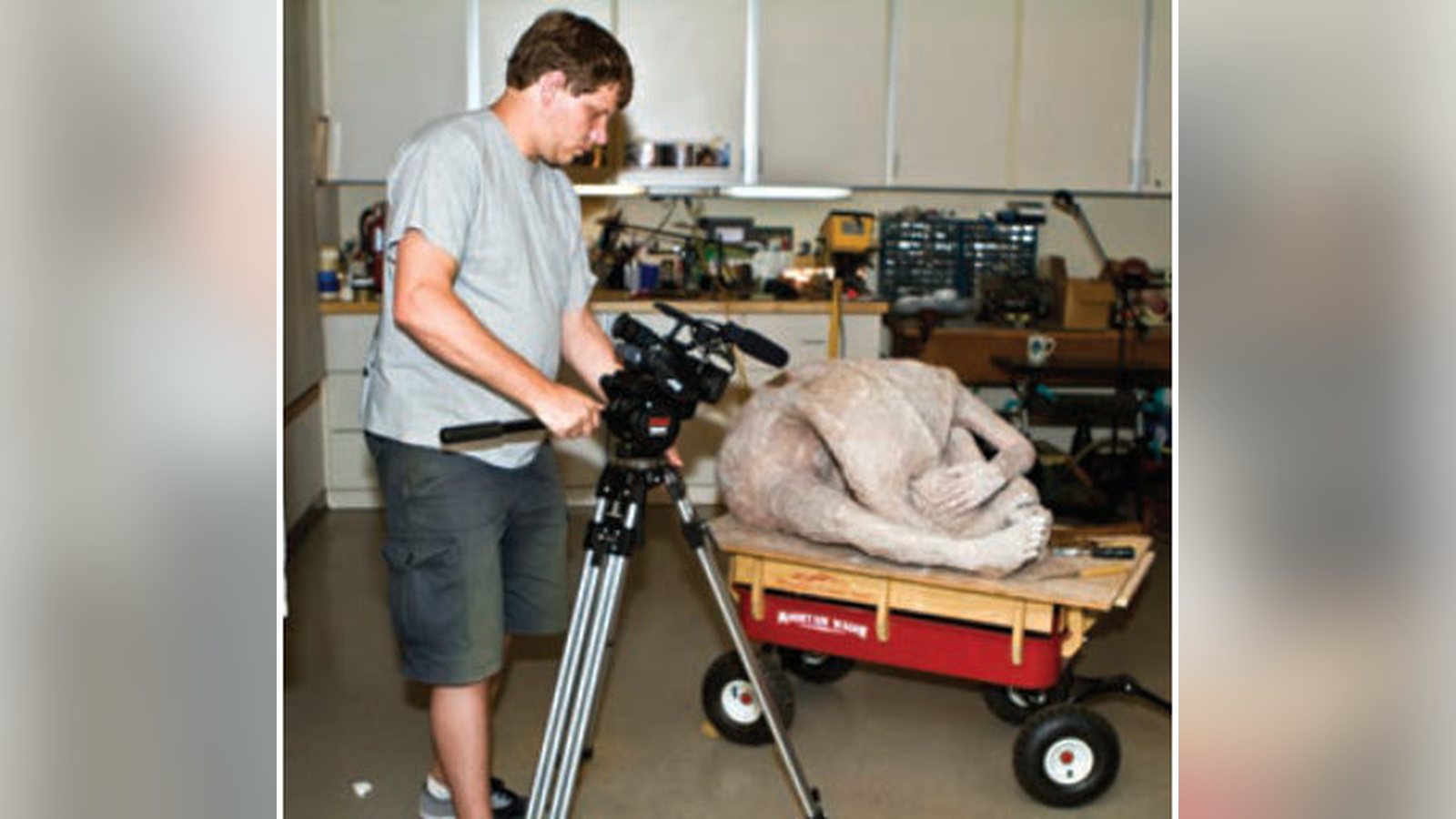
Apart from Grunwald’s expertise with an accordion, the artistic centerpiece of the film is a life-size female nude sculpted by Grunwald himself. Gaston and Strine shot the statue using an Indie-Dolly® to preserve the piece’s three-dimensionality. The form is bent in half, contorted, and painful to observe. The title of the piece, V-11071994, refers to the date that Grunwald’s mother Vilma and older brother John were sent to the gas chambers and murdered in Auschwitz-Birkenau.
As technology education teacher Sara Shelton prepared posters and a DVD jacket for the documentary, Gaston and Goss continued the rigorous fundraising needed for the $10,000 project. An early donation of $2,500 from The Jewish Federation of reading enabled the project to commence. While much of the existing technology and equipment was owned by the school, the district could not directly fund the project.
Alongside Valentino and professional editor Chad Haberstroh, Gaston polished a rough cut by posting completed footage on secure YouTube® pages and using Fleetwood students as a test audience for feedback.
The aggregate of this piecemeal process was refined by the premiere, when students, faculty, and historians witnessed the culmination of their efforts at Reading Area Community College’s Miller Center. The red carpet event commenced conjunction with a student art show at the nearby Goggleworks art complex. Misa’s Fugue then showed at the Goggleworks and will be screening at several universities and film festivals.
Misa’s Fugue is not merely a product of a school-wide passion for cinema or the determination to document the past; it will also be a permanent, personal account for Grunwald’s two children and five grandchildren.
“How cool would it be, and how much impact would it have, if a high school here in suburban Pennsylvania was able to document Frank’s amazing story so that one day his grandchildren could pop in a DVD and see and hear it right from the mouth of their grandfather,” Gaston said. “I want to do this for five kids I’ve never even met.”
At a time when the arts in Pennsylvania are threatened by excessive gubernatorial budget cuts, Gaston and his colleagues are providing students with a practical demonstration of how art and the real-world can operate in tandem. What’s more, the students seem to understand the unique opportunity they’ve been granted.
“We’ve learned about the Holocaust countless times in school, but you don’t get the full effect like hearing it from an actual victim,” Fleetwood senior Nicholas Ercoli said. “The film is accomplishing something much bigger than we think it is, and everyone who was able to be a part of it should know that it isn’t just some movie. It’s a life-changing experience.”
Educators interested in receiving a copy of “Misa’s Fugue” should follow www.fahsdocproject.com more information. The official film trailer is available for viewing on this site.
Sean Gaston, Director, Producer & Screenwriter. A fifteen year veteran of the film industry, Sean is in his fifth year of teaching Media & Communications at FAHS. A graduate of USHMM’s Belfer and Belfer “Next Step” programs, Sean co-teaches a course entitled, “The History of the Holocaust through Film & Literature,” with Jennifer Goss. Sean also produces the school’s weekly news show Tiger TV, with students in his TV/Media courses. He is also the Communication Director of the Pennsylvania Education Council. In 2011, Sean was named an Alfred J. Lerner Fellow with the Jewish Foundation for the Righteous.
Zachary Steven Houp, Screenwriter. Zach is a graduate of Kutztown University and has been teaching English at FAHS since 2004. Known for his creative and enthusiastic lesson delivery, Zach is also the co-advisor of the “Film Club” with Sean Gaston. In addition to teaching core English courses, Zach also teaches a course on Film Studies and is the advisor for the school newspaper, The Tiger Times. Outside of school, Zach has many hobbies including amateur theatre, reading and listening to film scores.
Related filmmaking guides
Keep learning filmmaking
Want more lessons like this? Join StudentFilmmakers free for live webinars with working pros, and stream on-demand filmmaking classes in cinematography, directing, screenwriting, sound and post.