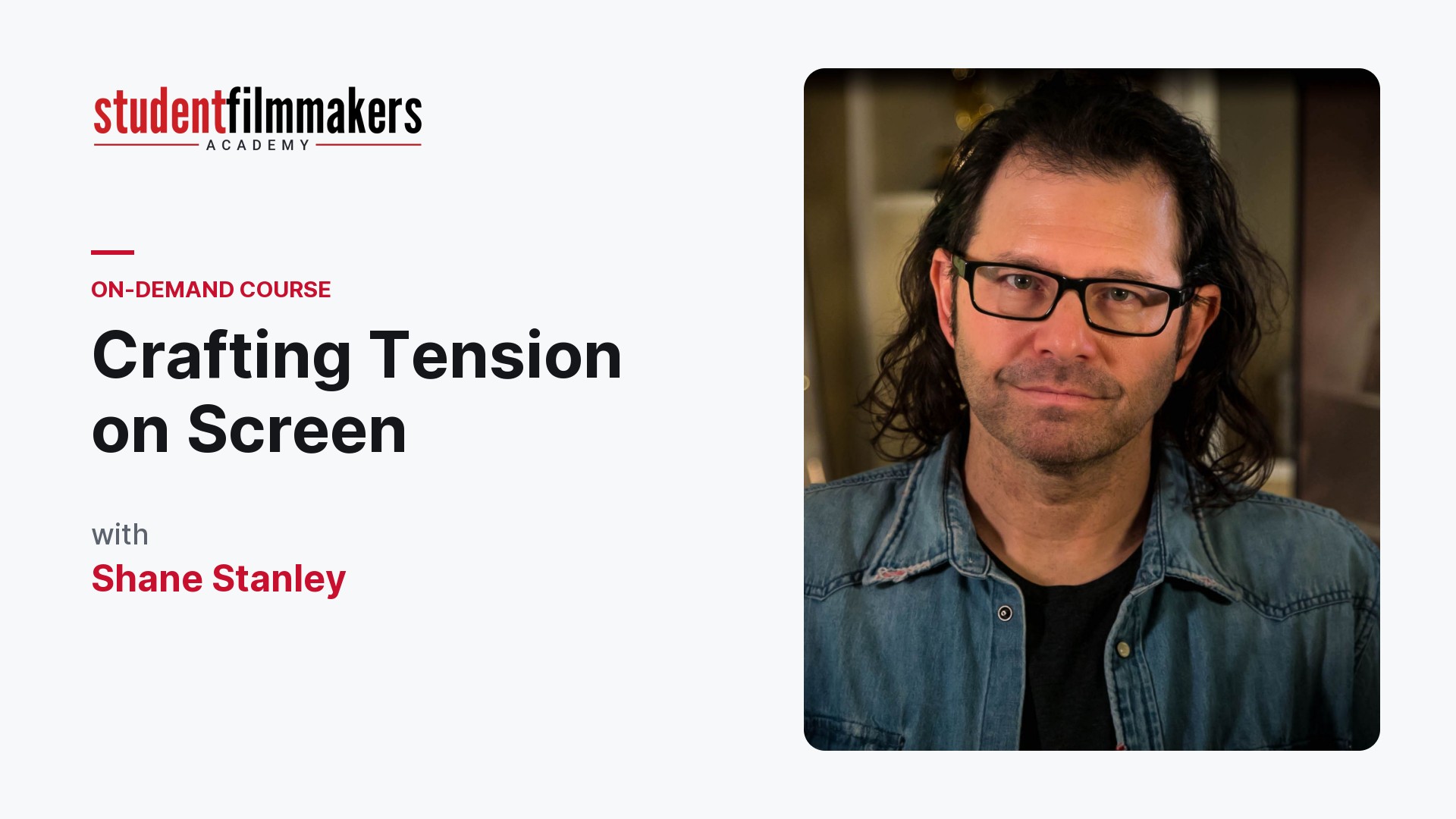
Shane Stanley, director of the action thriller Night Train and executive producer of Gridiron Gang, once found a perfect warehouse location that sat near an international airport, with a jet roaring past every five or ten minutes. Instead of giving it up, he rewrote the scenes around the planes. His class on building suspense comes down to that idea: tension is built in layers, from the page to the final mix, and the real skill is knowing which layer to leave out.
Where does tension on screen begin?
On the page. Stanley is developing a suspense thriller with producer Mario Kassar, whose credits include the Terminator and Rambo films. Kassar does his work in the script, and his notes are blunt: more jump moments, more scares, more tension. Before anyone talks about lenses, Stanley wants four answers for every scene: what is its purpose, who are the players, what happened just before, and where is it going.
The airport warehouse shows how far that thinking can stretch. The film he was four weeks from shooting had life-and-death choices in that location, a character deciding whether to stay free or go to prison for 25 years. The producers were furious about the noise. Stanley, who was also co-writing, told them the opposite: “You couldn’t ask for a better location. Think about the tension we can add with the airplanes.” The team went back and wrote the jets into the script, so a practical problem became a building block.
What actually makes an audience tense?
Not knowing. Stanley asked the class to remember a childhood car ride home after a parent promised a talk at home. For him that 30-minute drive was worse than the talk itself, and it had no DP, no score and no color grade. “I think a lot of what creates tension is the unknown.”
Stanley doubts Spielberg planned to keep the shark in Jaws hidden, but the unseen thing did the work. When Kim Welch raised Hitchcock’s bomb under the table, Stanley pointed to the same idea in Wells Root’s 1979 book Writing the Script, which calls it the dynamite under the couch: show the audience the lit fuse, then play an ordinary conversation, and they will watch it for half an hour.
How do you add layers without smothering the scene?
Stanley’s warning to newer filmmakers is that they over-layer. When he freelanced as an editor, he kept seeing directors ask for the same shortcut: the handheld point-of-view shot through the bushes, with heavy breathing added. He calls it the cheap go-to of old horror. His edit-bay saying: “Let’s not have bananas on bananas.” Once a point is made, move on.
He went through the layers he works with, and gave each one a test:
| Layer | The question Stanley asks |
|---|---|
| Script | Is the purpose of the scene clear before the shoot? |
| Lens and camera | Can a subtle move, or a shot through something, pull the viewer in? |
| Sound | Is there a ticking clock in the room? Do you add echo, or keep it dry? |
| Music | Does the score push the emotion, or step on the actors? |
| Color | What mood can the grade add on top of what the DP shot? |
| Cutting | Where should we not cut at all? |
The music row came from a real moment. His composers scored a six-minute scene between two actors in a house, a scene he had always kept dry in his cut. The new cue was beautiful, and everyone who watched it said to take it out, because it buried what the actors and the blocking were already doing.
For shooting through things, he pointed to the open stairs leading down to the bunker in 10 Cloverfield Lane, Dan Trachtenberg’s film made for about $15 million. You can see through each step, and the framing of the staircase becomes part of the dread. His bigger rule is to never let the audience off the hook. And to find a fresh way in, he still uses the advice of his high school drama teacher, Phil Patrick: come up with three ways to do something, then go with the fourth.
How did Night Train raise the stakes?
Stanley likes to flip old Hal Needham action films: put the woman behind the wheel and let the man ride shotgun. In Night Train, written by CJ Walley, a single mother has a son with cystic fibrosis. Keeping him alive costs $35,000 a year, she has no insurance, and she relies on black-market medicine. She is a land-speed motorcycle racer, she is chasing union hours in a gig economy, and she drives a souped-up dually truck with 680 horsepower that cruises at 160 miles an hour and makes the run from Las Vegas to Palm Springs in an hour and a half.
Then the supply dries up and a federal agent starts tracking her. Every new layer, her estranged father, the agent’s own demons, a promise of care for her son across the Mexican border, tightens the screws. For the chase, the obstacles grow out of the story: Baja trucks that can jump 20 to 40 feet, a desert train two miles long, and a border her truck cannot cross. That beats the old order to blow something up every five minutes.
That same rule shapes how he reads thrillers sent to him. The most common flaw is a hero who reaches each new level without breaking a sweat. “It’s very important that in your hero’s journey that people are not handing your star kitchen passes to get to the next level.”
Why does the diner scene work with almost no music?
The scene Stanley considers the most tense in the film is two women talking. The agent sits down with his lead, fresh out of the hospital after a real 275-mile-an-hour motorcycle wreck, in a nod to the diner scene in Heat. The only music is what might play over the restaurant speakers.
“It’s not about goofy camera moves. It’s not about bells and whistles.”
What carries it is the stirring of a coffee cup, the eyes moving from the cup to the other woman, and an offered stick of gum that she refuses. The music comes in hard only when the scene ends. He said the same trust in actors shaped a mother-and-daughter reunion in his newer film Six Days in Evergreen, with Penelope Ann Miller and Dawn Olivieri.
When should an editor speed up, and when should they wait?
A student asked whether you speed up or slow down the cutting for a tense moment. Stanley said there are no rules, and gave the interrogation scene in Basic Instinct as an example. The shots hold and hold, Wayne Knight sweats, and the cutting only quickens as Sharon Stone takes control. “It wasn’t cut, cut, cut, cut, cut, breathe. It was breathe, breathe, breathe, boom, boom, boom.”
He pushes back on the habit of cutting every three seconds, which can crush suspense, and suggests staying on an actor a beat after they finish talking. He cuts his scenes fat first, then asks whether the scene has overstayed its welcome. He treats each one like a drum solo by Neil Peart: it starts so quietly you barely hear the snare, and it builds to a crescendo. For more on rhythm in the timeline, see this beginner’s guide to editing and pacing.
Can you wear an audience out?
Yes, and Stanley cut his own favorite sequence to avoid it. Six Days in Evergreen opens with a concert in an arena with 7,000 extras, a big, expensive day. At the second screening he saw that people had not come to sit through a concert. He cut most of it, 70 to 80 percent by his own count, and intercut it with other story, so the opening moves.
He brought up the latest Mission: Impossible as the other side of the coin: the train sequence was thrilling the first few times and then went on long enough that his wife fell asleep and woke up to find it still going. In his action-film years, he said, a film had to land between 88 and 95 minutes. Giving the audience a breath is part of building tension, not a break from it.
A place to start this week
Stanley’s closing advice was to open the old scripts sitting on a forgotten hard drive and reread them with what you now know. Six Days in Evergreen started as an idea in 2004. If you want more devices to test on those pages, try these 26 tricks for adding layers of suspense, and for the lens side of the table above, the lens selection class with Nancy Schreiber, ASC, whom Stanley recommended.
In the full class, Stanley also covers writing a character’s inner struggle, the books he recommends to every filmmaker, and why he looks for flawed characters.