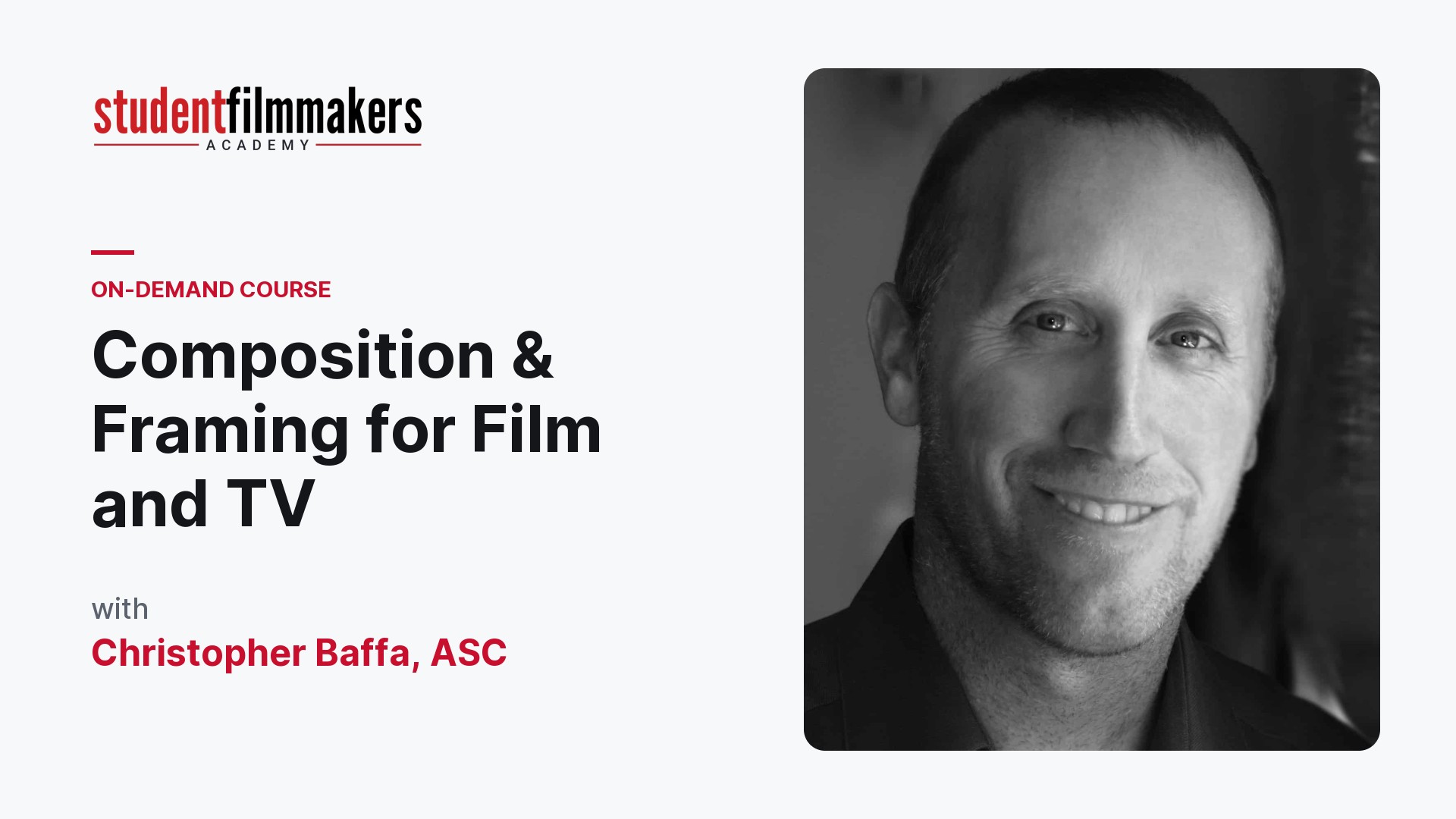
Christopher Baffa, ASC, who shot Glee, Nip/Tuck, Krypton and the American Horror Story pilot, frames every shot by asking how it should feel, then finding the empty space, edges and props that make that feeling land. For a composition and framing class with StudentFilmmakers, he put up frames from his own shows, drew lines and circles over them, and admitted which ones he would now recompose.
Is the rule of thirds a rule?
Not to Baffa. He opened by telling the class that what they were about to see were his own choices, not the correct ones, and he gave the thirds grid a softer job:
“I like to think of rules as a place to start so that you know how to break them.”
His first slides were still photographs he took himself: a sun pushed to the far right so the clouds get the left, a boat tucked in the lower right corner, an old wagon in the snow. Then came a house from Game of Silence, shot from the street below so it filled the upper third and looked daunting, with light added to the trees on the left to fill the other side.
The word he kept coming back to was feel. Some of composition is technical, he said, but a lot of it is what felt right on the day.
What does empty space say about a character?
Quite a lot. A very depressed character sits at the edge of frame with nothing but negative space beside him, and the space reads as his mood. A young woman placed low and to one side, under a huge window full of blowing snow, looks pressed down by the room. Baffa called that an emotional oppression.
On the American Horror Story pilot, he and director Ryan Murphy chose to put the actors at the bottom of the frame and give the top to the house and a light above them. It felt a little unsettling and ominous, which was the point for that show.
What does it mean to “reach for” or “hold” something?
These two words came up so often that a member, Dwight Williams, asked for a definition. Both mean including it. If a stair rail is where the murder happened, Baffa might ask the actor to stay near it, or move the actor’s mark so the frame can take in the rail.
“Holding and reaching just mean, keep it alive within the frame, keep it as part of the frame, because it’s telling a story.”
In a church scene, his crew reached up for the hanging lights, the top of a window and a sconce. He joked that a religious person would call it composing high for God, an architect would want the window, and the gaffer who climbed a rickety ladder to change all those bulbs would want them seen.
Holding works at the bottom of the frame, too. In a Running with Scissors master, he kept Alec Baldwin’s feet and Annette Bening’s chair in the shot. In a wide kitchen frame, he kept the sink and the actress’s hand. Without those anchors, things seem to float, which he finds a little disconcerting.
When should a shot be balanced?
When the story is about two forces in opposition, Baffa likes to give each side its own weight. A post on Crossbones in Puerto Rico (luckily movable) rounds out one side. On Krypton, a black Lucite floor gave a mirror image of a man, and he and his operator framed low to keep that reflection rather than reach for the ceiling.
He also showed the hardest balancing job of his career. When he took over season two of The Mysterious Benedict Society, the show was already centered in a symmetrical, Wes Anderson style, in a 2.35 widescreen frame. That leaves a lot of empty width on both sides. He and his operator, Ben Speck, filled it by moving furniture and lamps all day, and Baffa apologized to every art department person listening. On one scary scene, he moved a lamp and a chair about 70 or 80 times each.
How do you frame an over-the-shoulder?
Baffa watches three things: the size of the subject’s head, how much shoulder is in the foreground, and the eye line, which sets the gap between the two. His usual spot for the foreground shoulder cuts that person roughly in half. Then he showed the far end of the range:
“This is an extremely tight over the shoulder, where the shoulder, the woman’s head that he’s looking at, is literally infringing upon his own face. That to me emotionally is very evocative.”
Any closer and her head would block his right eye. In a scene where a doctor tells a man he has a brain tumor, Baffa went the other way: a very wide eye line, a lot of distance between them, and the scan of the tumor hanging in the gap. “To me, the distance between the heads is oftentimes a very emotional thing,” he said. In another pair of characters, the eye line starts wide and tightens over later scenes as their relationship grows.
What is short-siding, and when does it work?
A short-sided actor faces the closer frame edge, so the open space sits behind the head. Baffa uses it selectively because it asks the audience to work, and he does not want them working too hard. In one frame, a man left on the right side of his foyer stays put while his wife slips in behind him, so the frame traps him with her. In another, a woman turns away from a man and has a private moment:
“That to me is fun that we get to see something that the other character doesn’t.”
He also showed what he calls a triple over: one actor in the middle of three looks back over her shoulder to one person, to another, and to a computer screen, covering three directions in one setup.
Baffa’s framing words, in one place
| Term | What he means |
|---|---|
| Reaching / holding | Keeping an object, prop or edge of set in frame on purpose |
| Convergence | Lines in the set that run toward the subject and show depth |
| Corners | Shooting into a corner of the room so the frame does not go flat |
| Short-siding | Facing the closer frame edge, open space behind the head |
| Triple over | One actor turning between three directions inside one shot |
| Fat | A frame with loose area around it that needs trimming |
He ended the slides with foreground, a couch rising around a trapped character “like rising water,” and a frame within a frame, shooting through a window or doorway whenever he can. For more on that last idea, see Framing Your Shots as a Visual Device.
Zoom lens or primes for composing?
Both, depending on the job. On episodic schedules he leans on zooms, because he can tell an operator to come in three millimeters when a frame looks fat, and he described fat as the loose area you trim off a piece of meat before it hits the grill. Primes bring a discipline he likes: you find the spot with a viewfinder, tape your foot, and bring the dolly over, instead of asking the crew to move gear 20 times. There is more on that choice in Zoom Lenses vs. Prime Lenses.
Tight is not always right. On the first emotional dance scene of Glee, Ryan Murphy wanted a close-up, and Steadicam operator Andrew Mitchell chased the actress around until it was a blur. Baffa asked the choreographer to build in a beat where she stopped, so the camera could get in close for the emotion.
What filmmakers asked in the class
- Cutting between sizes: keep the subject in about the same spot in the wide and the closer shot so the eye isn’t jerked across the screen, unless that jolt is the point of a violent moment.
- Centered student framing: his film school friend Matt Jacobson sees students centering more after years on video calls. Baffa thinks the final screen, phones included, belongs in every framing decision, and recalled protecting shots for 1.33, 1.85 and 16:9 at once.
- Handheld: he thinks it is overused as a stand-in for energy, and points to Emmanuel Lubezki’s close handheld work in The Revenant as a case where the intimacy was the whole aim.
- Car interiors: he loves hostess tray shots and backovers, shot over the shoulders from the back seat.
Under all of it is one test. If he can’t say what a frame is telling the audience, he doesn’t shoot it, and the meaning should reach viewers almost without their noticing. For a different angle on the same craft, read It Ain’t Rocket Science: Composition Is Brain Surgery.