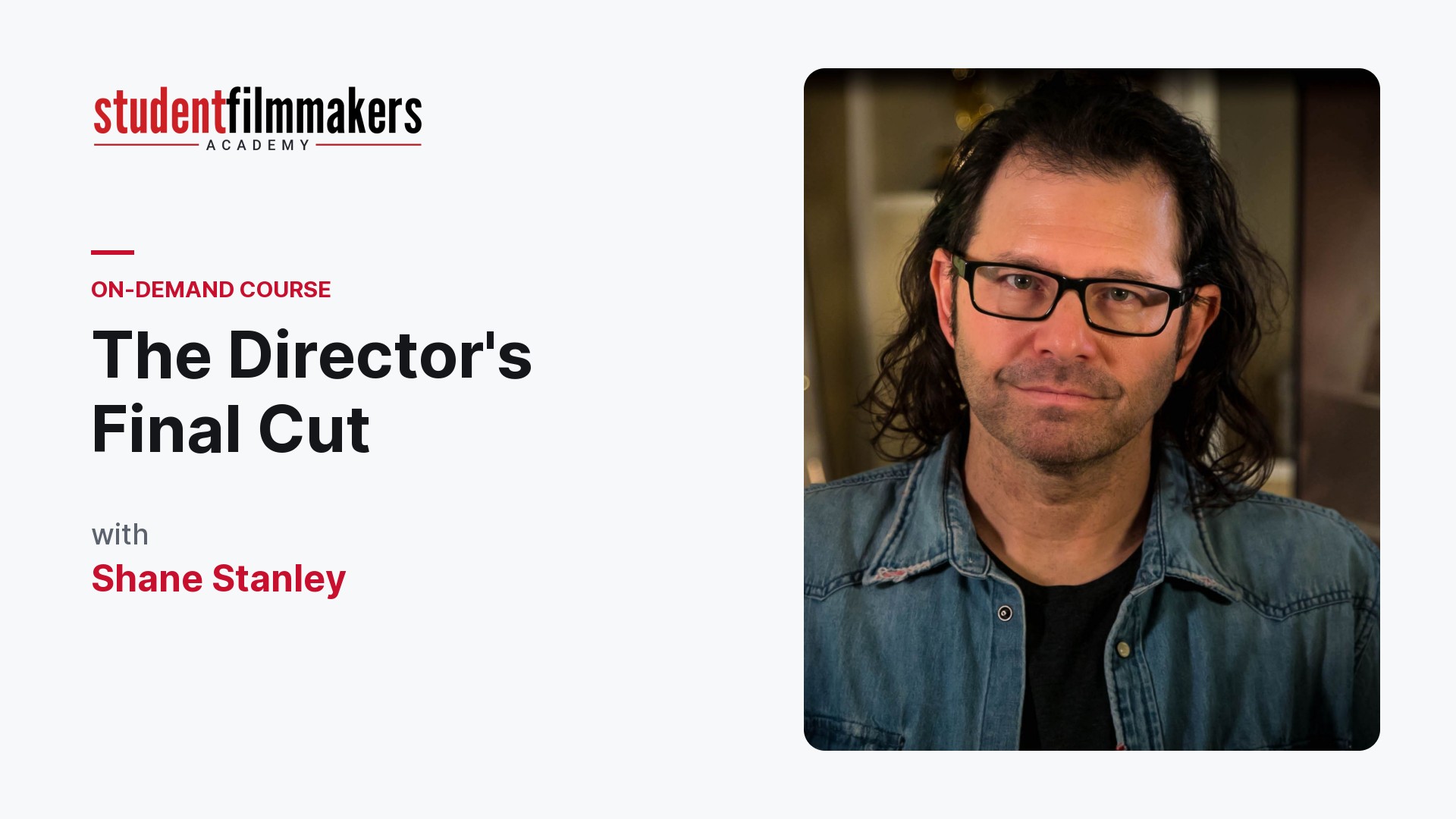
An executive producer on Sony’s Gridiron Gang and an Emmy winner, Shane Stanley has cut films for hire, for himself and for distributors. In a StudentFilmmakers class on the director’s final cut, he explained who controls a film after the wrap, how test screenings can keep a director in the edit room or push them out, and how a director can protect the cut.
What happens to the footage while you are still shooting?
On a properly run show, the editor assembles dailies as they arrive, usually two to four days behind the camera. That is not only about saving time. It is the director’s early-warning system. Stanley’s example: on a Showtime film he produced, the editors called during the shoot to say an actor’s tie created moiré, the shimmering pattern that can make a film fail quality control. They reshot the whole day. Had nobody looked until after the wrap, it could have been far worse, since the actor wore ties all through the film.
On his film Six Days in Evergreen, he had an assistant editor checking dailies and an editor assembling, and he checked in every day: any problems with focus, cinematography, anything that stands out?
What is the director’s cut, exactly?
When shooting ends, a director under a typical directors’ agreement gets a set period, which Stanley said can run from about six to twelve weeks, to work with the editor: choosing takes, asking to hold a shot longer, pointing to an alternate angle shot for a specific moment. After that, the producers, the studio or the distributor can take over.
And there are more versions than most people think:
“There’s the assembly edit, there’s the cut, the director’s cut, the producer’s cut, and then we got comment cards, we’re gonna recut it again.”
The fix-it-in-post stage, he said, is like finishing a chair: it may look good, but the edges still need sanding, staining and wax before it can be sold.
How do test screenings decide who keeps the cut?
Studios recruit 200 to 300 people for a free screening, take their phones, and hand out comment cards several pages long: rate the film, the pacing, favorite and least favorite scenes and actors, would you tell a friend?
If the director’s cut scores well, the studio wants that director to keep going. That is what happened on Gridiron Gang. The first assembly ran over three hours; the release was a little over two. The film scored so high in its three test screenings that producer Neal Moritz called it rare, and director Phil Joanou stayed on through picture lock. If the numbers are poor, Stanley said, the studio is watching the clock until the director’s period ends.
He has been on the other side. Hired as an editor, he had grown close to a director, as editors do after weeks of 12- to 14-hour days. When the director’s period ended, the producers told him they wanted an entirely different movie and would start from frame one. They kept him on about 12 more weeks. He rated the director’s cut a solid seven out of ten. The producers’ version was bad enough that he asked to have his name taken off.
What do producers change in the edit?
Good producers should never need to tell an editor to cut from a master to a close-up, he said. When they step in, it is usually about structure: the villain is revealed too early, two scenes play better in the opposite order from the script, a reveal tips its hand. His guiding rule for thrillers:
“You never want your audience to be ahead of the characters because then the audience gets bored and they check out.”
He pointed to Jaws, where the shark stays hidden for much of the film, and asked the class to imagine what would have happened if someone had overruled that choice.
How does a director look for hidden footage?
Two examples from his own cuts:
- On Gridiron Gang, a transition in a scene where Dwayne Johnson’s character turns a troubled player away from the team was not working. Stanley reminded Joanou how often he kept the cameras rolling and sent the actors back to one between takes, and bet that the actor’s dejected walk back was somewhere in that footage. The next day Joanou called: it was there.
- On Six Days in Evergreen, he wanted body language instead of a close-up during a tense roadside talk, shot handheld while racing the light in a canyon. He found the right moment in a different part of the scene, from a take where the actor was simply listening to his direction, and it cut far better.
The lesson: the gutters of your footage, between “cut” and “action,” can save a scene.
How do you see your own cut fresh again?
A filmmaker asked how he keeps perspective after weeks in the edit bay. His answer: export the cut, upload a private link, and watch it on a different screen in a different room.
“When you watch your movie that you’ve been working on for six weeks in a different room on a different screen, it’s like seeing it for the first time.”
He does not stop to write notes, because that breaks the flow. He starts a stopwatch with the film and taps a mark whenever something bothers him, say at 13 minutes and 12 seconds, then goes back to the edit bay with a list of times. It is the same reason music engineers play a mix in the car, on a phone and on a home stereo.
For small screenings, he suggests renting a screening room for a couple of hundred dollars, inviting 30 or 40 people with no stake in the film, and not grilling them:
“Let the movie play and stand in the back of the room and watch the heads.”
When people start to squirm, you have found your long scene.
Who gets final cut?
It comes down to reputation and the contract. Directors like Martin Scorsese, Steven Spielberg and Michael Bay have final cut written into their deals. Others earn the studio’s trust with results. He admires filmmakers like Mike Figgis who cut their own work. A director can negotiate for the final say, he agreed when Kim Welch asked about it, and he left the class with a line he learned the hard way: “You never get what you deserve. You get what you negotiate.”
On union films, know the rules about who touches the controls. When Joanou grabbed a camera from an operator to nail a tough football shot in one take, the camera local sent a penalty hire to sit on set the next day reading a magazine. On a studio film Stanley cut, a co-producer making edits at his station was reported to the editors’ union, and it never happened again.
How do you keep egos out of the edit room?
He once kept a sign in his edit bay reading “no weapons allowed,” and has broken up fights and dodged a phone thrown at his head. Tempers run hot, he said, partly because, in a saying he credited to Ron Howard, every film will find a way to break your heart. The protection is choosing the right partner. His test for a new editor:
“Go out to a movie with an editor that you’re thinking about hiring and then go out to dinner or lunch afterward and have a conversation.”
Talk about style and pace before the shoot, involve your post team early, and stay open to an editor who shows you something you did not plan. And when the clock or the money runs out, accept what Stanley called an old saying: films are never finished, only abandoned.
Related reading: collaborating with your editor, the stages of an edit and how to deliver them and why editing is every filmmaker’s secret weapon. The full class also covers streaming deals, short-film budgets and whether to write to a budget.