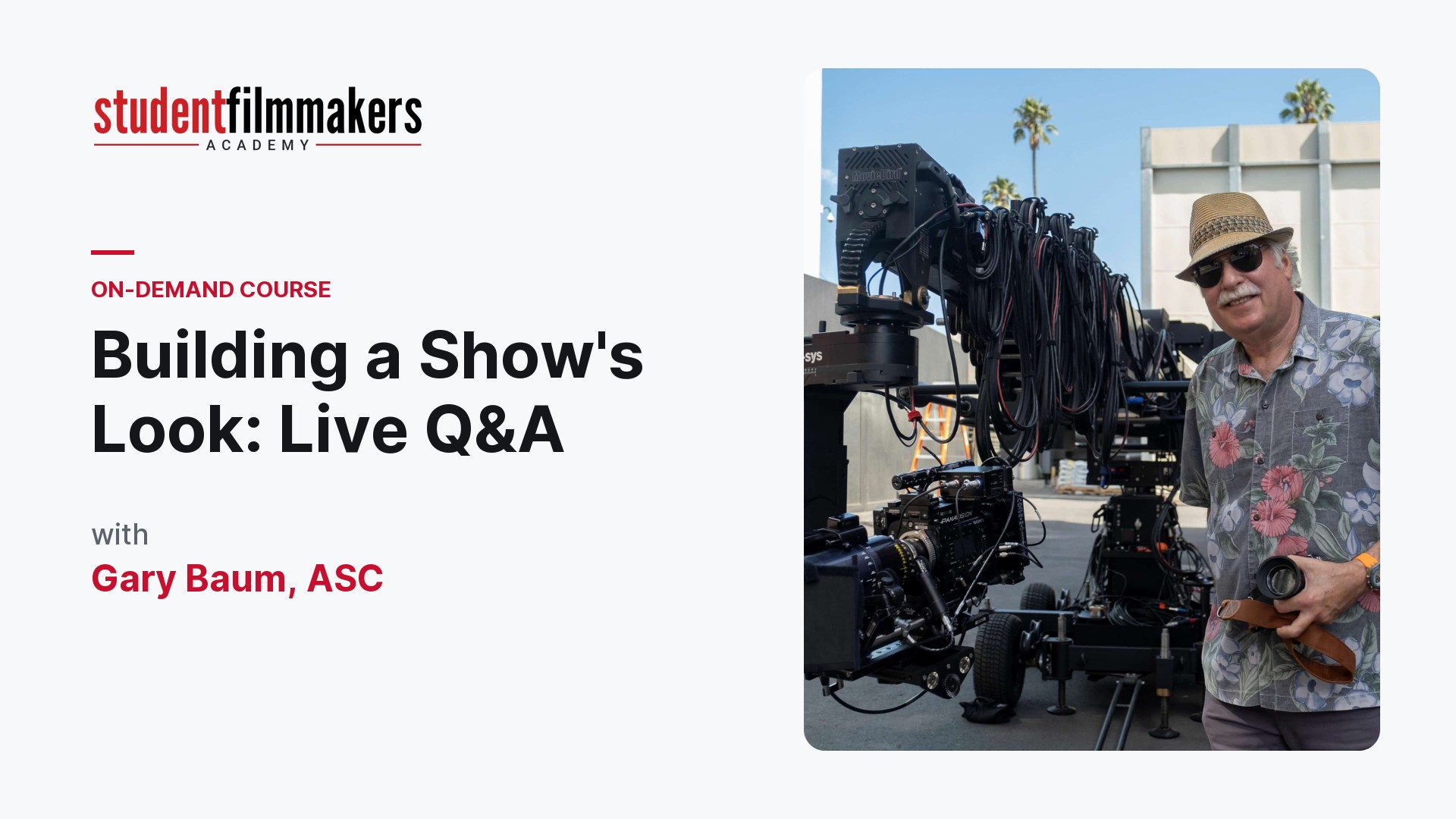
Gary Baum, ASC, has won four Primetime Emmys for cinematography, for Mike & Molly, the Will & Grace revival and two for How I Met Your Father. Taking live questions from StudentFilmmakers members, he explained how a TV show’s look is settled before a light goes up, and why he thinks listening and staying calm matter as much as any lighting skill.
Baum works mostly in multi-camera comedy, shot on stages with several cameras rolling at once in front of an audience. That world has changed, he said, and most of his answers came back to the same thing: a show’s look is built by a group of departments, and the cinematographer’s job is to keep them pulling in one direction.
Who decides what a TV show looks like?
It begins with the showrunner and the studio, and with one department that is there before almost everyone else:
“The first person would be the production designer. So they usually get on board well before anybody else.”
By the time the director of photography is hired, the designer often has plans and models. Baum says everyone needs to agree early on a set of limits for the look, knowing that scripts will move the show into new places and the look will move with them. He has joined series after someone else shot the pilot and watched the look shift a lot at that point. It is the showrunner’s show, he said, so you serve it.
What about lookbooks? He has made some, but finds them limiting. Often the producers already have a picture in mind; sometimes they honestly do not. He passed on a story about a cinematographer whose reel was dismissed because the producers could not see their show in it. The reply: of course not, the show has not been shot yet.
How did How I Met Your Father get its look?
The producers came from This Is Us, a single-camera drama, and this was their first sitcom. They wanted something that was not a traditional sitcom: a drama look with a comedy flavor, a hybrid of multi-camera and single-camera styles. Baum remembers one producer’s note with pleasure: “Gary, you can’t make it dark enough for us.”
That fits a wider trend he described. Showrunners no longer want the three-set rotation of a 1970s sitcom like The Mary Tyler Moore Show. Even multi-camera shows want the polish of a single-camera series like Modern Family, and single-camera shows now run two or three cameras. In drama, he said, there is no longer a line between TV and features.
How much light does a digital TV stage need?
A lot less than it did on film. With film stocks topping out around 400 ASA, he keyed faces at 25 to 40 foot-candles. Shooting log on today’s cameras, roughly three times as sensitive, he keys at about 11 or 12 foot-candles for a stop of around T4.
“You don’t use three times less lights, you just use less intensity.”
On his stages the big units are still incandescent, hung about 20 feet from the actors, with LEDs added for car interiors, small units and lights built into the set. He said the LEDs of a few years ago had color shift from unit to unit, but the last three or four years have been a huge leap. He has not shot film in about 16 or 17 years and says he misses some things, but likes seeing exactly what he is getting.
Crews have not shrunk with digital. They have grown: a digital imaging technician and a video controller handling on-set color joined the camera team. His last show ran four dollies with operators, assistants and dolly grips; others run two pedestals and two dollies. Multi-camera comedy has no dailies in his world. He sees an online rough cut, then sets the final look himself in the color session.
What does Gary Baum look for in a crew?
A filmmaker in London asked what clients look for in a DP. Baum answered with what he looks for in his own people:
“I look for character. I look for people of stand up honor.”
The work matters, he said, but more important is how someone gets along with and treats the other departments: wardrobe, sound, paint. His core crew has been with him for close to 18 years, which gives productions a team that does not need hand feeding. That saves time and money and lets writers and producers stay out of things that are not their job.
With script supervisors, his rule is open communication both ways, and if someone needs to fix something before a take, they fix it, because the camera does not roll until he says so.
How do you stay calm when a shoot goes wrong?
An actor turned writer-director asked about fear. Baum’s answer came from John Flynn, ASC, a tough, old-school cinematographer he assisted, who came up on Gunsmoke. On Magnum, P.I. in Hawaii, facing a sequence with a helicopter, water and four cameras, Baum told Flynn he would have to figure it out. Flynn told him never to let them see him sweat.
“If the DP panics, the rest of the crew panics.”
The scariest job of his career was his first as a director of photography: the last season of the original Will & Grace, carrying forward seven seasons of an established look. After day one, he said, it was just “the fear of fear itself.” When the sun shifts and a scene has to be turned around, you just do it. He also keeps a line a production designer once gave him: they don’t pay us to say no.
How did he get into the business?
In high school he came off the subway and found William Friedkin’s crew shooting the elevated-train chase for The French Connection. He and a friend stayed and watched for two or three days. Later he moved to Los Angeles, worked in the electronics department at Panavision, then took a film loader job at Lorimar at MGM and moved up the old way. As a camera assistant he worked on action series like MacGyver and Jake and the Fat Man, and was an assistant on the first two seasons of Friends. He landed in multi-camera comedy by accident, filling in for Tony Askins, ASC, and found a set where everyone laughed all day. He stayed.
For a new camera operator, his advice was practical: learn the equipment, take a job such as camera PA, go help out at a rental prep house, and read American Cinematographer. For job interviews: research the people first, then mostly listen, a bit like a detective.
Small things a DP can fix with the art department
Sets shape a show’s look within hours, he said. Some sets have texture and character; a small kitchen with white walls does not. He once saw a yellow wall read as green on camera, showed the production designer, and the designer chose a red-based yellow instead. Not every set is meant to be beautiful, he added. A dumpy apartment is a dumpy apartment, and your job is to make it look as intended.
He closed with the attitude he has come to embrace: be positive, include every department, and give people the confidence to do their own jobs, because “everybody can smell fear.”
More reading: shooting a sitcom in one day, job advice for first and second ACs and what works in TV and why. The full class has the rest of the questions, including his memories of working with director James Burrows and production designer John Shaffner on Friends.