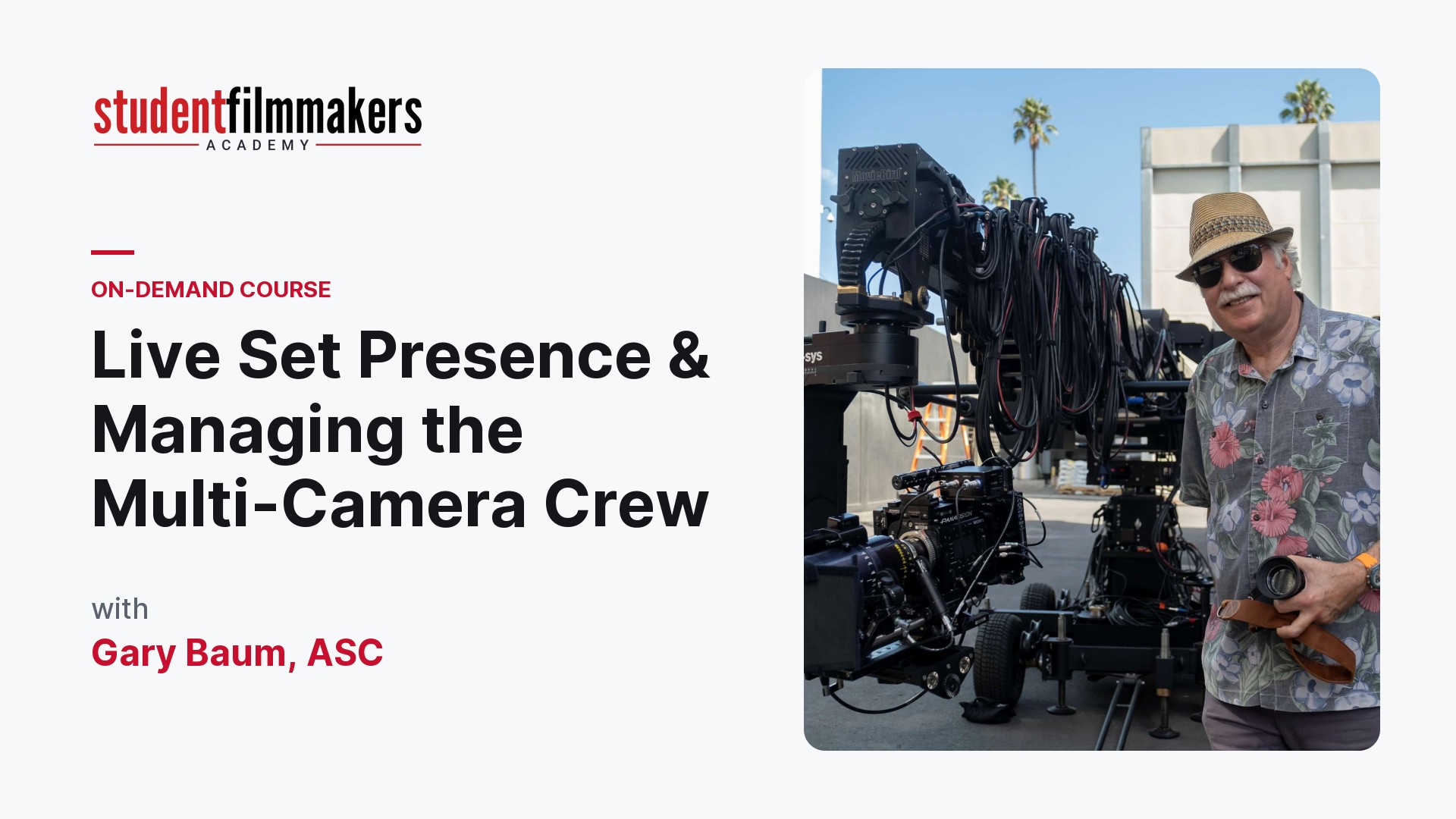
Gary Baum, ASC, is the director of photography on Happy’s Place and the Frasier revival, and he won four Emmys for Mike & Molly, Will & Grace and How I Met Your Father. His core lesson on multi-camera production: everything is rehearsed so a recording night can flow without stopping, and a cinematographer runs that floor by trusting a big crew to think for itself. He shared how it works in a live class with StudentFilmmakers.
Who is on the floor of a four-camera sitcom?
A single-camera show might carry one or two camera crews. On Happy’s Place, the NBC comedy starring Reba McEntire, Baum lists four dollies and everyone who goes with them:
| Role | How many |
|---|---|
| Camera operators | 4 |
| Camera assistants (on the dolly, pulling focus by hand) | 4 |
| Dolly grips | 4 |
| Camera utilities | 2 |
| Second assistant | 1 |
| Video controller | 1 |
| Digital imaging technician | 1 |
That is before electricians, grips and the sound team, all sharing one stage in front of an audience. Some shows swap dollies for pedestals on the side cameras, where one operator focuses, zooms, frames and moves the pedestal alone. Baum has tried it and says he does not know how they do it.
How are the four cameras assigned?
The director sets the shots. On Happy’s Place that is Pamela Fryman, working with a camera coordinator, a DGA position, who breaks down the script with the operators. The two wing cameras on the sides usually take singles and overs. The two middle cameras handle movement, masters and submasters.
In a three-minute scene a single camera can hit ten different marks, sliding from a two-shot to a four-person master five feet away and back again, on line cues or on actors’ moves. A switcher cuts the four feeds live onto a big screen so the director, showrunners and writers can see the episode take shape and ask for a missing shot.
“It’s basically like a Broadway show, but we’re shooting it with a camera.”
That only works because of rehearsal. The company rehearses on camera and shoots an extra day before the audience show, then rehearses again on the day. A typical episode has twelve or more scenes, and every operator writes down each assignment to repeat it later, even after new pages arrive.
What happens when something breaks on recording night?
You keep going. Baum told the story of moving up to DP on Will & Grace under director James Burrows:
“Jimmy, I lost the lamp. He goes, well, if you fix it, is it gonna make it any funnier? I go, no. He goes, okay, let’s go.”
It was an architectural light in the background, nothing on a face. He now waits for a break between scenes to replace a lamp like that. A key light on an actor is different. And when an actor ends up ten feet from a mark, the gaffer, the board operator, the key grip and the assistants all adjust at once.
He calls these on-the-fly changes the fun part. Multi-camera is built for change, he says, unlike single camera, where a new blocking can mean ripping out a setup.
How do you light a sitcom from the grid?
Almost everything hangs overhead. Only about 10 to 12 percent of his package is LED. Incandescent Fresnels can throw 20 to 25 feet from the grid, and LEDs that match that are very expensive. Even at Universal, which would like more LEDs, the studio owns a lot of incandescent fixtures. LEDs go into background and architectural lighting and the Obie lights on the cameras.
Levels sit on a board: one light at 80 percent, another at 90, another at 75, whatever the exposure calls for, and the gaffer and board operator call audibles together during the show. Baum shoots log with the LUT on the floor monitors, so the director and showrunners see something close to the final image, and he still uses his meter for backings and backgrounds. Our piece Exposure: Why Still Use a Light Meter? covers that habit.
Sound is the constant dance. The sound department works almost entirely with booms, from the green beds above or on big perambulators on the floor, and the booms come from the same place as the lights. Gaffers leave lanes for the mics, which helps until the blocking changes and an actor goes left, then right, then sits.
How does a DP manage a crew that size?
Not by radio. “My crew doesn’t want me on a walkie-talkie,” he says. He would rather step away from the monitors, walk the floor and talk to people face to face, and every new camera person gets a talk about how the show works.
The lesson he learned over the years is to keep people engaged. He and his gaffer discuss how a scene will be lit, but he does not place every lamp: “I want my crew to think for themselves.” The same goes for operators and framing. He speaks up only when someone is shooting off the set or missing something, and suggestions are welcome, even when one has to wait because it will not cut with the next shot.
Why put the same lens and filter on every camera?
Consistency. Baum’s cameras are Sony Venice bodies from Panavision, after years on Sony F55s, and each carries the same Primo 11:1 zoom. Directors do not want to decide which camera gets which lens, so all four match. He saves specialty lenses for the rare extra-wide shot.
The same rule applies to diffusion. On Happy’s Place he uses a Schneider Radiant Soft. In single camera you can change filters per shot; in multi-camera, a halo on one actor’s close-up would vanish when the switcher cuts to the wide. He checks all four filters in prep, because batches from the factory do not always match, and runs lens tests to be sure. For older actors he adds a bit more light, watches shadows, works with makeup and uses only a little filtration, because heavy filtering draws the eye to the filter.
Does 4K change the look of a classic show?
The Frasier revival had to feel like Frasier, but Baum says matching a show from 30 years ago would be impossible even on film, because lenses and lighting have changed. Streaming partners require 4K, and the Venice will not record less. He likes it: instead of holding the image within two stops, he can work with a range of about eight.
Running time shapes the edit too. A network episode is 21 minutes and 40 seconds. On How I Met Your Father episodes ran 35 to 38 minutes. The script supervisor times each show so the cut is only a minute or two long; otherwise the editors start cutting into the story.
His advice to new cinematographers is to let the script set the look rather than chase a signature style:
“You want to make sure your work is sort of, I wouldn’t say in the background, but you’re complementing the story. You’re not the story.”
He also gave a reason he has stayed in multi-camera so long: shorter days, weekends off, and a set that laughs all day. “I like going to work and laughing.” For a student version of the format, read Shooting a Sitcom in One Day.
The full class has more from the live Q&A, including working with booms and editors, keeping a show’s look fresh across seasons, and how color is reviewed after the LUT has done most of the work.