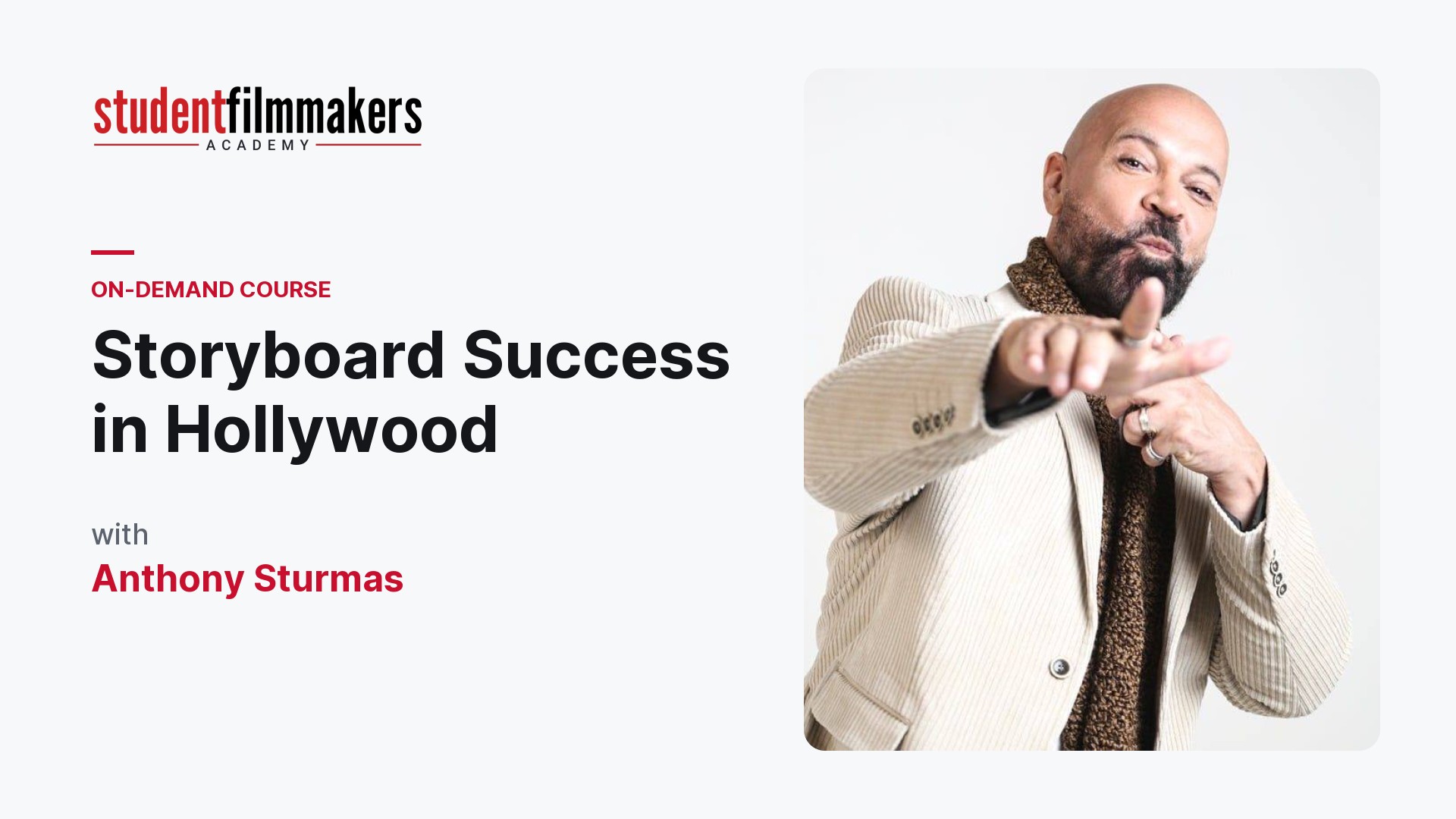
Storyboard artist Anthony Sturmas was senior storyboard artist on the zombie feature Z Dead End and has drawn boards for Anthony Ferrante, the director of Sharknado. His advice to anyone who wants the job is blunt: talent gets you noticed, but finishing on time is what gets you hired again. Speaking to filmmakers on a StudentFilmmakers live webinar, he explained how he found his first clients without a guild or an agent, how many frames a feature expects each week, and what he charges.
How do you get your first storyboard credits?
Sturmas graduated from the Art Institute in 2006 and felt like he had been dropped “in the middle of the ocean.” Guild dues were out of reach for a new graduate, so he started what he calls guerrilla marketing. He found directors and producers on LinkedIn, Facebook and Instagram and offered to board a few scenes or draw concept art for free, in exchange for an IMDb credit.
Then he kept in touch. Every three months he sent a short follow-up, plus a note at Christmas or New Year’s, so his name stayed in front of them. He has kept that habit for more than 15 years, and today he counts more than 80 film credits. The list he built that way is his “Hollywood Rolodex,” and it is where most of his calls now come from.
Before any meeting, he studies the director. Look at what they made in the past two or three years, he says, so you walk in already talking about their work and their vision.
Why does being on time matter more than talent?
This was the point he came back to most. Many of his own jobs started with a panicked call from a director whose artist had vanished halfway through a film or a commercial.
“I’ve seen the most gifted storyboarders not get any jobs due to the fact that they don’t complete the projects. If you can complete the projects and be on time, you’ll begin to get more work.”
Hollywood is small, he reminds students. He has been on calls where two directors he had worked for had just worked with each other. Keep your work solid, keep your word, and leave your politics out of the room, because the wrong comment can burn a bridge you never knew you were standing on.
How many storyboards does a feature film need each week?
Sturmas gave a number that surprised some people in the room:
“When you begin to draw for a feature film, the minimum per week for black and white storyboards is 100 storyboards per week plus. I do about 120.”
That works out to about 20 to 25 finished frames a day for him. On features he usually works alone, so the pace is his to keep. Animation is a different job. Boards there are built as sequences with much more movement, and several artists may split one scene between them.
To keep that speed, he shoots his own reference. Before a fight-scene commercial comes in, he may already have 100 photos of people throwing punches in a folder, which he says cuts his research time in half. His other tools are simple: Photoshop, a drawing pad, and two portable drives, because “your computer will crash.”
What makes a storyboard read like film?
Early on, a teacher stopped him from drawing like a comic artist, and he passes the same note on:
“You don’t want to give them storyboards that look something out of Marvel Comics or something that’s anime.”
Film boards are about perspective, movement and transitions that flow from frame to frame. A few habits from his own work:
- Directional arrows on every frame. He uses red arrows to show where actors and the camera move. He said Ferrante loved that, and so did Ethan Maniquis, co-director of Machete.
- Light in the drawing. Directors often tell him they like that his boards show lighting. For horror he may add a sepia wash or a hint of red.
- Something in the foreground. In horror, he likes to frame through a crack or down a hallway with an object close to the lens.
- One consistent method. Mix styles inside a single film and it “starts to look really weird.” Show a range of styles in your portfolio, though: watercolor, digital paint, quick black and white.
He still works by hand in Photoshop rather than in dedicated storyboard software. When a director wants an animatic, he moves the frames into After Effects, which he charges for separately. Animatics are most useful, he said, when a team is crowdfunding or pitching investors.
What does a storyboard artist charge?
A filmmaker asked for numbers, and he gave them. He was clear that each job is quoted case by case, and that he bends for low-budget filmmakers.
| Kind of job | What Sturmas quoted |
|---|---|
| Commercial | Day rate of about $900 to $1,200 for full-color boards with arrows and text (up to $2,000 for some brands); most jobs last a day or two |
| Studio feature or short | About $1,400 to $2,000 a week, with 100 to 120 frames a week expected |
| Low-budget indie | For example, a month and 500 to 600 frames for $5,000 |
| A handful of boards | $25 to $125 per board, depending on detail |
A full script, depending on its action scenes, could run anywhere from about $2,000 to $10,000. On a tight budget, he suggests skipping the B-roll and boarding only the opening, the middle and the climax, with most of the frames going to the climax.
Why do producers want boards for stunts and action?
Kim Welch, who moderated, said cinematographers he talks to insist on boards for car crashes and stunts, and asked why. Sturmas said it is about money as much as pictures. Beside each frame he writes notes: visual effects, blood splatter, gunshots, particle effects, a helicopter. Producers read those notes and see costs. A helicopter alone, he said, can run $2,500 to $3,000 an hour.
Another filmmaker asked what is lost when a low-budget team works from a shot list only. His answer: “They’re basically shooting blanks.” The board shows the time of day, where the sun sits, where the police cars park and where the dust blows in. It also heads off continuity problems. On set, he said, “That’s the blueprint for the whole day. That’s the budget for the whole day.”
The process usually starts with just him and the director, before the cinematographer joins. They read the script together, flag the scenes that will be hard to shoot and bounce ideas back and forth.
Habits to start this week
- Fill a sketchbook every week. He suggests 30 to 100 sketches.
- Draw in public with your sketchbook open. He has picked up work at a coffee shop next to Gower Studios.
- Get a simple website (his costs under $10 a month), a professional photo, a bio, an IMDb page and a reel.
- If you have no client work, shoot a short on your phone and board it yourself.
- Never turn down a job because it is small, then deliver exactly when you promised.
Directors weighing boards against a list can compare notes in Storyboards: The Benefits to Production, and a step-by-step guide to the list itself lives at How to Make a Shot List.
Still to watch in the recording: a two-week rush job for a Tokyo game producer, writer-directors who call him while they are still writing, and the book he is writing about going from graffiti artist to storyboard artist.