By Dean Goldberg
Film professor Dean Goldberg explains why a Super 35 sensor camera won him over and how it gives students real on-set production practices and crews.
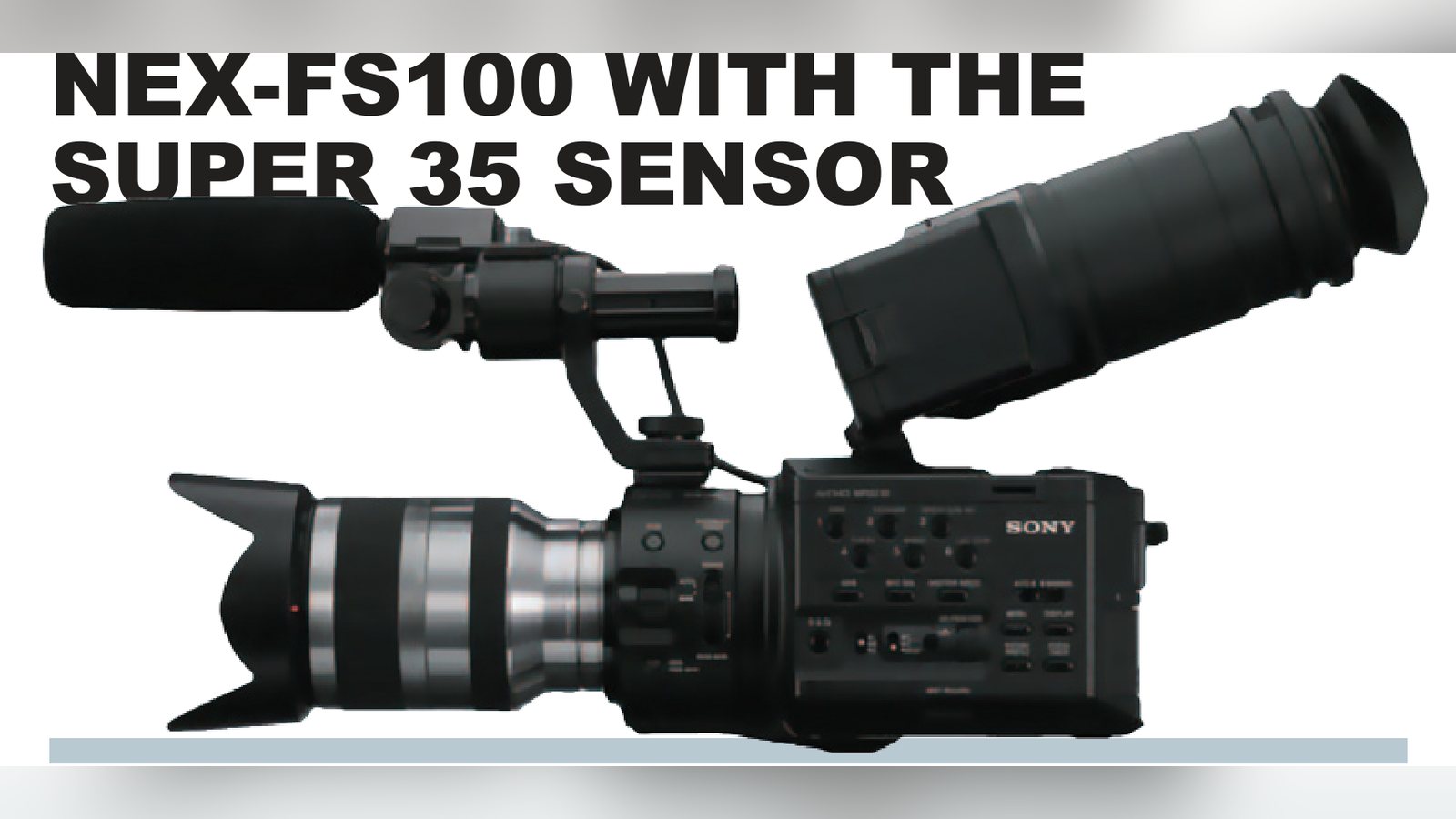
Let me begin with the good news. I am in love. Smitten. Imbued with an almost lusty enthusiasm. The object of my desire? The Sony NEX-FS 100 with the super 35 sensor. Let me explain.
I wrote my first article for StudentFilmmakers Magazine in April 2009. It was called, “The Digital Revolution, What is Missing?” In that article, I bemoaned the point and shoot mentality of many of today’s Video Production classes. Sure we professors spend hours lecturing about on location organization, pre-pro and post production practices. We give tests on camera and lighting set ups, color temperature, depth of field, the role of chrominance and luminance in shooting and finishing. Some of us old dogs still talk about the Hurter–Driffield curve— the origins of sensitometry.
But all too often students come back from the field with footage that looks dull, badly lit and hastily produced. And that’s probably because it is. Now Sony’s answer to the superior pictures of the DSLRs at a price that small communications programs can afford has brought us full circle to the problem of introducing good production practices in an academic environment.
During the last few years, I have been happy enough with the EX1 and EX3. Nice cameras, good pictures, ability to “paint” blacks, colors, etc. But their compactness—their lightweight, though great for “grabs,” doesn’t help my quest to get students to form a crew each time they go on location.
My new camera seems to be a lot more social. The body, which is now the obligatory stubby box, needs enough additions and hands on it to cause even the most stubborn of students to text for help. For example, to work this camera hand held, which Sony has made very tough in terms of balance, shoulder rack, etc., a student must have a focus puller (thank you, Sony, for finally making an inexpensive camera behave like its big brothers!) and possibly even someone to “watch your back” in case you go off balance.
Might I be blinded by love? Maybe a little.
The camera’s body is plastic, the eyepiece is a joke, the IRIS control is much like the cheapo HXR cameras. There’s a lot more I could talk about, but I’ll leave that up to the camera geeks. As a director and professor who spent most of his adult life at the shoulder of a DP, I now love to shoot on my own but fall asleep as soon as specs become the subject of conversation. For me the proof is in the picture, and I can and have made beautiful pictures with this camera. And so have my students, which is the best motivator of all. To be able to control an image and to create a subtle change of depth of field without being at the long end of the lens is a godsend. And to need more than one or even two people to create those images has finally created a practical reason for students to establish real on site production practices. I can’t wait ‘till Valentine’s day.
Keep learning filmmaking
Want more lessons like this? Join StudentFilmmakers free for live webinars with working pros, and stream on-demand filmmaking classes in cinematography, directing, screenwriting, sound and post.