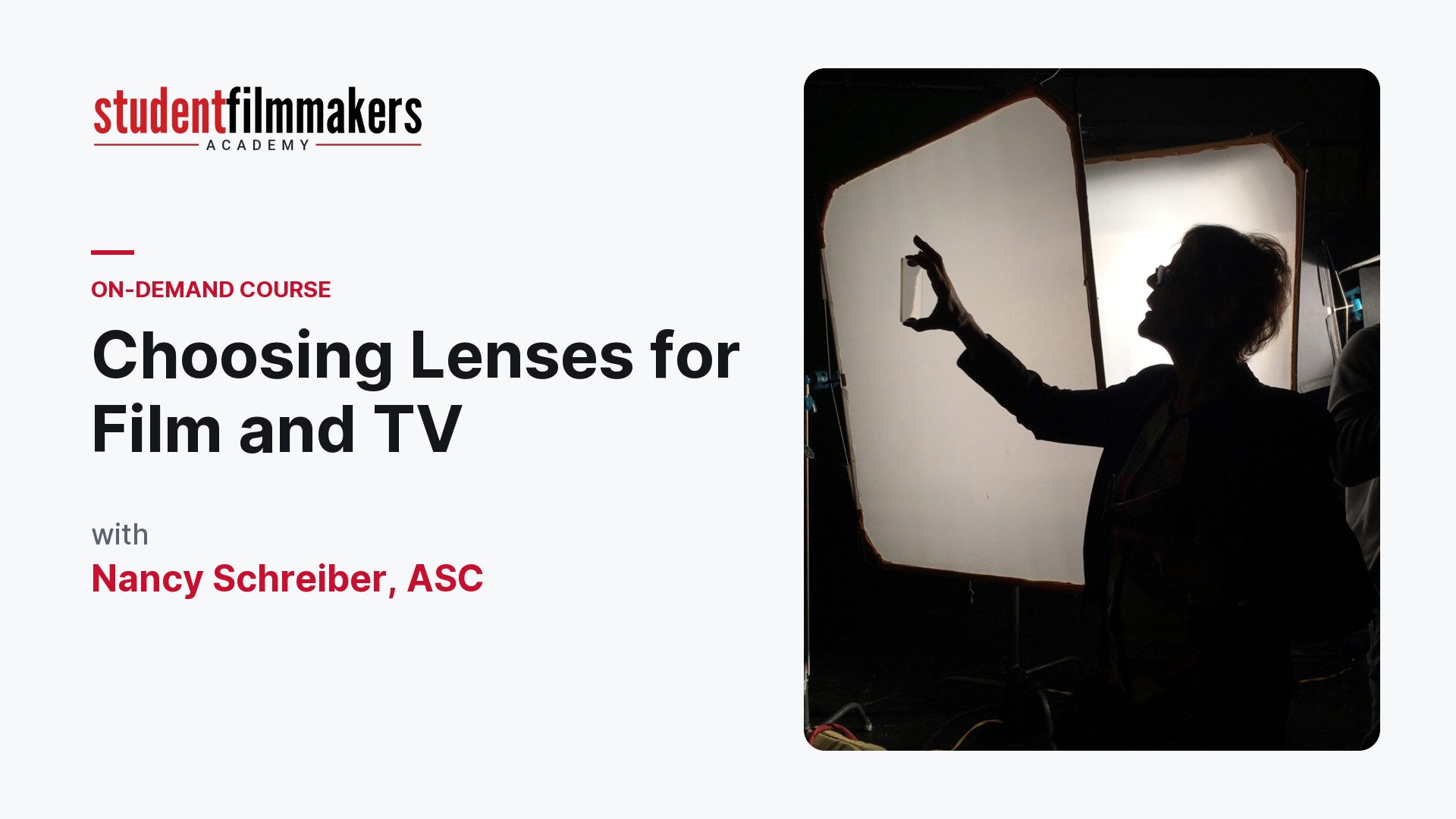
Nancy Schreiber, ASC, director of photography on P-Valley and The Comeback and winner of the Sundance cinematography award for November, starts every lens choice with the story, not the spec sheet. In this class she explained why a technically flawless lens can be the wrong one, how P-Valley‘s detuned Panavision glass got its flares, and why she finds anamorphic lenses more personal, not less.
Schreiber has shot features, network and streaming series, and documentaries from New York to Los Angeles, Atlanta, Salt Lake City and Nebraska. Her rule, repeated all class: whatever you read about a lens, go test it yourself.
What makes a good lens for film?
Her opening answer turned the question around.
“You can have a really perfect lens, technically, but it may not fit your story.”
A period film, or a sad, edgy story where characters are going through hard arcs, may call for something softer and less exact. So she judges a set on resolution, contrast, color, overall sharpness and edge-to-edge sharpness, then asks how each fits the emotion of the project. Older sets can vary in color from lens to lens even within one manufacturer, which is part of their charm and part of the work.
Why are vintage lenses so popular on digital cameras?
Because modern sensors are so sharp. Early in her Los Angeles career, on films of a couple million dollars or less, she couldn’t afford Panavision Primos, so she rented Zeiss Super Speeds for night work. Today those lenses are in high demand, and she wishes she had bought some.
“The vintage lenses make digital human, I think. They really take the edge off the harshness of the digital frame.”
Old glass also needs care. Lenses from the 1960s and ’70s can turn sticky inside and need proper lubrication, which rental houses handle. Sets like Super Baltars, used on The Godfather, rarely match within the set, but she has matched mismatched lenses in the color grade.
Manufacturers have noticed. Zeiss built its Supreme Radiance line to look vintage, and she said its engineers were thrown by the request: “Zeiss customers wanted imperfections.” They had to work backward, changing coatings and moving elements to undo their own precision.
How were the lenses on P-Valley detuned?
For season one, showrunner Katori Hall wanted a look that wasn’t too polished. The show is set among pole dancers with many lights in frame, so the team wanted flares. Guy McVicar at Panavision Hollywood sent her in Atlanta three strengths of detuned lenses: minimal, medium and extreme. On the extreme ones, coatings were changed or stripped and elements rearranged. “I wouldn’t try it at home,” she said.
Detuning used to require a rental house lens technician. Now there are other routes. Angénieux, through Band Pro, makes rear attachments that change how its zooms render, and lens specialists like Matthew Duclos rehouse and customize individual lenses.
Anamorphic or spherical?
Spherical lenses are usually described as closer to what the eye sees. Anamorphics were long saved for wide vistas. Schreiber disagrees with that old habit.
“For me, anamorphics just have a presence that feel ironically more personal.”
She pointed to Chinatown as anamorphic used close and intimate. Out-of-focus lights become ovals instead of circles, which many people love. When a production can’t afford anamorphics, she fakes the look on spherical glass: go a little wider and closer, shoot near wide open, and add a blue streak filter to detuned lenses for anamorphic-style flare.
Speed has changed the math. On Neil LaBute’s Your Friends & Neighbors, shot on film in about 18 days, the anamorphics of the time needed so much light that the production wouldn’t allow them; they shot Super 35 framed for 2.40 instead. The fastest film stock, Kodak 5219, is rated at 500, and she rates it at 400 for rich blacks. Digital cameras start around 800 and go to 2500 on the Sony Venice, so “a T4 is not a problem” anymore, and those slow old anamorphics are usable again.
When does she reach for zooms instead of primes?
| Situation | Her choice |
|---|---|
| Day exteriors | Long zooms with ND, so she can stay wide open and soften the background |
| TV at 60 pages in seven days | Zooms used as “variable primes,” with the camera still moved in for close-ups |
| The Rookie: Feds, three cameras | Leica Summicron primes on ARRI Alexa Minis at 3.2K, for about 95 percent of the series |
| Ensemble scenes | A smaller sensor or 2.40 framing, so more of the cast stays sharp |
| Isolating one character | Full frame or a longer lens, as wide open as she can go |
On the ensemble comedy It’s a Disaster, shot in 15 days, she paired a vintage Cooke 25-250 zoom with an Angénieux 25-250 HR. The Angénieux was sharper and more contrasty but “it was a breather,” so the frame edges swam during focus pulls. She used it carefully and matched the two zooms in the grade.
For The Rookie: Feds, she also noted that network broadcast still runs below 4K. She graded for the streaming version on Hulu, which looks far better, and covering the entire sensor isn’t required when the delivery is that small.
Why do still lenses get rehoused for cinema?
She taught Canon 5D workshops when DSLRs took off and saw the problem firsthand. Still lenses have no repeatable focus; the barrel spins past infinity, and the distance marks are bunched together, so a focus puller can’t hit 12, 10 and 5 feet precisely. Rehousing adds proper cine focus scales and calibrates the lens in T-stops, which measure actual light transmission. Then a T2 is the same T2 on every lens in the set. Rehoused Rokinon still lenses are an affordable example.
Who chooses the lenses, the director or the DP?
It depends on the director. Some, like David Fincher, are very specific; others let the DP lead. Either way, it starts with look books, references and conversations with the production designer and costume designer about palette, time of day and tone. She also shared a habit for new cinematographers: watch scenes with the sound off, so you see only the blocking and the lens choices.
For her, testing settles everything. Visit rental houses and demo days, set up a resolution chart, check back focus, zoom in and pull out to confirm a zoom holds sharpness, and never judge a lens from compressed tests online.
For more from Schreiber, see the lens selection webinar recap and her talk on creating look books. For the basics, read Zoom Lenses vs. Prime Lenses.
The full class also includes her tour of lens makers from Cooke to Atlas, split diopters on The Rookie: Feds, and her view on autofocus lenses.