
By Dana Dorrity
How Richard Linklater and Eric Schlosser turned the book Fast Food Nation into a feature film, and what it teaches about telling stories that matter.
Fast Food Nation, which opened November 17th, is a dramatic feature film directed by Richard Linklater and co-written by Linklater and Eric Schlosser. The film is based on Schlosser’s nonfiction bestseller of the same title. After the success of his book and the successes of recent documentaries on fast food culture like Super Size Me, a few producers were interested in making a documentary film based on Fast Food Nation, but a good documentary film is an investigative journey not just a report on findings. Schlosser already did the investigative work for his book, and if he was going to make a film addressing the same issues, he wanted to create characters and dramatize the story.
Schlosser began his writing career as a playwright, and then found success as a journalism and non-fiction writer in his early-thirties writing for Atlantic Monthly, The New Yorker, The New York Times, The Nation, and Vanity Fair.
On a trip through Austin, Texas, he met with Richard Linklater to see if he would be interested in directing a film based on Fast Food Nation. Linklater had wanted to do a project about workers in America, and although he has directed documentary projects, he was particularly interested in turning Schlosser’s book into a narrative film. “I’m more interested in fiction than nonfiction, anyway,” Linklater said in an interview about the development of their script, “I like working with actors and their performances.” From that meeting, the two began the two-year process of developing the script. They used Sherwood Anderson’s novel, Winesburg Ohio as a model for the structure of the movie and created the fictional town of Cody, Colorado, for the setting of a variety of stories that revolve around a fast food chain called Mickey’s and a meat-packing plant that supplies their beef.
Turning a Non-Fiction BestSeller into a Dramatic, Narrative Feature Film
The movie begins with a young Mexican couple, Raul and Sylvia, (Wilmer Valderrama and Catalina Sandino Moreno) who are crossing the border with her sister Coco (Ana Claudia Talancon) in search of better jobs. At the top of the food chain is Don Henderson (Greg Kinnear) an executive at Mickey’s who is dispatched to Cody, Colorado, to inspect the local burger supplier and find out why a recent study found fecal matter in the meat. Kris Kristofferson plays Rudy, one of the last ranchers in a part of the country that is rapidly being transformed into suburban subdivisions; and Ashley Johnson is Amber, a smart teenager who works in a Mickey’s franchise. Although the script was designed to show how the fast food industry diminishes people’s lives across the economic spectrum, Schlosser stated that, “hopefully, in the end, none of these characters are representative of anything but are real, living, breathing people.”
In Fast Food Nation, Linklater and Schlosser make the case that the factory hasn’t just replaced the family farm, it’s replaced the family. In one scene, Patricia Arquette, who plays the mother of Ashley Johnson’s character, Amber, pokes at the microwave sausage and egg breakfast that she’s just heated up. The look on her face indicates that she’s not really sure about what she’s eating. A hundred years ago most Americans made their own clothes, now we don’t even make breakfast.
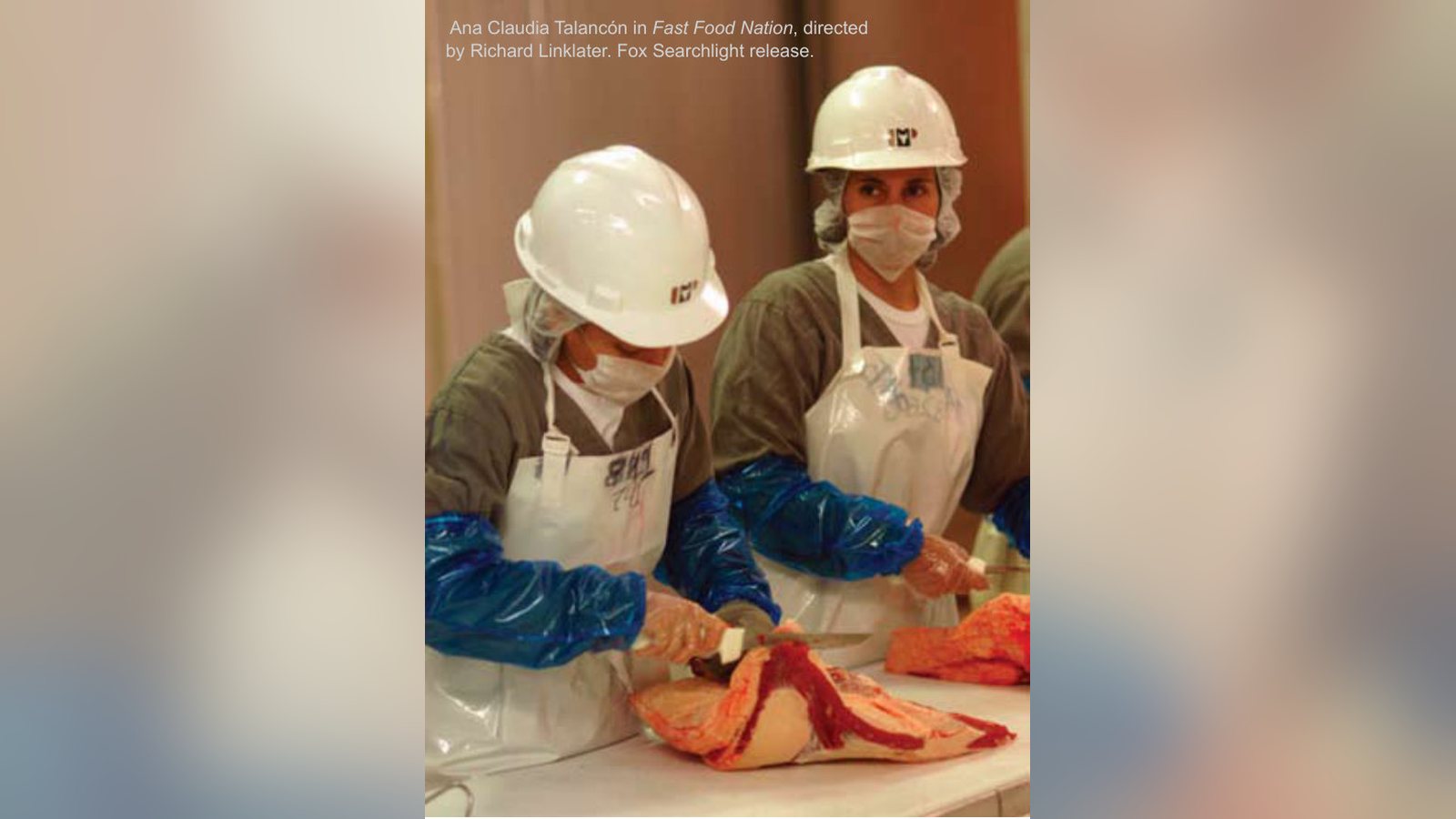
In many ways Fast Food Nation could be considered neo-realist. The Italian neo-realist films of the 1950’s, like The Bicycle Thief and Shoeshine by Vittorio De Sica, were initially mistaken for documentary films. De Sica used unknown actors and shot his films on the streets of Rome rather than on studio lots. Like De Sica, Richard Linklater uses real locations, the scenes inside the meat-packing plant were shot in an actual slaughterhouse, but rather than casting unknown actors, Linklater cast many well-known and familiar television actors in the main roles. Wilmer Valderrama, Greg Kinnear and Ashley Johnson all got their start on television shows. Patricia Arquette is currently starring in the popular series Medium. Even Bruce Willis, who plays the Mickey’s meat buyer in Colorado, got his start on the 80’s detective show Moonlighting.
Somehow seeing these familiar TV actors heightens the dramatic impact of the movie. Viewers have watched Ashley Johnson and Wilmer Valderrama grow up on the sitcoms That 70s Show and Growing Pains, they are like old friends, and this gives us the sense that we are part of this community.
Fast Food Nation offers an insightful look at who we are today as Americans living in what Tyler Durden of Fight Club would call a single serving society. Patricia Arquette’s character, Cindy, works in a pet store and tells her daughter how sad the caged puppies make her and how much she wants to bring them home. The puppies caged up in a megastore don’t seem that different from the penned cattle awaiting slaughter or the Mexican laborers locked up in a cheap hotel room waiting for an opportunity to work in the meat-packing plant, or even Cindy and Amber living in their generic, pre-fab apartment eating microwaved dinners.
Since one of the main storylines involves the Mexican workers in the plant, the movie is bi-lingual. The scenes with Sylvia and Raul and other characters are in Spanish with subtitles. Ana Claudia Talancon who plays Coco is a major star in Mexico, but Valderrama, who is originally from Venezuela, had to convince the producers that he could master a Mexican accent. There is a large and talented cast, and Linklater manages to get compelling performances from all of them. Columbian actress, Catalina Sandino Moreno who plays Sylvia, was nominated for an Academy Award for best actress for her leading role in Maria Full of Grace in 2004. Ethan Hawke who plays Amber’s uncle, Pete, was nominated for an Academy Award for best supporting actor for his role in Training Day. Luis Guzman, who has had featured parts in many films including Carlito’s Way and Boogie Nights was attracted to the role of Benny, the benevolent coyote who brings Sylvia and Raul over the border, because he thought that it offered him a chance to make a difference. “Every now and then, as actors, we have the opportunity to be part of the message and that’s why I’m here,” the actor said, “It’s a great story. It’s a story that needs to be told.”
The prequels to Fast Food Nation are Barbara Kopple’s 1991 documentary film American Dream and Upton Sinclair’s novel The Jungle, written in 1905, about the meat-packing industry in Chicago. In American Dream, the meat cutters at the Hormel plant in Minnesota go on strike because the company wants to cut their wages. At that time, meat cutters were considered skilled labor and were paid an hourly wage that enabled them to purchase homes and support their families. In the course of the documentary, the union decides not to accept any compromises. Using Bruce Springsteen’s No Surrender as their theme song, they held out for their full wage, and they lost. Now twenty years have past and slaughterhouses employ, almost exclusively, new, illegal, Mexican immigrants. The coyotes that bring them over the border drop them off in cheap hotels next to the meat-packing plants. Sinclair’s novel inspired the President at that time, Teddy Roosevelt, to institute regulations to protect both the factory workers and consumers.
As the story progressed, I was worried that Ashley Johnson’s character Amber was going to get shot in a fast food restaurant robbery, or that Wilmer Valderrama’s character Raul was going to get killed in the plant, but the movie ends in the kill room of the slaughterhouse and so, of course, it’s the cow that dies. The scene is shot through the point of view of Catalena Sandino Moreno’s character, Sylvia, and although we feel her sorrow at being forced to participate in this dangerous and dehumanizing work, we also feel the profound sadness for the horrific death of these animals. All I could think of was last line from a 1932 Joan Crawford movie called Rain, “I feel sorry for the whole world.”
Dana Dorrity is an assistant professor of Communications and Media Arts at Dutchess Community College. She has an MFA in screenwriting from the American Film Institute and teaches media writing, screenwriting and video production classes.
Related filmmaking guides
- Film directing: getting good performances
- Coverage and the master shot
- Camera angles in film: a beginner’s guide
Keep learning filmmaking
Want more lessons like this? Join StudentFilmmakers free for live webinars with working pros, and stream on-demand filmmaking classes in cinematography, directing, screenwriting, sound and post.






