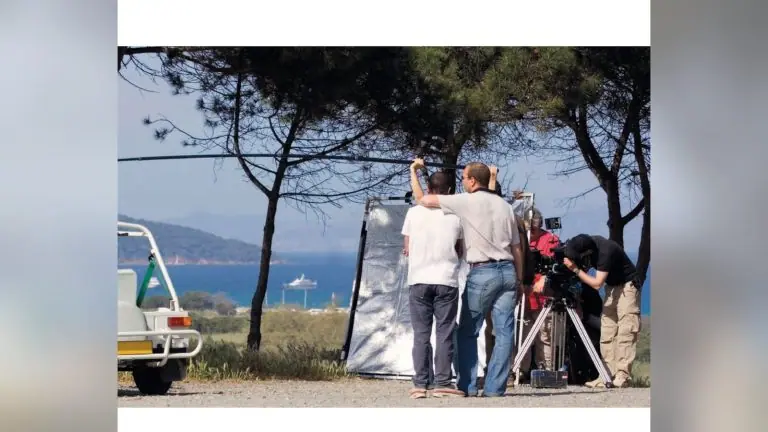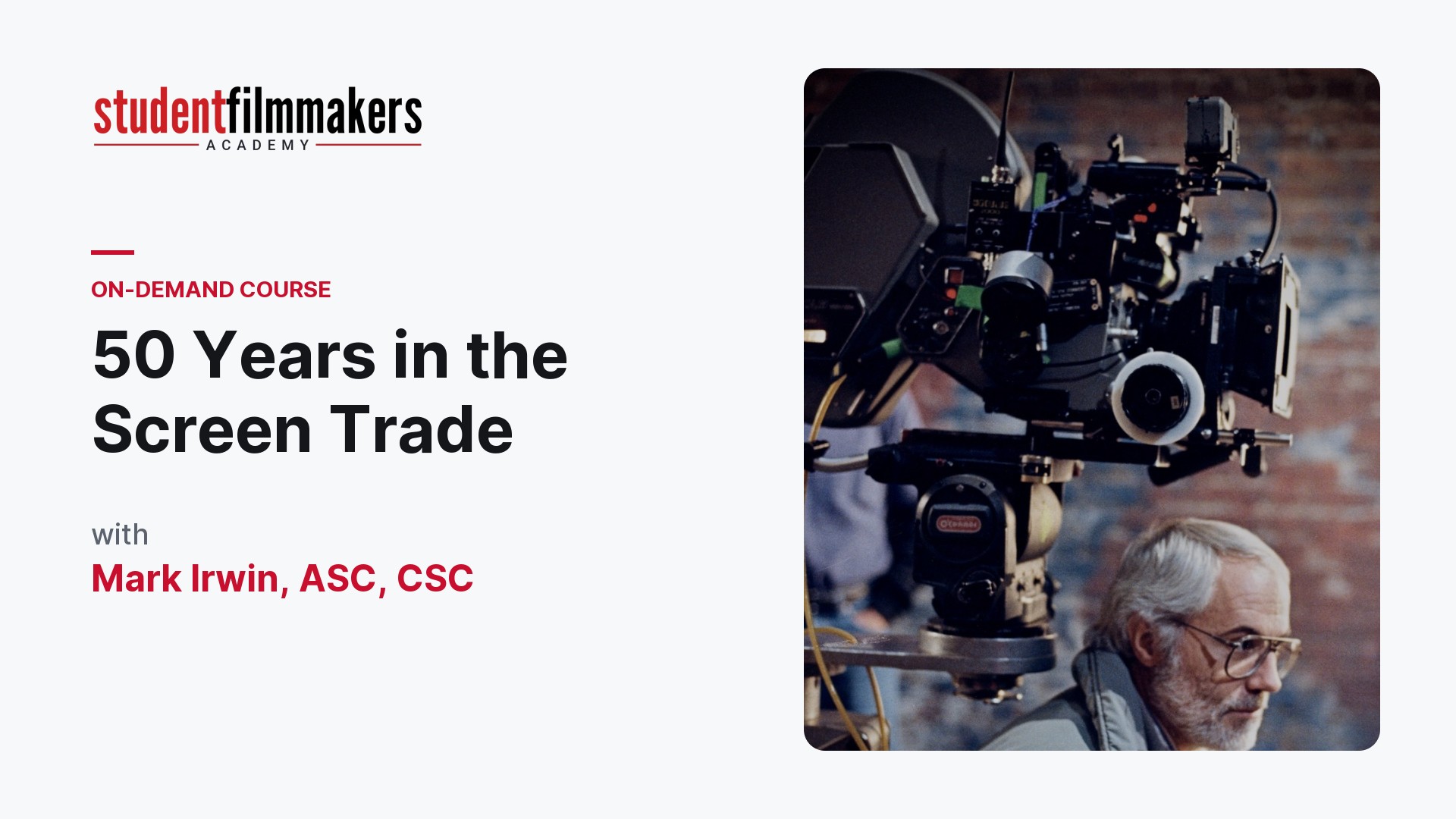
After roughly 190 movies, from The Fly and Scanners with David Cronenberg to Dumb and Dumber and Scream, Mark Irwin, ASC, CSC, says the best tools on a set are often the cheapest ones. Talking with filmmakers in a StudentFilmmakers class, he laid out the working habits behind his 50 years as a director of photography: a second camera, a better kind of floor mark, and lighting that changes as the story does.
Why does Mark Irwin shoot with two cameras?
It started on the first day of Dumb and Dumber. The crew shot a master of Jim Carrey and Jeff Daniels, and the plan was to go in for coverage and have the actors repeat what they had just done. Carrey had other ideas:
“Jim said, well, what did I do? I don’t know. I have no idea what I did. I don’t think I can do it again. And both directors look at me, what are we gonna do? Get another camera.”
Ever since, Irwin has run an A and B camera on nearly everything, usually a two shot plus a single, and that changes how he lights. If the two shot holds a soft cross key on the woman, that same light is already doing the work for her close-up, and he comes around with a more contrasty look on the man. With a wide on one camera and a close-up on the other, often on his favorite Canon 17-120mm zoom (currently on a Sony Venice), he has to light a face from across the room. His goal is a lighting style “that travels.”
Two cameras also free him to break the old order of wide shot first, close-ups last. On one film, a seven-year-old girl played a scene with an actor in his late sixties. In rehearsal, Irwin could see she would be worn out long before the crew reached her single, so he asked the director to shoot her close-up first. For Irwin, performance decides the order of shots, not tradition.
What are horseshoe marks, and why not T marks?
T marks are the tape crosses actors stand on. Irwin says they come from theater, where every seat in the house has a wide shot and nobody notices if an actor is six inches off. A camera on an over-the-shoulder notices right away. So he took a page from Stanley Kubrick and gives actors a horseshoe instead, a curve that marks the outside of where their toes go.
“Nobody stands like a ballet dancer with their toes touching together. I give them horseshoes and say your heels, your hips, and your head are all connected.”
If the feet land in the horseshoe, the head lands in the right spot for the light and the composition. With young actors who miss on the first take, he simply pans away so the take has to be cut, and they quickly learn where their feet belong. One attendee, Vince, was Irwin’s trainee more than 20 years ago and said in the class that he still uses horseshoe marks today.
How was the lab in The Fly lit?
The crew spent almost 10 weeks on Seth Brundle’s loft set. In rehearsal, Irwin realized the room was a character as important as Jeff Goldblum and Geena Davis, and that it had to fall apart along with Brundle. As the art department aged the set, he changed the lighting with it. The China hats were changed to read more and more linear, the smoke changed, the key light climbed, and new kinds of rim light came in. By the time Brundle is a full monster, everything was lit through cookies and Charlie bars, so he was always moving in and out of shadow.
Goldblum’s makeup took about 10 hours to apply. Davis never changed. Her skin was so pale and luminous that Irwin had to light Goldblum two or three stops brighter just so he would read as dark, while she was kept a stop or two under with a halo backlight.
The hard part came when the two met face to face and kept drifting into each other’s light. Irwin calls it a game of millimeters. His fix cost almost nothing: a strand of monofilament taped to the floor and run up to a pipe overhead, out of focus and invisible on camera, marking the line neither actor could cross. They played the whole scene without breaking it.
Which lighting setup does he start from?
Irwin’s instinct is a soft cross key, then a liner on the cheek or a halo rim, and then the fill decision. He traces that taste to the British cinematographers he studied as a young projectionist, Ossie Morris, Billy Williams and David Watkins, and to Watkins’s early bounce light in particular. Today he plays most HD scenes at about 2.5:1 to 3:1, a forgiving range on modern sensors, and goes to 4:1 or even 5:1 when a scene turns sinister. To make a character more threatening, he raises the key and takes some sparkle out of the eyes.
One rule he started following in film school and still feels in his stomach: “Always light to the eye line. If someone’s looking a certain direction, key them from that side, so they’re looking into the light.”
He gave up his light meter in 2005, when he started shooting HD on the Sony F900. “I no longer trust my light meter because it will guide me into corners of darkness and depression.” He reads the whole set on a calibrated waveform instead,
Homemade tools from five decades of sets
Irwin says he was “raised by grips,” and many of his favorite tricks prove it:
- The Kino Flo connection. On The Fly, his electrician Frieder Hochheim was sure he could light movie sets with office fluorescent tubes. The crew doubted him. Hochheim went on to start Kino Flo.
- Wedding dress diffusion. Instead of paying about $40 a square foot for grid cloth, he took a swatch to the Los Angeles garment district and came home with 300 yards for $300. He is still using it.
- Dollies in tight rooms. A small Dana Dolly fits behind a bar or on a kitchen island, with a blanket protecting the granite countertop, and can carry two cameras.
- Pipe track. A key grip in Livingston, Montana, laid 20-foot sections of pipe on grass with no cross ties. It was built so horses could walk down the middle.
Inspired by gaffer and inventor Jacques Brandes, his crew, including his son Matt, also built box lights with built-in diffusion, now fitted with LED tubes, to cut what Irwin calls “the fuss factor.”
Where should camera movement go in a schedule?
When the first AD lays out eight pages across six scenes in a 12-hour day, Irwin asks which scene gets the most eggs in its basket, meaning the most angles and moves. The rest stay simple. He tells his operators that about three quarters of what they shoot will be two shots and over-the-shoulders, however much anyone thinks the day calls for a 50-foot Technocrane. Movement needs mood or motivation, he says, and the biggest moves are worth saving for later acts. For more on track and moves, see our piece on laying dolly track.
What advice does he give new cinematographers?
In film school, Irwin didn’t want to direct, so he shot everyone else’s films and finished with ten three-minute movies to their one. He sees two routes up: rise with a director from your school, or sell yourself with your own images. His own rule was simple:
“Say yes to everything and everything that you do will teach you something.”
When agents asked for his best five minutes, he couldn’t choose, so he cut short reels by mood (day, night, romance, action) and lets people pick. He urges young camera people to build their own reels the same way, or find a director who needs a shooter.
He closed with what he tells directors on the first morning of a shoot:
“I am just a contractor with the guys, with the trucks and the tailgates and the ladders and the power tools. In the afternoon, I’m the lifeguard and you’re the drowning man.”
The nuts and bolts stay in the crew’s back pocket, he said, and the story stays in front. For another angle on running more than one camera, read Are Two Better Than One? Multiple-Camera Single-Camera Production, and for more working pros, the Cinematographer Honor Roll.
The full class also covers lighting crews in India and Thailand and how Irwin preps a script with a new director.