
By Simon Walker
What counts as digital cinema? Simon Walker compares definitions from exhibitors, the DCI, SMPTE and manufacturers, and the questions they leave open.
This is, very possibly, not the first article you’ve ever read with the title ‘What is Digital Cinema?’ Indeed, the duty of defining ‘what digital cinema is’ has already been accepted by a slew of filmmakers, exhibitors, industry consultants, equipment manufacturers, political organisations and even the occasional academic. But what is it?
Essentially, the term ‘digital cinema’ is used to describe the commercial exploitation of moving pictures which have been distributed in a digital format, and which have not been transferred onto physical film prior to exhibition.
So then, that’s ‘digital cinema’ defined and done! Unfortunately, it’s not quite so simple. Some people (often very influential people) feel that there should be conditional limits applied to this definition – and different people apply different conditions. For example, Michael Karagosian, the ‘Digital Cinema consultant’ to America’s National Association of Theater Owners (NATO), claims that “the accepted definition of digital cinema is the art of presenting first-run motion pictures”1. And, in a paper commissioned by the UK Film Council, Neil Watson & Richard Morris offer that “digital cinema is defined as the projection of full-length feature films to audiences in a purpose-built cinema where the quality of projection is not less than that provided by current 35mm technology”2.
Significantly, not all commentators are convinced that it is necessary to limit the definition of ‘digital cinema’ to a presentation quality equalling 35mm print resolution. In an article published by NATO, Bill Mead, creator of the independently run ‘DCinemaToday.com’ website, is cited (by Alma Freeman) as observing that “even a cinema owner projecting a DVD can legally and legitimately claim ‘digital’ status, because he is technically correct”3. Furthermore, whilst the Digital Cinema Initiatives (DCI) group – formed by representatives from each of the major Hollywood studies – appear to agree with Watson and Morris’ resolution-based restrictions, they do not appear to agree that ‘digital cinema’ should be limited to the presentation of ‘first-run’ feature films; it is stated in the DCI ‘Digital Cinema System Specification’ document that “The Digital Cinema system shall have the capability to present a theatrical experience that is better than what one could achieve now with a traditional 35mm Answer Print” and that “The Digital Cinema system shall also not preclude the capability for alternative content presentations”4. Adding further to the confusion is that some equipment manufacturers are not so quick to deny non-purpose-built venues the right to associate themselves with the phenomenon of ‘digital cinema’. For example, in a promotional report entitled, “Digital Cinema for Alternative Venues”, on the website of ‘Qube Cinema Incorporated’, it is claimed that through their technologies, “The power of digital cinema is no longer restricted to cinema halls”5.
In light of such contradictions, Walt Husak, a member of the Society of Motion Picture and Television Engineers (SMPTE), and senior manager of Electronic Media at Dolby Labs, declared in an open e-mail to SMPTE members: “I suspect the intended meaning of digital cinema will be lost on the consumer. My guess is it will become anything that is delivered and projected in digital”6.
Projected in Digital?
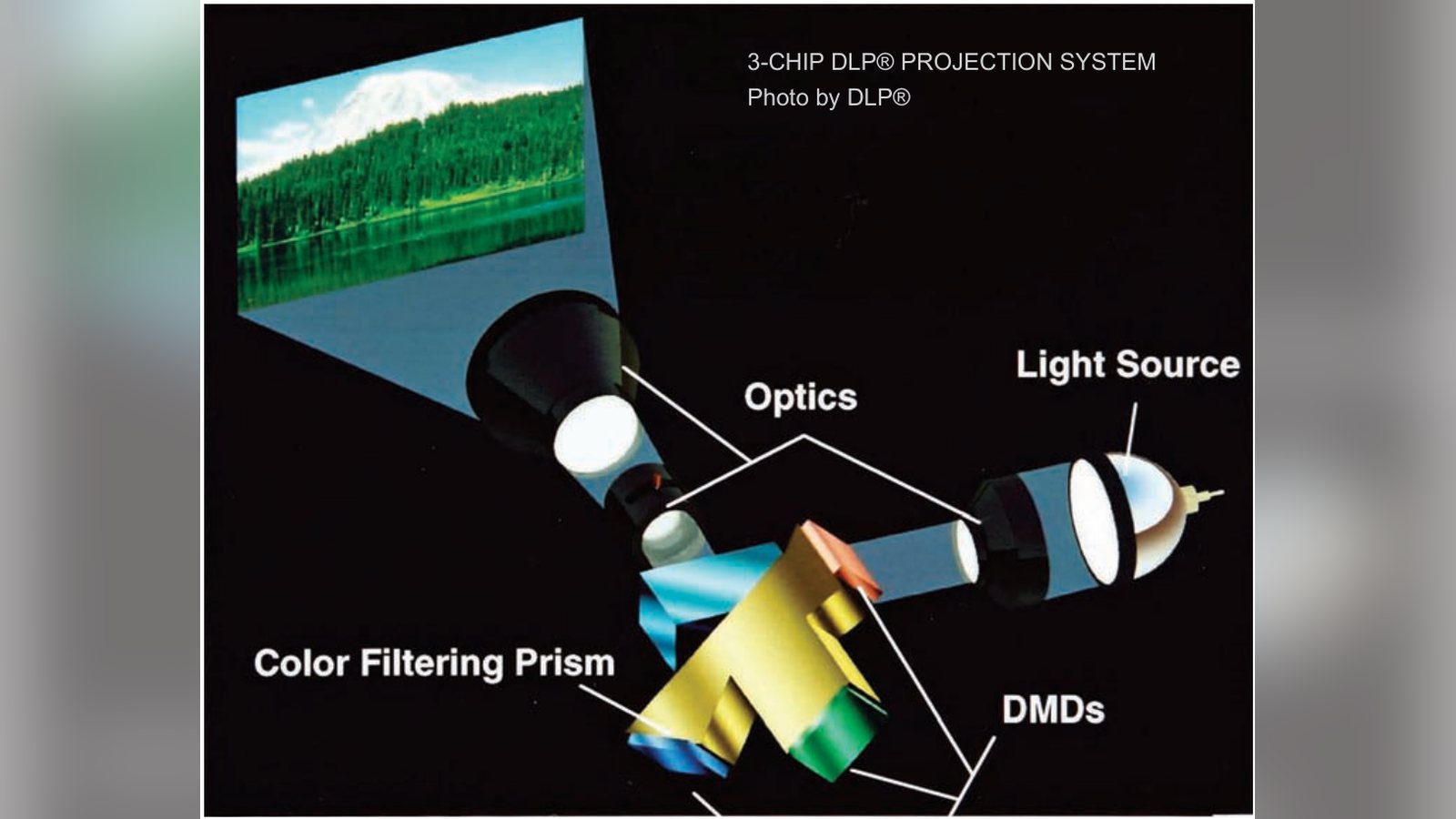
Unfortunately, even this consideration is not technically, one-hundred-percent legitimate. There are at this time (and speaking very generally) two types of projector associated with the term ‘digital cinema’. The first of these employ the Texas Instruments Digital Micromirror Device (DMD) – a microchip coated in millions of tiny mirrors, each of which represents a single picture element (pixel). Within a DMD projector digital video data signals undergo a process of ‘pulse width modulation’ (PWM), which translates the data into binary pulses of electricity (either on or off). These electrical pulses cause the microscopic mirrors to move in such a way that the light from a projection lamp, which is reflected off the micromirrors and onto a screen, may be rotated completely off or fully on. When rotated ‘off’ the relative pixel shows as black on the projection screen, and white when the mirror is rotated ‘on’. Although the mirrors are only able to project light as digital/binary signals (i.e., black or white), the ‘flicker rate’ of each mirror is so fast (and controllable) that a comprehensive greyscale is perceived by the human eye. The application of DMDs in this manner is referred to as ‘Digital Light Processing’ (DLP).
Reflective Liquid Crystal Display (LCD) technology, the second approach to ‘digital cinema’ projection, has largely been driven by JVC and the Sony corporation, who have developed systems known as the ‘Direct Drive Image Light Amplifier’ (DILA) and the ‘Silicon X-tal Reflective Display’ (SXRD) respectively. Both these systems house LCD panels that are able to directly receive a digital input, i.e., digital video data, which has undergone a process of PWM. However, it has to be noted that in all LCD devices the physical motion of the liquid crystals – which dictates how much light passes on to the screen – is actually analogue.
In other words (although both receive a digital-input) the DLP projector acts like a digital light-switch, i.e., it switches light on or off, whereas the reflective LCD projector acts like a dimmer switch, i.e., it provides an analogue modulation of light levels in projected images. This now brings into question the validity of the expression ‘digital projection’. It could feasibly be argued that with LCD systems the image is no more ‘digitally projected’ than a CGI/DV picture which has been printed onto film immediately prior to exhibition.
Once again I ask, ‘What is digital cinema?’ Well, my previously suggested definition of digital cinema, “the commercial exploitation of moving pictures which have been distributed in a digital format, and which have not been transferred onto physical film prior to exhibition” still appears valid, but this evidently does not satisfy all concerned parties. Therefore I personally attribute this definition to the term ‘Digital Exhibition’. Ultimately it would now appear to be that the term ‘digital cinema’ means different things to different people, and therefore the phenomenon of ‘digital cinema’ can be defined as a fundamentally indeterminate variety of the phenomenon of Digital Exhibition as a whole.
Clearly, this is not the all enlightening answer you were hoping for when you set about reading this article – and it actually carries with it a number further fundamental questions – including, ‘How do people refer to those varieties of Digital Exhibition which do not match their preferred definition of digital cinema?’ Or in other words… The nomenclature for those aspects of Digital Exhibition which don’t meet an individual’s definition of ‘digital cinema’ falls into two broad camps. In Europe the term used is ‘electronic cinema’ (or e-cinema for short). This is evidenced in a report commissioned by the British governmental Department of Culture Media and Sport (and compiled by ScreenDigest). In this report it is claimed that ‘Electronic Cinema’is the family name given to any means and any content shown digitally to a public audience in an out-of-home environment, which at its ‘highest form’ is known as ‘digital cinema’. Furthermore it is stated that “E-cinema is thus a term that can be applied to non-feature content, digital projectors of less than 35mm equivalent quality and non-cinema screening venues”7. Significantly, the language used here overtly suggests such application of Digital Exhibition represent a ‘lower form’ of entertainment than ‘digital cinema’.
In American literature that which fails to meet the ‘digital cinema’ criteria is not generally deemed worthy of the revered ‘cinema’ designator (digital, electronic or otherwise). This is evidenced in the discourse of NATO consultant Michael Karagosian. Karagosian claims that “[digital] theatrical presentation can be divided into two classes, one having the highest quality possible, the other less restrictive in quality”. Furthermore, with regards to this, and his statement that ‘digital cinema is the art of presenting first-run motion pictures’ Karagosian considers, “Our definition of digital cinema allows us to split the universe of [digital] theatrical presentation into digital cinema and everything else”. Karagosian adds that, “The common language applied to ‘everything else’ is “alternative entertainment” or ‘other digital stuff’”8. It is not insignificant that the acronym for ‘other digital stuff’ (ODS) is pronounced ‘odious’.
Yet More Questions – Unanswered
I concede that I have not provided you with the comprehensive ‘definitive’ definition of ‘digital cinema’. I hope, however, that you will now begin to question anybody who actually professes to be able to provide such a thing. I really hope that you will ask yourself ‘Why would anyone want to so limit their definition of digital cinema?’, ‘Why would they openly seek to devalue that which does not meet their personal specifications?’, ‘What’s in it for them?’, and maybe you might even ask yourself -‘Can any variety of Digital Exhibition truly pertain to the cinema – a medium which until this time has been intrinsically linked with physical film?’
Perhaps we’ll explore some of these questions together next time.
Simon Walker has a BS in ‘Business Information Technology’ and an MA in ‘Communication Studies’. He is presently enrolled at the University of Bradford and is authoring his PhD thesis entitled, ‘Interpretations of Digital Exhibition: Assessing the Academic Pertinence of Commercial Definitions’. He is also busy maintaining his Digital Exhibition themed website (www.digital-exhibition. co.uk), and he is hoping to find employment in the cinema exhibition industry very soon.
Article References: (Endnotes)
[Internet], Karagosian MacCalla Partners. Available from: <http://mkpe.com/publications/digital_cinema/insasia/ introduction_to_dc.php > Also Published in the December 2003 issue of INS Asia Magazine
2 Watson, N. & Morris, R. (n.d.) Specialised Distribution and Exhibition: E-Cinema. [Internet], UK Film Council. Available from: <http://www.ukfilmcouncil.org.uk/usr/downloads/ ECinemaMainReport.pdf> 3 Freeman, A. (2004) Digital Divide [Internet] In focus: Available from: <http://www.natoonline.org/infocus/ 04augustseptember/digitaldivide.htm>
4 Digital Cinema Initiatives (2005) Digital Cinema System Specification V1.0 [Internet], Digital Cinema Initiatives, LLC. Available from: <http://www.dcimovies.com/DCI_ Digital_Cinema_System_Spec_v1.pdf>
5 Digital Cinema For Alternative Venues (n.d.) Digital Cinema For Alternative Venues [Internet], Qube Cinema. Available from: <http://www.qubecinema.com/qubemini.htm>
6 Husak, W. (4 April 2003) RE: [DC28.0]. FW: Landmark Theaters and Microsoft Create the Largest Digital Cinema Circuit in United States. Email to members of the Society of Motion Picture and Television Engineers [SMPTE]. Digital Cinema Group [DC-28].
7 Screen Digest Report on the Implications of Digital Technology for the Film Industry (2002) Screen Digest the Film Industry. [Internet], Department of Culture Media and Sport. Available from: <http://www.culture.gov.uk/PDF/ Screen_Digest_Report.pdf> [Internet], Karagosian MacCalla Partners. Available from: <http://mkpe.com/publications/digital_cinema/insasia/ introduction_to_dc.php> Also Published in the December 2003 issue of INS Asia Magazine.
Keep learning filmmaking
Want more lessons like this? Join StudentFilmmakers free for live webinars with working pros, and stream on-demand filmmaking classes in cinematography, directing, screenwriting, sound and post.






