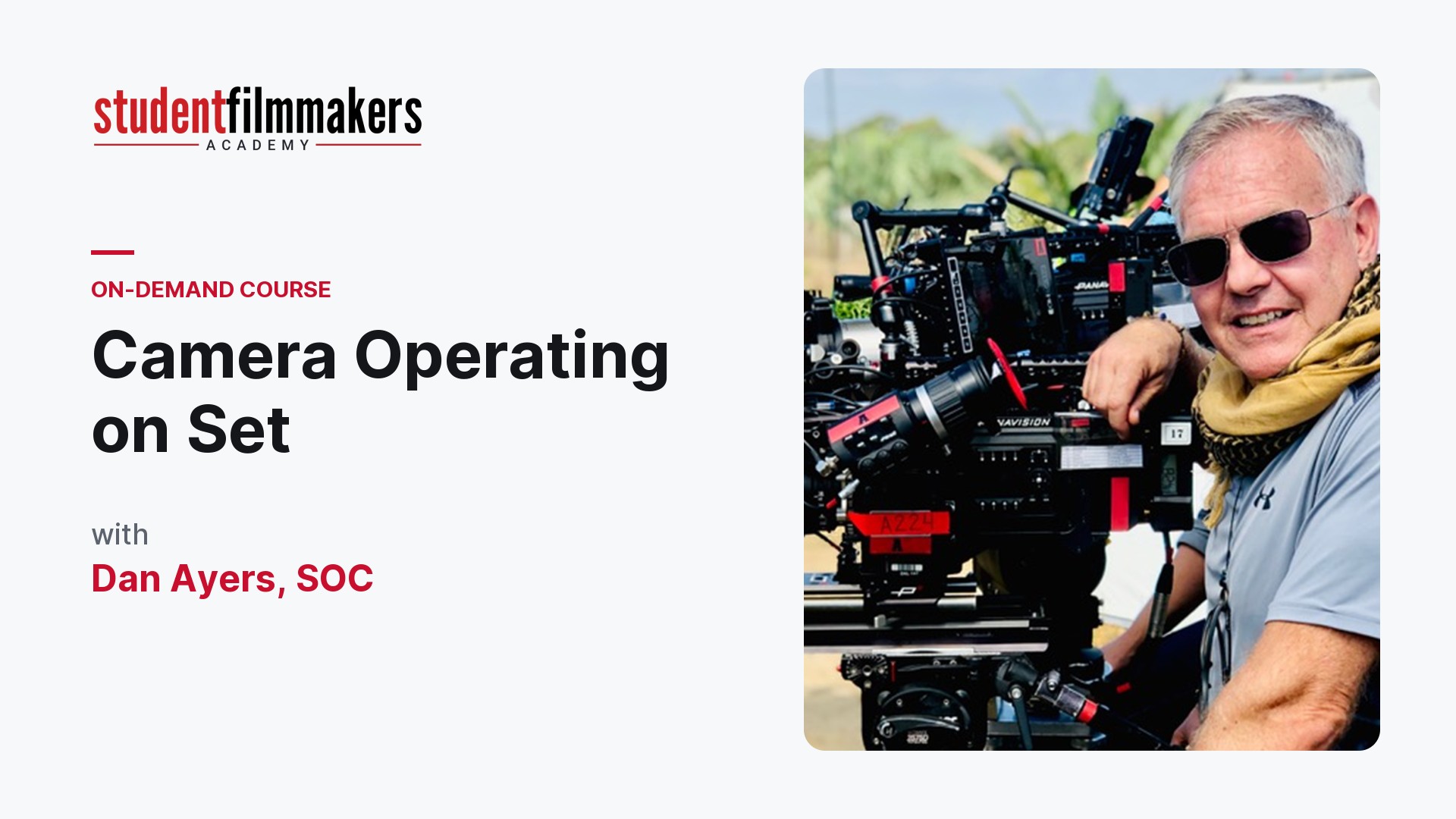
Dan Ayers, SOC, a camera and Steadicam operator who worked on Avatar: The Way of Water and whose TV work includes Blunt Talk, Reverie and The Rookie: Feds, says the operator’s first loyalty on set is to the director of photography. Taking open questions from filmmakers, he walked through the way a shot is built from rehearsal to “roll camera,” why his dolly grip always has his back, and how to frame action that won’t exist until visual effects add it.
Ayers grew up in a small Michigan town with no stoplight. A fifth-grade teacher let him work in a darkroom, and a neighbor brought home one of the first video cameras, which the kids used to stage newscasts. He studied film at Grand Valley State, worked as a grip, electrician and camera assistant in the film days, took up Steadicam, then moved to Los Angeles.
Who does a camera operator work for?
“I kind of tell people, I work for the DP,” Ayers said. He works with the director too, and sometimes the two leaders stop talking to each other. Crews have a name for it: mom and dad aren’t getting along. His job then is to try to get them back in the same conversation.
A viewer described a TV movie where the B camera operator kept getting the DP’s version of a shot and then criticism from the director. Ayers admitted there is no clean answer. Bring in a producer if you must. Beyond that, he falls back on the old film-school rule of serving the DP, and on a practical question: who will you want to work with again?
How is a shot built before “action”?
His order on a typical TV day:
- Rehearsal with the actors. Are they walking, talking, moving to other parts of the set? On TV today the camera is almost always moving.
- Pick the lens. He prefers shows on primes because they force a decision. With a zoom, a director can stay vague. “If you show them a prime lens, then they go, yes, I want a 45 over there in a corner.”
- First team leaves for makeup. Lighting and grip work out where lights and gear can go without landing in a moving shot.
- Second-team rehearsal. Stand-ins walk it so the shot is close to ready when the actors return.
- Slate and roll. Digital still gets slated. Ayers calls “set” loud and clear so everyone knows camera is ready.
He no longer turns the camera on or off. Modern cameras are complex computers, so the assistants start, stop and pull focus, and he concentrates on framing and the move. With the DIT watching a 30-inch monitor, exposure calls have moved away from the eyepiece too.
What does the operator actually add to a frame?
A viewer asked about the art of the job beyond following orders. Ayers pointed to backgrounds. While a shot is set, he works with the set dresser to fill the frame, keeps lights out of the edges, and moves extras to make a set look bigger than it is. He even checks a DP’s taste in practical lamps: some want every lamp on in a day scene, others want none.
Framing follows the tone of the show. On Blunt Talk, the Patrick Stewart comedy, the DP and directors wanted the feel of The Grand Budapest Hotel: static, composed, center-punched frames. He spent one whole day there on a 32mm lens. On Reverie, characters returning from the dead were shot “short-sided,” against the balanced framing he would normally choose, so the audience felt something was off.
His Steadicam advice works the same way:
“Most of the stuff we shoot, that I teach people, it’s not what we shoot, it’s what we don’t shoot.”
That means the light in the corner, the top of the set, the gas station you have no clearance to show.
When do you choose Steadicam, dolly or handheld?
Style and geography decide. If the actor has to go over a step, through a doorway or around a corner where dance floor can’t be laid, it’s Steadicam. A big action scene can work on a dolly, or on Steadicam for more energy. The Rookie: Feds, which he worked on with Nancy Schreiber, ASC, was 60 to 70 percent handheld, and he once put all three cameras on one dolly for a handheld walk-and-talk. He also likes to “operate sloppy” when a director wants energy but not true handheld.
| Question | Ayers’s answer |
|---|---|
| Longest handheld lens | A 200mm, following actors from across the room |
| His Steadicam rig | Pro 2 sled, Pro arm and vest, plus a Volt added about three years ago |
| Learn on a Volt? | No. Start without one, so you know how the rig really works |
| Eyepiece or monitor? | He switches from show to show; a big monitor helps judge focus |
| Footwear | ASICS, for about 30 years; no gloves or knee pads |
To get good, wear the rig and shoot real shots with a purpose: music videos, low-budget films, favors for film students. He says it takes a couple of years to learn which foot to land on. Keep your legs, core and back in shape.
Why does a Steadicam operator need a dolly grip?
He never works without one. The dolly grip walks beside him, clears people from his path and steers background actors around him.
“They basically have saved my life many times, probably more than I even know.”
Even with that help, he has fallen a couple of times.
How do you frame something that isn’t there yet?
“Pretty stinky,” he joked. Almost every show now has him following an element that VFX will add later, so he relies on muscle memory, instinct and a good explanation from the director. On Avatar: The Way of Water he shot motion-capture reference. Crew got one page a day, not the script. James Cameron used real machine guns with half loads so the actors truly reacted, built rigs so they really climbed hills, and ran a water tank with three-foot waves. Physical set pieces and eyelines helped everyone picture the giant tentacle that would come later.
On Reverie, which went into a virtual world, he wore CG tracking markers on his body for 360-degree Steadicam moves around a blue screen.
What was one of his hardest shots?
On The Rookie: Feds, he followed an actor out of an elevator on a dolly pulling back, then whip-panned 50 feet to find another actor, who had to land dead center. The set was gray, and she was dressed in gray, so she was tiny and hard to see in the monitor. It took a few takes; he finally lined up on a piece of architecture and trusted she would be there. He still says the shots that sound impossible often turn into his favorites.
What advice does he give new camera operators?
Watch a lot of films and TV, go to talks, ask questions, and learn every tool, even ones you won’t operate, so you can recommend a Ronin, a Steadicam or a drone when it is the right call. He has no interest in moving up to DP himself; he likes the physical work too much. He passed on one DP’s warning that “the hardest show is the second one to get.” Most of all, it’s a people business:
“Dealing with everybody on the set so you can get your frame is the hard part.”
He has been recommended by assistant directors, UPMs and camera assistants, not only DPs. For more operator perspectives, read Steadicam Operator Peter Robertson on Atonement and In Bruges and The DP as Camera Operator: Good Idea?
The full class also covers filtration for aging actors, with a guest answer from filter designer Ira Tiffen, and what makes a good B camera operator.