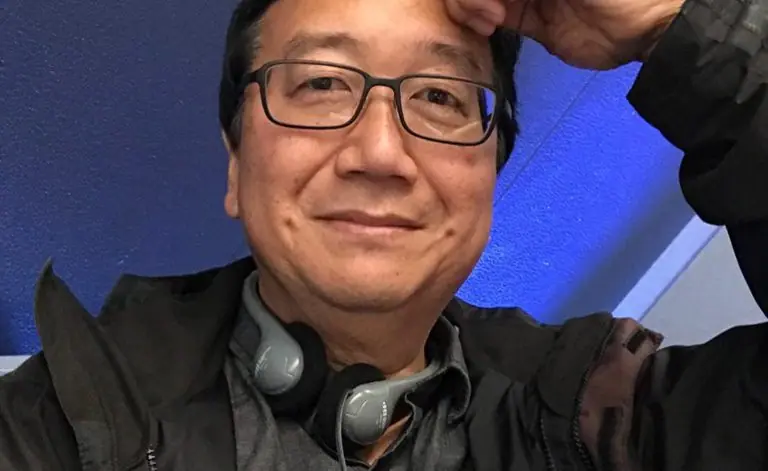
Bing Rao is a cinematographer and producer trained at the Beijing Film Academy and New York University, where he later taught cinematography in the Graduate Film Program. He shot the Chinese feature Suffocation, the Dolph Lundgren films Diamond Dogs and Missionary Man, and Heart of a Dragon, inspired by Rick Hansen’s journey to the Great Wall. Before all of that, he was the interpreter between Woody Allen and cinematographer Zhao Fei on Sweet and Lowdown. And he once turned down a studio job in China rather than cut his ponytail.
Early life in Beijing
Bing grew up in Beijing. His father worked for the government’s radio station, and that is how young Bing was invited to a special screening of The Sound of Music at an ornate Beijing theater. Word of the film caused a near riot, with about a thousand people storming the building.
The theater’s screen and old projector could not show a wide 35mm print properly. Chinese films at the time were made in 1.33:1 or 1.66:1. “It looked awful, but everyone loved it anyway,” he told us. That screening started his love of American movies.
He studied at the Beijing Film Academy, then the country’s only film school, and earned a BFA in Producing. He met his future wife, May Lyle, there. She was an American student at the Academy who was born in New York, and they married in China.
The ponytail story
Graduates of the Beijing Film Academy were assigned to a studio. In his fourth year, Bing’s interview with the department head turned to his long ponytail instead of his work. He had been too busy to cut his hair, and he refused.
“I was a stupid, 26-year-old kid,” he told us. “I said, ‘No. If you want me to cut my hair, the next thing you will want is to cut my script.'” The film company withdrew its offer. He says that without that moment he would be working in China full-time.
His first piece of advice for students came straight from that story: let go of trivial principles that may defeat your career goals.
Getting started in New York
Bing’s film career began in Beijing in 1989. In 1994 he moved to New York, where his wife was from, to keep studying. At first his English was not good enough for NYU. A year later it was, and he entered the MFA program in cinematography at the Tisch School of the Arts.
At NYU he shot every project he could. “Work for free, or just food, and work when it’s cold outside,” he told us. In 1998 his black-and-white short Ellis Island won Best Cinematography at Columbia University’s Ralph Lauren New Works Film Festival.
Being bilingual and trained as a cinematographer gave him an unusual first job on a big American film. A classmate of his wife’s was working with line producer Richard Brick for Woody Allen. Allen admired Raise the Red Lantern and hired its cinematographer, Zhao Fei, who did not speak English. Bing became Zhao Fei’s interpreter on Sweet and Lowdown (1999). He learned quickly that Allen and star Sean Penn did not want small talk on set, so he kept it all business.
In 2000 he was associate producer on Ann Hu’s Shadow Magic, a story about the arrival of motion pictures in China, and he shot the New York features All the Wrong Places and The Sunshine Deli and Grocery. He graduated from NYU in 2002 and stayed on as an instructor in its Graduate Film Program.
Working between China and the West
His work on Suffocation, about a husband who thinks about killing his wife, caught the eye of the Beijing Film Studio, part of China Film Group. The studio hired him to shoot Zhang Si De, a feature about Zhang Side, written by Liu Heng. Bing called it the biggest film project of 2004.
He found that what he had learned in America about running a production was worth even more to Chinese producers than Hollywood polish. “At this point, I like working in China,” he told us.
That bridge led to his best-known features. In 2007 he shot two films with Dolph Lundgren: Diamond Dogs, a Canadian-Chinese adventure set in the Chinese wilderness, and Missionary Man, which Lundgren directed. In 2008 came Heart of a Dragon, written and directed by Michael French and made with China Film Group. It follows a reporter tracing Rick Hansen’s wheelchair journey through China to the Great Wall. When Bing first talked to us about the project, he was set to be a co-producer and one of its cinematographers, because of his experience shooting in China.
Career timeline
| Year | Milestone |
|---|---|
| 1989 | Film career begins in Beijing |
| 1994 | Moves to New York after earning a BFA in Producing at the Beijing Film Academy |
| 1998 | Best Cinematography, Ralph Lauren New Works Film Festival at Columbia University, for his black-and-white short Ellis Island |
| 1999 | Interpreter for cinematographer Zhao Fei on Woody Allen’s Sweet and Lowdown; shoots the short The Magician |
| 2000 | Associate producer on Shadow Magic; shoots All the Wrong Places and The Sunshine Deli and Grocery |
| 2002 | MFA in Cinematography, Tisch School of the Arts, NYU; later teaches in NYU’s Graduate Film Program |
| 2003 | Shoots, produces and operates Steadicam on the short Slowly Silently |
| 2004 | Shoots Zhang Si De for Beijing Film Studio |
| 2005 | Suffocation released (credited as Xiaobing Rao) |
| 2007 | Shoots Diamond Dogs and Missionary Man, both starring Dolph Lundgren |
| 2008 | Shoots Heart of a Dragon; executive producer of the video Shishang xiansheng |
| 2017 | Shoots the shorts Mam and Death by the Lake |
People Bing Works With
- Dolph Lundgren: star and uncredited co-director of Diamond Dogs (2007, directed by Shimon Dotan as Samuel Dolhasca) and star and director of Missionary Man (2007), both shot by Bing.
- Zhao Fei, the cinematographer of Raise the Red Lantern, with Woody Allen on Sweet and Lowdown (1999), where Bing was Zhao Fei’s interpreter.
- Ann Hu: Shadow Magic (2000), her first film as director, with Bing as associate producer.
- Michael French: writer, director and producer of Heart of a Dragon (2008).
Tools he loves
Bing learned on film stock and has shot more of it than video. When he talked with us, his HD camera of choice was the Sony F900. He did not want to buy a camera of his own, because the technology changes so fast. “I’m not skeptical about the look [or quality] of HD. I know it’s just great. It makes things simple,” he said.
His bigger tool is his attitude toward the job. Film or video, he said, a cinematographer should do their best to help the director as much as the director allows. He also told us he was writing a script he planned to direct.
Life outside the set
Bing’s life has moved between two countries since film school. He met his wife, May Lyle, at the Beijing Film Academy, and her hometown of New York is why he chose NYU. “So, I am just lucky regarding choosing film school,” he told us.
In his own words
“I couldn’t get into NYU because my English was so bad.” (Student Filmmakers Magazine)
“Work for free, or just food, and work when it’s cold outside. I’ve done all that myself. A lot of students won’t do it.” (Student Filmmakers Magazine)
“And be thorough, don’t run in the other direction just because something appears to be hard.” (Student Filmmakers Magazine)
“… my approach as a cinematographer is that you should do your best to help the director as much as he/she allows you.” (Student Filmmakers Magazine)
With StudentFilmmakers
Bing gave an exclusive interview to Student Filmmakers Magazine, conducted by New York writer Larry Jaffee, about how China’s film industry was changing and what he had learned working in both countries. It closed with four pieces of advice for students: let go of trivial principles, get on shoots whenever you can, don’t pass up networking, and remember what job you were hired to do. The earliest copy we can find online was posted on our website on October 10, 2009. We shared it again on February 7, 2020.
His story has come back in our pages since. Our 2025 guide What Does a Cinematographer Do? points readers to his interview to see how a cinematographer adapts to different markets and workflows. Our Cinematographer Honor Roll names him as proof that there is more than one way in, since he could not get into NYU at first because of his English.
Current Productions
No current projects are publicly listed for Bing Rao as of November 28, 2026. His most recent credits on IMDb are the 2017 shorts Mam and Death by the Lake.
Complete credits
Newest first, from IMDb (checked November 28, 2026), with Wikipedia and our own interview noted in our source list.
Cinematographer
- 2017 | Mam | short
- 2017 | Death by the Lake | short
- 2008 | Heart of a Dragon | feature | directed by Michael French
- 2007 | Missionary Man | feature | directed by Dolph Lundgren
- 2007 | Diamond Dogs | feature | credited on Wikipedia as Xiaobing Rao
- 2005 | Suffocation | feature | as Xiaobing Rao
- 2004 | Zhang Si De | feature | Beijing Film Studio (from our interview; not on IMDb)
- 2004 | Shen Nong Jia Adventure | film | from our interview; not on IMDb
- 2003 to 2004 | Angel Beijing Opera | from our interview; not on IMDb
- 2003 | Too Late Loving You | from our interview; not on IMDb
- 2003 | Slowly Silently | short
- 2001 | Wisdom Day | short
- 2000 | All the Wrong Places | feature
- 2000 | The Sunshine Deli and Grocery | feature
- 1999 | The Magician | short | as Xiaobing Rao
- 1998 | Ellis Island | short | black and white; Best Cinematography, Ralph Lauren New Works Film Festival (from our interview; not on IMDb)
Producer
- 2008 | Shishang xiansheng | video | executive producer
- 2003 | Slowly Silently | short | producer
- 2000 | Shadow Magic | feature | associate producer
Camera department
- 2003 | Slowly Silently | short | Steadicam operator
Other crew
- 1999 | Sweet and Lowdown | feature | interpreter for cinematographer Zhao Fei
Self
- 2010 | Taming the Dragon | TV movie | himself, cinematographer
- 2008 | Making of ‘Diamond Dogs’ | video | as Xiaobing Rao
On StudentFilmmakers
Articles by, with and about Bing
- Working in China: Chinese-American Cinematographer Bing Rao Tells How (online by October 10, 2009; shared again February 7, 2020)
- Cinematographer Honor Roll: Passing On the Art of Cinematography (November 8, 2026)
Other articles that mention him
- 10 Best Tips for Young Filmmakers (November 18, 2020)
- 10 Inspiring Tips for Next Generation Filmmakers (November 19, 2020)
- What Does a Cinematographer Do? (November 28, 2025)