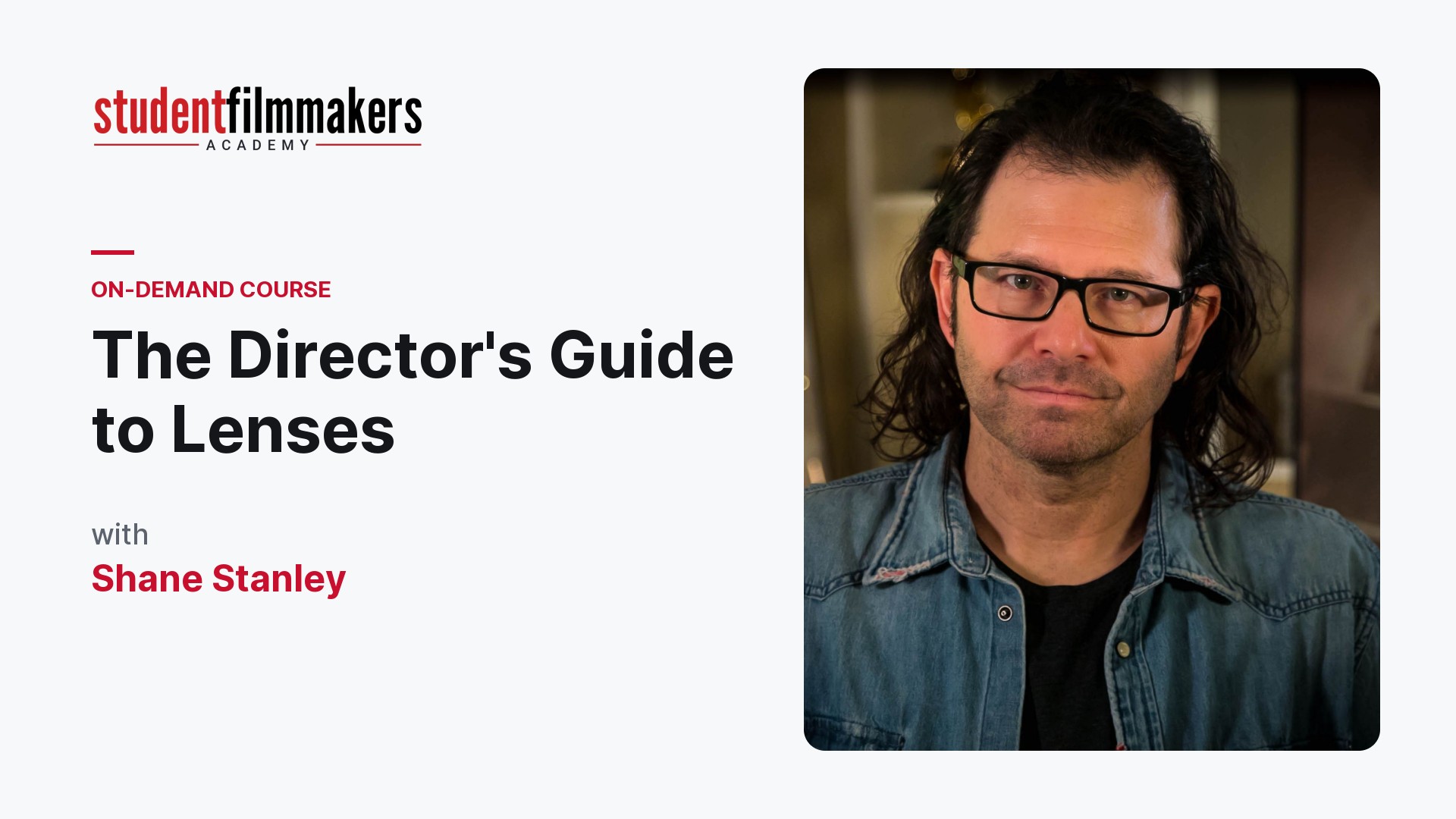
Shane Stanley, who directed Night Train and Double Threat and served as an executive producer on Gridiron Gang, treats every lens as a story decision that also lands on the schedule and the rental invoice. His class for directors walks from the widest glass to the longest and shows what each one does to space, depth and feeling, so a director can talk shots with a cinematographer without guessing.
Why should a director care about focal length?
Because the lens decides how near the audience feels to a character before anyone acts. A low number takes in more of the world and pushes things apart. A high number narrows the view and squeezes the background up behind the subject. Shane’s point is that a director does not need to light or pull focus, but does need to know which of those effects a moment calls for, and to say it out loud in prep.
He works from still frames in the class rather than theory. Each picture is a chance to ask what the lens is telling the viewer about place, about the relationship between two people, and about how small or large someone is in their world.
Where does a scene start?
Shane likes to open wide. His example is a couple walking along a beach under a huge sky: one frame sets the location, hints at how the two feel about each other and makes them look tiny against nature. He adds extras moving through the foreground to build layers of depth.
Wide has limits, though. In a small room he rarely reaches for a 14mm or an 18mm, because that glass bends faces and walls in a way that pulls attention to the lens itself.
Which lenses carry a dialogue scene?
For most conversations, Shane leans on three focal lengths in the middle of the range:
| Lens | How Shane uses it |
|---|---|
| 35mm | Wider singles and two-shots that keep some room around the actors |
| 50mm | The workhorse medium for dialogue |
| 85mm | Tighter singles that separate a face from the background |
His favorite trick is to run a 50 and an 85 at the same time on two cameras. The editor then has two matching sizes on every take and can cut between them freely. He also questions the familiar claim that a 50 matches human sight, and he argues that even a film shot entirely on one focal length can change its look from scene to scene through distance, angle and movement.
One more relief for new directors: you do not need a single flawless take from the first line to the last. Good coverage lets the editor build the best version from pieces.
How do you plan coverage for a busy scene?
Shane breaks a crowded scene down step by step, from the master down through mediums and close-ups, deciding at each stage what the lens has to show. Planning in that order keeps the day moving and makes sure the editor gets every size the scene needs. For more on building that plan, see The ABCs of Coverage: Master, Matching and Multiple Coverage.
What does a lens choice cost?
This is the part many lens talks skip. Shane explains who puts together the lookbook and the equipment wishlist with the cinematographer, and why specialty glass should be scheduled with care. If a long lens is needed for several shots, he groups those shots back to back so the rental covers as few days as possible.
He also tests big ideas before the shoot. Before Gridiron Gang, the team spent a full day testing at a location rather than discovering problems with the clock running. On his Civil War film, he found a way to get a wider, more cinematic frame without anamorphic lenses.
That leads to his caution about anamorphic for indie filmmakers who hope to sell their work. The look is beautiful, but the glass costs more and slows a small crew, and a 2.39 crop can deliver a similar shape for far less.
Primes or zooms?
Filmmakers in the live audience pushed on this, along with a student film that felt wrong and how a slow dolly creep should feel on screen. Shane does not crown a winner. Primes tend to be faster and sharper; zooms let you reframe without a lens change. The right answer depends on the scene, the crew and the time you have. The magazine’s Zoom Lenses vs. Prime Lenses goes deeper on the trade-offs, and Choosing the Right Camera Lenses for Filmmaking covers the basics of a first lens kit.
Lens habits to bring to prep
- Pick each focal length for what it does to the audience, not out of habit.
- Open wide to set the world, then move in.
- Pair a 50 and an 85 on two cameras for dialogue.
- Group long-lens shots so specialty rentals stay short.
- Test bold ideas before the first day.
Shane is clear that no lens is the correct one for every film. The skill is matching the right glass to the right moment, and the full class, with its audience questions, shows how he makes those calls.