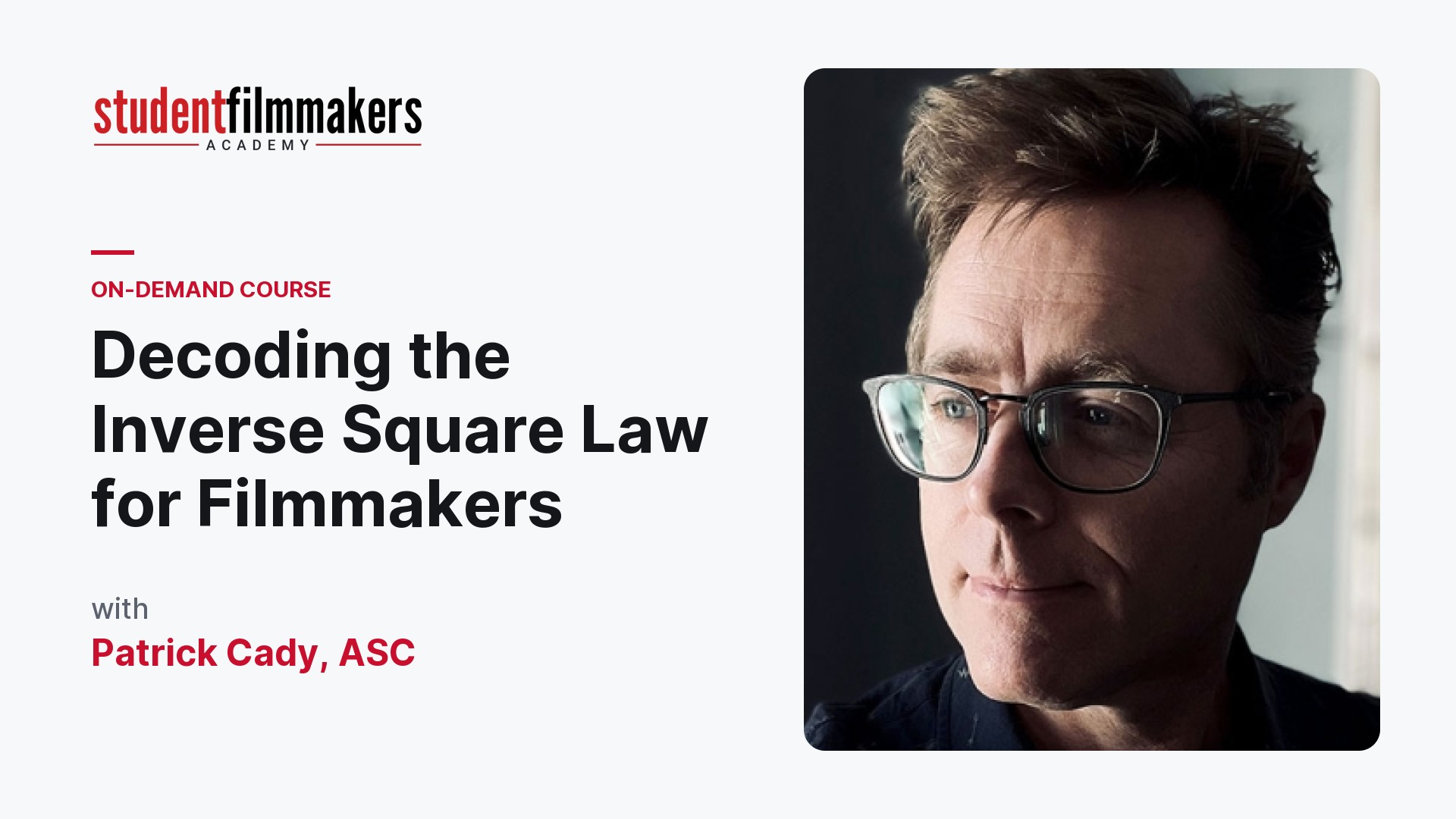
Patrick Cady, ASC, Emmy-nominated for shooting Insecure and a director of Bosch, Rectify and Interrogation, made a short film in a Panavision test room to explain the one bit of math every cinematographer fights: the inverse square law. His practical takeaway is simple. Put the light far enough away, or bounce it, so your actors move around where the light barely changes.
What is the inverse square law, in plain terms?
Cady admits he glazed over the first time it was explained to him in film school, because it was math. He did not expect to use it every day. His film, made with friends Nathaniel Miller and Janice Whitehead, opens with a warning: “If you’re a young cinematographer and you don’t know what the inverse square law is yet, welcome to the bane of your existence.”
The demo used a bare 200-watt bulb, chosen because a point source makes the math clean. A gel frame with a taped square sat three feet away. At six feet, twice the distance, the light passing through that square covered an area two squares wide and two squares tall: four squares. At nine feet, three times the distance, it covered nine. So doubling the distance leaves one quarter of the light, and tripling it leaves one ninth. The light is not traveling in a neat line to your meter; it spreads out in every direction.
Before the film, he gave the unit it was all measured in. One foot-candle is the light of one candle measured from one foot away. Twice the foot-candles is one stop brighter. That also means two stops needs four times the light: if a scene needs 100 foot-candles at f/2, it needs 200 at f/2.8 and 400 at f/4.
How fast does light fall off as you walk away?
Next, the team marked the floor every time the meter dropped one stop. These are the distances they recorded from the bulb:
| Foot-candles | Distance from the bulb | Extra distance for that stop |
|---|---|---|
| 800 | About 1 ft | – |
| 400 | 1 ft 5 in | About 5 in |
| 200 | 1 ft 11 in | About 6 in |
| 100 | 2 ft 9 in | About 10 in |
| 50 | 3 ft 11 in | About 13 in |
| 25 | 5 ft 8 in | About 21 in |
| 12.5 | 8 ft 3 in | About 31 in |
| 6 | 12 ft 6 in | About 4 ft |
| 3 | 18 ft 8 in | About 6 ft |
Close to the lamp, four stops of change happen in under three feet of floor. Out past 12 feet, an actor can walk six feet and lose only one stop. Cady calls that region “the bottom of the curve,” and it is where he wants people to work.
What does that look like on a face?
To show it, Cady set the camera at 1600 ASA and worked out the stop by halving: 100 foot-candles at 100 ASA gives f/2.8 (at 24 frames and a 180-degree shutter), so 1600 ASA needs only about 6 foot-candles for f/2.8. Standing at the 25 foot-candle mark meant stopping down two stops, to f/5.6.
From that mark he walked toward the lamp and quickly gained four stops, “ridiculously bright.” Then he reset at the 6 foot-candle mark and walked a long way in both directions for a change of about one stop, which most cameras today will handle fine.
That is why big lights sit far outside stage windows. If you are faking sunlight, it should not jump in brightness as an actor crosses a room:
“We want lights big enough and far away enough that we’re working in that end of the scale down there where we’re further away.”
He has even sent sunlight down the full length of a stage with mirrors so the parallel beams through one small window looked right.
What if the room is too small to back the light away?
Bounce it. In the cramped test room, he aimed a Fresnel over his head into a bounce card covered in Rosco Roscoflex gold soft. The steep part of the falloff happens on the way to the bounce, out of the acting area. By the time the light comes back to the actor, the team measured about a one-stop change across a usable patch of floor.
He learned this as an intern on John Sayles’ Passion Fish, his first set, watching a cinematographer from England named Roger Deakins do exactly that. “The student in me who had been taught the inverse square law, I was like, I know why he’s doing that.”
Other fixes he mentioned:
- Nets on the bottom of a fixture to cut the light where actors pass closest, adjusted while a stand-in walks the scene.
- Heavy diffusion, so the diffusion becomes the new, larger source. He likes grids and book lights for this, and once lit a tiny set with a giant light bounced into a corner and through heavy diffusion to match a big light far away through curtains.
- Mirrors overhead. On the first half of season one of In Treatment, there were only about five feet outside the set’s window, so he bounced lights from above into mirrors to gain distance.
- Graph paper. He has helped decide how high an expensive set should be built by drawing the distances out.
Modern fixtures do not escape the rule. He pulled up ARRI’s published numbers for an Orbiter: 132 foot-candles at 20 feet, a quarter of that at 40, a ninth at 60. Even a xenon follows it once past its focus point.
Does Cady still use a light meter?
Rarely. In film school his meter broke and he could only borrow the school’s foot-candle meter, so for a year he converted every reading into stops by hand. That year, he says, made him see light as a physical thing. As a working cinematographer he moved to false color: “It’s like a spot meter of the entire scene,” read by the same sensor that records the image. His meters stayed on the truck except on scouts.
For someone starting without a meter, he suggests locking exposure in Blackmagic’s free camera app on a phone and walking around a lamp at home to watch how fast things change. He also recommends old film noir, where hard light is shaped into pockets and actors move from one controlled pocket to the next.
How do you light a big room full of moving actors?
Block, light, shoot, in that order, every time:
“You are there so that they can tell the story. If your photography is of a great performance because they had freedom, you’re gonna look better.”
Once a scene has hard sun coming in, he says, you have permission for light to bounce around the room in interesting ways. He likes to rip a light across the floor under the camera into a bounce, so a bright window behind the actors seems to fill the room. It helps, he adds, when something in the room feels as if you could not control it, even though you did.
What can you light with on no budget?
Whatever gives you the most freedom: one hard point source you can push through things, one source that turns soft easily, and plenty of bounce. Hardware-store clip lights work. A bulb in a white five-gallon bucket is a sturdier China lantern. For the test, he sanded the bottom of a baking pan into a matte silver bounce, and one shiny card was insulation from the hardware store. Black disposable picnic tablecloths, hung from a drop ceiling with hook magnets, make cheap, light teasers. His rule: “If the idea is stupid and works, it’s not stupid.”
Limits can help, too. On Girlfight, the first feature he shot that people saw, the crew had one 5K, push-processed the film to 1200 ASA for night exteriors, and lit everything to f/4 because one zoom was so slow.
Keep going with Exposure: Why Still Use a Light Meter? and our earlier interview with Patrick Cady, ASC.