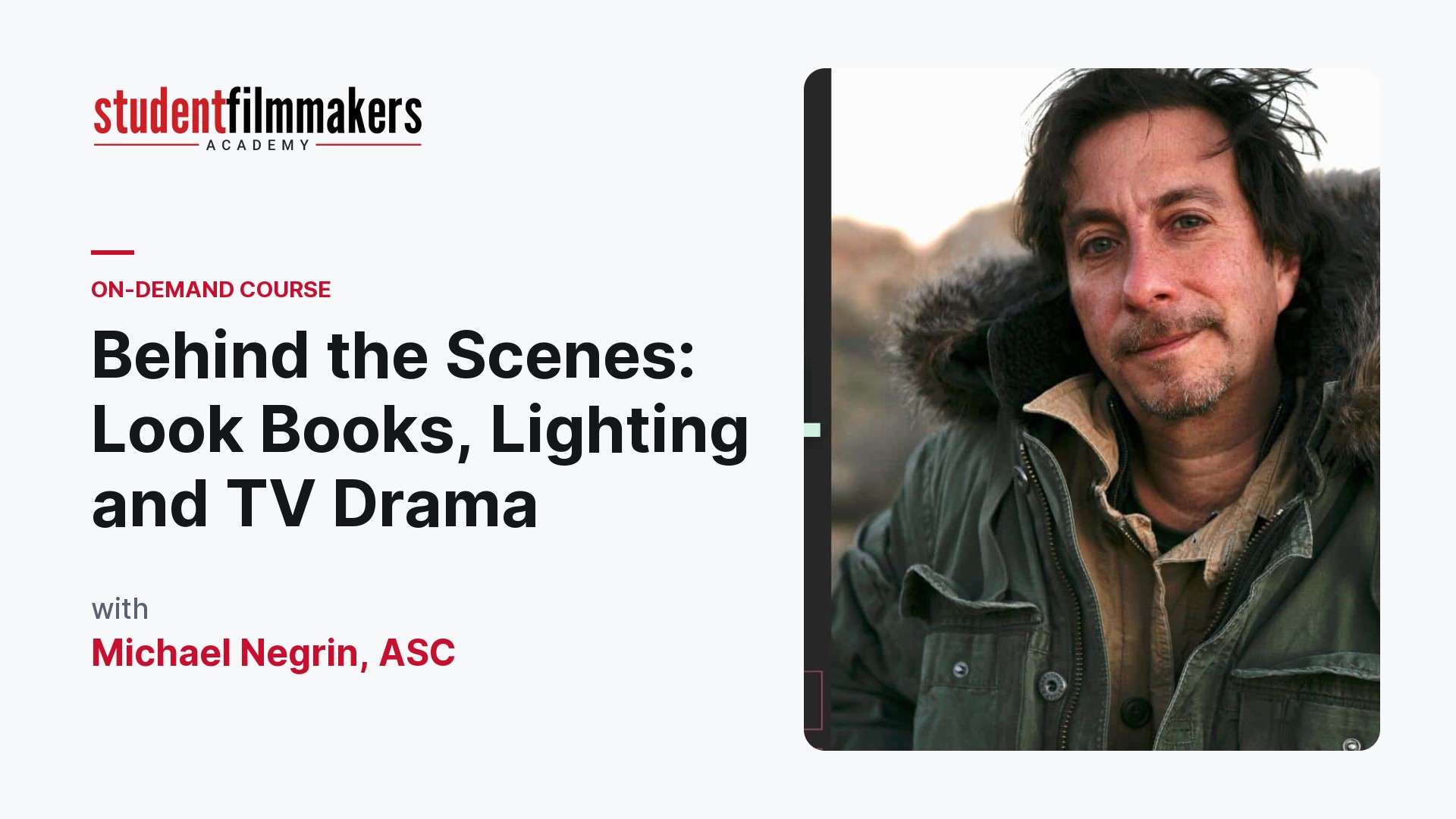
Michael Negrin, ASC, a director of photography on Hulu’s legal drama Reasonable Doubt and on BET’s Being Mary Jane and Bigger, keeps television lighting dramatic, naturalistic and simple enough to finish in a 12-hour day. Between seasons, he opened his look books for StudentFilmmakers members and explained how he lights a courtroom for four cameras at once, why he keeps TV dark, and how he works with a new director every episode.
Why does a TV cinematographer make a look book?
More and more, it is part of getting hired. When a producer is choosing a DP, Negrin says, they often ask for a look book that shows what you would bring to the show. His are built from frame grabs of his own series, mixed with stills from other work that fits the writing.
For Bigger, a BET series about five college friends in their early 30s, the lead kept breaking the fourth wall. Negrin studied the shows that do it best, House of Cards and Fleabag, where a character in a classic over-the-shoulder suddenly looks into the lens to comment on what was just said. He explained the difference from crossing the line: on a fourth-wall break, the actor steps out of the scene for a moment and speaks to the audience.
The book became a style sheet for the writer-producers and a guide for each visiting director on when a look to camera was allowed. It also made his case for drama in a funny show. He pushed for naturalistic source light instead of flat comedy light, and the producers agreed, as long as the cast looked good.
A second book, for a period music project about singing sisters, went unused when the show moved to Toronto. The research wasn’t wasted: much of it fed his dramatic lighting on Kingdom Business, a series about a gospel church and its big performances.
How do you light a courtroom for four cameras?
On Reasonable Doubt, several episodes had big courtroom scenes with heavy page counts. His solution was one direction of light for the whole room:
“I lit everything from one side with very soft light. And the director and I agreed we will shoot the axis, the one axis that looks great on everybody.”
The soft light wrapped around the lawyers, the defendant and the jury box alike. Because the source sat to the side, it worked for both directions of coverage. People who faced away from it were simply backlit, so he added a little bounce fill in front of them for exposure. That let him shoot cross angles at the same time: one camera over the lawyer’s back to the witness, one behind the witness on the lawyer, and two more on people listening. Four cameras, and the lighting never had to bend.
Outside it is harder. Big silks help, and so does scheduling. He avoids shooting at noon in summer unless the harshness is the point, and he looks for morning or late-day light when several cameras are rolling on stunts and crowd reactions.
What does a long lens give the editor?
His Being Mary Jane frames showed what he means by naturalistic and dramatic. In the final season, in a real hotel, he put lamps on condors across the street to create daylight, then shot on ARRI Alexa with Cooke lenses at T2 and used diopters for blur as the lead drifts into disbelief that she is finally getting married. Backlight and cross-light carried the romance.
In a restaurant he backed off to a 135mm lens so extras could cross the foreground. The editor then used those crosses as wipes to jump to a fresh close-up. At a family dinner he gave the lead’s brother a big close-up on one third of the frame with the niece soft behind him, then racked focus as he turned to see her reaction. One shot covered two reactions.
Is TV too dark now?
He has read the critics who ask that. His reply: “why is television so dark? And I mean, my answer is, because it looks good.” Digital has made that possible. In the film days, a release print or a transfer added contrast, like a copy of a copy, and dark faces could fall into black. His father, Sol Negrin, ASC, shot Kojak, where a low-contrast print was projected into a video camera to make the two-inch tapes for broadcast.
Asked whether he lights darker skin differently, Negrin said today’s cameras let him light everyone naturalistically, and he loves how digital renders African American skin. If a producer later wants to see a face better in a dark scene, a tracked power window in DaVinci Resolve lifts it in post. Outdoors, a polarizer is his fix for shine. On Kingdom Business it took the sun’s glare off Michael Beach’s sweating head so you saw his eyes, though he warns it can add a slight magenta shift to skin.
Who wins when the DP and the director disagree?
He goes by what his father always said, that the director is the captain of the ship: “If ultimately the director wants to go in a certain direction, then you go in the direction of the director.” Early in his career, an older director picked a shot that wasn’t from anyone’s point of view. Negrin whispered his doubt, was overruled, and kept going. As the scene played, the director came back and quietly asked him to turn the other way, which meant relighting everything. Negrin did it without a fuss.
A DP on episodic TV has to be a diplomat, he says. Executive producers often make the cinematographer responsible for the show’s look, so if a director wants to go far off style, the producers need to hear about it. If he agrees with the director, he offers to be their ally in that conversation.
Before taking any job, look at the director’s work. If your taste and theirs don’t match, he says, don’t sign up for a battle that lasts the whole show.
How fast does episodic lighting have to be?
Fast. Moderately budgeted shows want to wrap in 12 hours. Negrin has simplified his style so it is “elegant, but not complicated.” He aims to finish the first lighting setup of a scene in 20 minutes to half an hour, 35 at most, and designs it to hold up on the reverses without a big relight. A touch that adds 10 or 15 minutes gets cut, because across 30 setups a day those minutes cost you the day.
What makes the prep pay off?
On both seasons of Reasonable Doubt he had a week of prep with each episode’s director, walking the locations before sending notes to his crew. He expects his gaffer, key grip and operators to read the script and bring ideas, like a high crane shot that shows a character’s isolation, because “the people I’ve been working with are not just technicians, but they’re filmmakers.” He asks for stand-ins who are real actors and learn the lines. On Being Mary Jane, one stand-in played scenes so well that the crew put her in the wig and wardrobe for overs when Gabrielle Union wasn’t available.
And then the actors run the scene:
“There’s no director. There’s no cameraman, camerawoman who doesn’t want to see a rehearsal. The rehearsal tells you everything.”
A great rehearsal can change the plan. The director may decide the master plays so well that one medium close-up and a reverse are enough.
For more, read about how polarizers work, lighting in small spaces and what happens in a rehearsal.
In the full class, Negrin also covers a Showtime series’ rules for masters and overs, documentary coverage on a single camera, operating a geared head and lighting tight spaces with Astera tubes.