By Mary Ann Skweres
How Adam Parrish King’s stop-motion student film The Wraith of Cobble Hill was made and went on to win at Sundance, with lessons for student animators.
When they attended the Sundance Film Festival Closing Night Awards Ceremony, writer, director and animator, Adam Parrish King, along with wife, producer and editor, Monique Zavistovski, were unaware that their short animated film, The Wraith of Cobble Hill (15 min., B & W, 2005), was even in competition. So when the bittersweet fable was announced Winner of the Sundance Jury Prize for Short Filmmaking, the filmmaker was literally speechless. The award is well deserved. The heartfelt, beautifully executed film comes to life almost entirely from King’s singular vision.
This coming-of-age-tale tells the story of Felix (Jonathan Sayres), a disaffected teen who lives in a cramped tenement apartment with his deadbeat mother (Kathleen Demarest). Left to fend for himself, Felix habitually pilfers candy bars, comic books and TV dinners from the corner deli, right under the noses of the kindly Polish shopkeeper, Mr. H (Pedro Pano), and his beloved dog, Mitzie. At night when the shopkeeper returns home, the widowed Mr. H’s lonely sobs and the nostalgic Polish ballads he plays on an old 78, seep from the apartment above into the boy’s room, to be heard by the equally alone young man. When Mr. H asks Felix to watch the store and care for Mitzie while he is on holiday, the boy is faced with a life-changing decision. He must decide between acting with uncharacteristic honesty or betraying the trust the benevolent shopkeeper has bestowed upon him.
As an undergraduate at the University of Pennsylvania, King studied painting and sculpture. King describes his artwork as surrealistic and figurative. He admits that the characters he created always had back-stories, “concocted in my head.” With an interest in moving pictures sparked by collaboration on a monthly college television series, eventually King realized he wanted to tell those stories. After completing his undergrad degree, he was accepted to the University of Southern California Graduate Production Program.
USC has an intensive filmmaking program, arguably the most prestigious in the country. Students produce 5 films per semester with a schedule of about 2-3 weeks per film. Film school offered King the ability “to explore ideas freely without the pressure of money-making.” He could also learn the various filmmaking crafts. Although he had thought that he would be drawn to cinematography, instead he gravitated to sound design and animation. King took all the courses he could in those disciplines and crewed up on other student productions as both production and post sound mixer.
The Wraith of Cobble Hill is King’s thesis film. He wrote the script in a class. To have it produced under the auspices of the program, he had to pitch the project to a panel of faculty members. However, since King wanted to use stop-motion animation, production was going to take longer than the three semesters allotted for completion. The film got the green light when faculty member, Brenda Goodman, agreed to guide the epic undertaking, an all-consuming passion for King that eventually took six years to complete. Technically, he has yet to receive his MFA. The film qualifies him for his masters, once he turn-ins paperwork, including his production notebook.
To King, the choice to use animation was “a more subjective approach to story” than telling the tale with live-action. It was like choosing between having a portrait painted and taking a photograph. To create an animation studio, King and his wife converted the only bedroom of their cramped Silver Lake apartment, while they slept in sleeping bags on the floor.
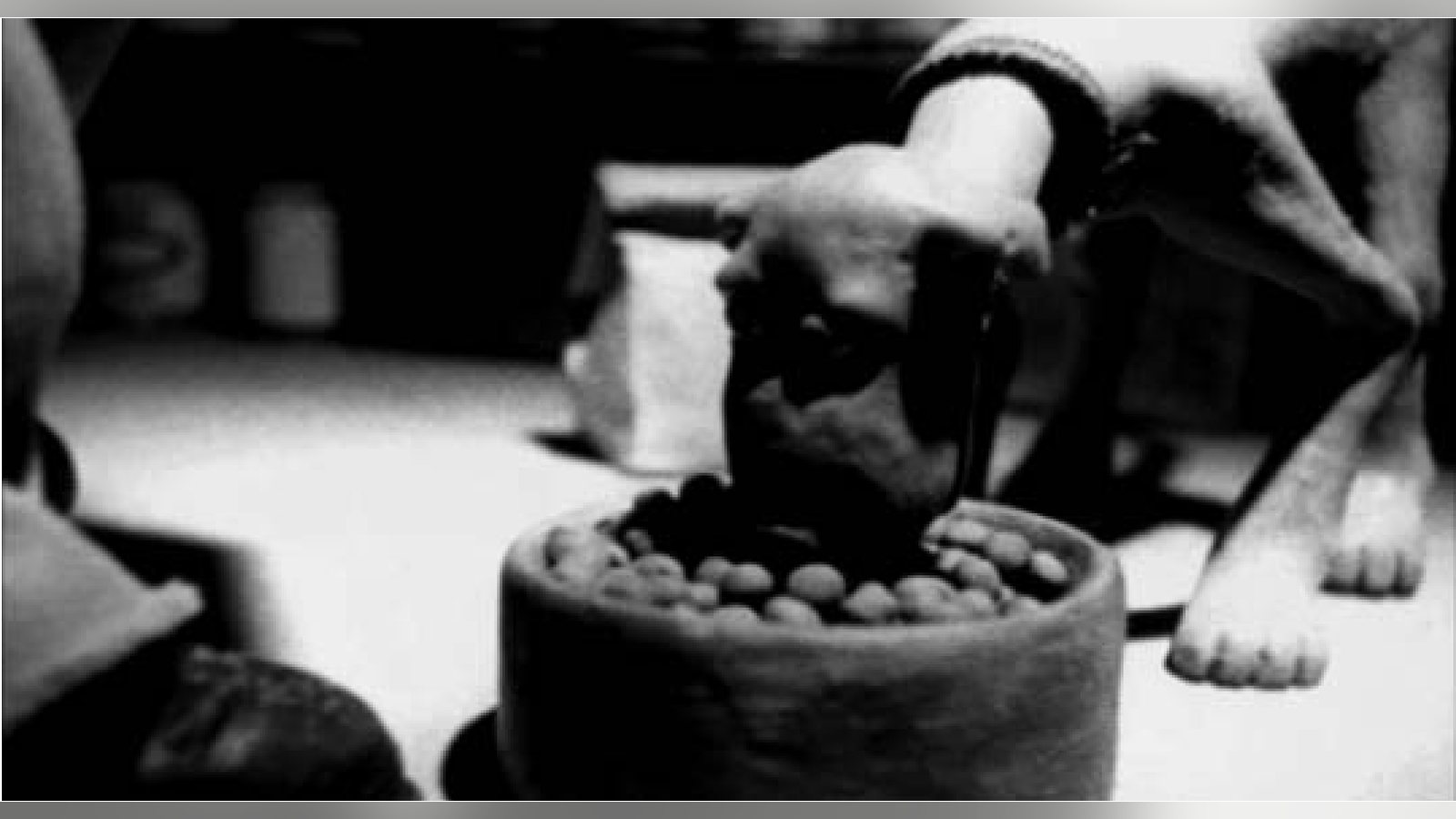
King began the filmmaking process by assembling his cast of actors, recording the dialog in early summer of 2000. He then compiled X sheets of all the syllables and on which frames they hit. At first King tried to animate too many mouth movements for each word, soon realizing there is more latitude in animation sync than in live-action. He abandoned the time-consuming practice of creating the lower jaw out of soft clay, then sculpting each syllable. Instead he created hard clay lower jaws for different mouth shapes and then attached the jaws as needed to the characters’ heads with soft clay.
The sets that King created for the film recall a Brooklyn based on sketches from the years he lived there – a neighborhood of brick tenements, rusting fire escapes and rooftops pieced by pipes. He painstakingly crafted this haunting, visually stunning film from scratch, meticulously re-creating the working class neighborhood with its corner store and crumbling interiors. The corner store alone, took 5 months to produce. The detailed, hand-made process included constructing costumes, building furniture and fashioning hundreds of props — from the lace doilies on the thread-bare sofa to the original comic books, liquor bottles and branded TV dinners that line the store’s shelves. Although costume designer Moe Moe Lwin sewed the costumes for Felix, King learned to sew so he could dress Mr. H.
Steven Gutheinz composed the original music, including a ballad reminiscent of Edith Piaf, which metaphorically serves as both the voice and the memory of the deceased Mrs. H. King wrote the lyrics, which were translated by his father-in-law into Polish. The soulful rendition of the ballad was performed by Krakow cabaret singer, Magdalena Bircynska, discovered when her employer heard “the nanny” singing to the children and introduced her to King.
King had a detailed storyboard as a map to guild shooting. He shot at 24 fps, capturing two frames per movement, essentially 12 double frames per second. For a smoother effect, scenes with camera moves were shot 24 fps, or one
Keep learning filmmaking
Want more lessons like this? Join StudentFilmmakers free for live webinars with working pros, and stream on-demand filmmaking classes in cinematography, directing, screenwriting, sound and post.