By William Donaruma
Film professor William Donaruma explains why his program looked at the RED camera, what he learned from other shooters and what it means for students.
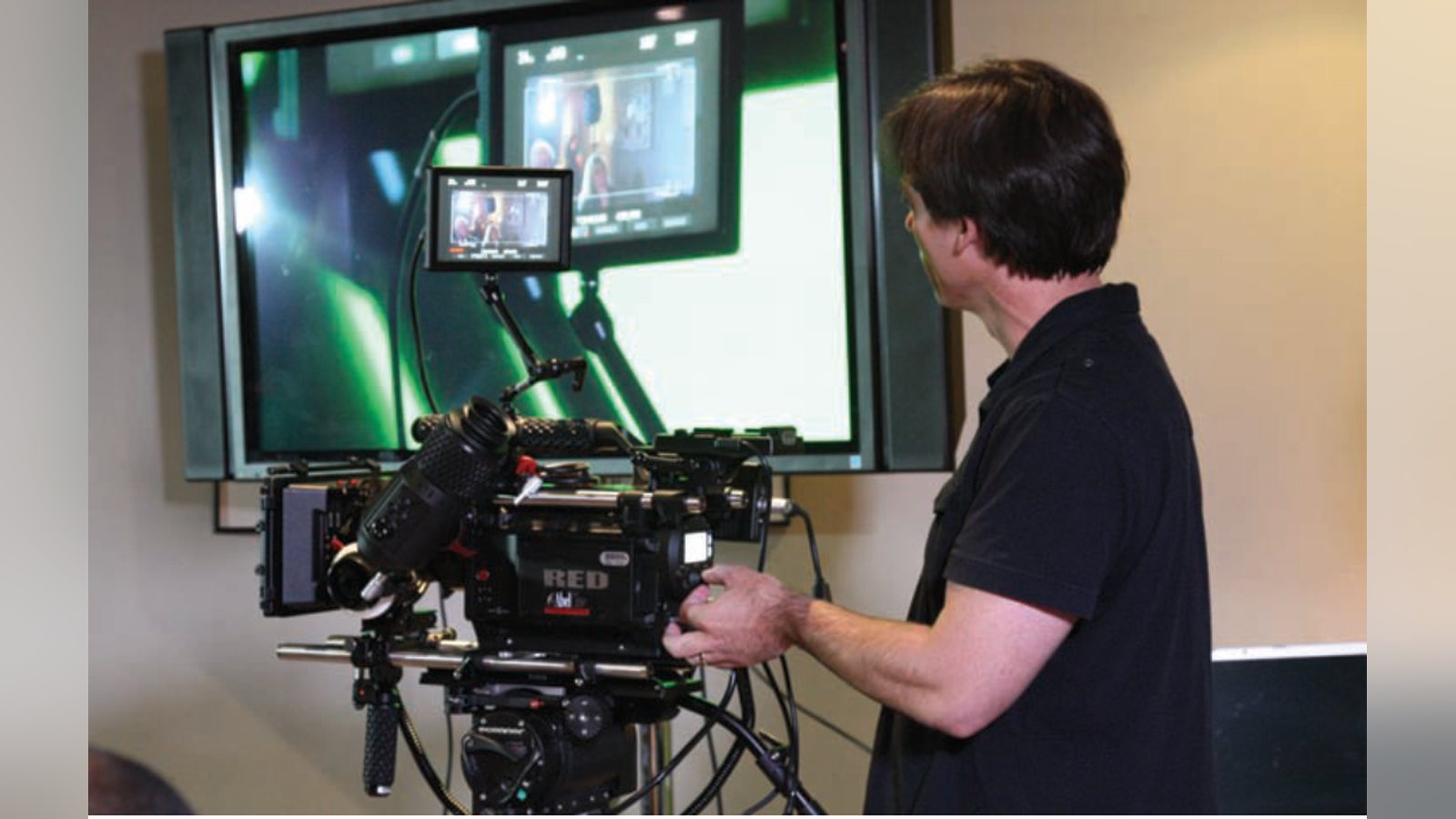
Being relatively new to REDvolution that seems to be happening I have been pouring through industry forums, blogs, countless articles, friends shooting with the Red, and any seminar I can go to, not mention just watching the shows and movies that have adopted the Red format. I have been researching the comparison of other HD cameras to film stocks the past few years, as I primarily work in film and I am a huge advocate of the format. In my opinion, Red and all the companies creating HD cameras (Sony, Panavision, Thompson, etc.) are all still trying to emulate the master medium. I had started working with the HVX200 with good results as a tapeless workflow and became a fan of that system for what it was worth. The film program at the university where I teach was lucky enough to get a Red One camera and my initial excitement gave way to temporary confusion. How do you put this thing together? There are so many options, configurations and potential uses for the Red, that one can get lost in an HD mentality, with a camera right out of the box that has nothing attached to it. It is, in fact, quite useless by itself. But once you put the package together and pass the erector set test Red seems to put you through, you can start getting some extraordinary results.
One of the first things Red proclaims, in any presentation I have been to, is that this is not an HD video camera. It is, in fact, a super-computer housed in an Oakley-inspired shell. They prefer to call it a “Digital Cinema” or “Digital Film” camera, which records a data stream representing an image in a RAW format. This they like to compare to a film negative with the flexibility to alter in post in that it is logarithmic in nature emulating the sensitometric curve of film. The “Mysterium” CMOS sensor compares in size to a 35mm, 3 perf film frame recording an image in wavelet compression, which apparently is a very ‘efficient’ compression and used in digital cinema projection. Other cameras record an MPEG4 compression mostly to HR tape or separate hard drives by way of an electronic umbilical cord. The resulting image is linear in that you commit to what you shoot, thus what you see is what you get. The camera as a computer is also an economic boon, which doesn’t get much discussion. Currently Red is on Build 20, which is comparative to a free software upgrade, thus changing the capability of the camera. Once I buy an HVX200, I have to then shell out for the 200A model if I want better functionality and picture. The same can be said for a Super16mm conversion. Early Red devotees are still up to speed with their investment two years ago.
Much is also made about the true math behind what Red claims to be a 4K image, because of its Bayer pattern sensor. This means that for every line of red or blue pixel information, there are two green pixels, which also carry luminance information. This single sensor pattern holds 4096 lines of resolution, but with a doubling of the green pixel information, technically this drops it below that full 4K image size. The Panavision Genesis, however, records 1920 lines each of red, blue and green on a three sensor CCD. One could argue that this would result in a 5760 line image for the Genesis when you add them together across three chips. This kind of math just gets complicated and the semantics of numbers gets in the way of the bigger picture, as it were. What really happens is ‘pixel binning,’ whereby each layer is then combined to form a kind of super pixel of information. The end result is still 1920 x 1080. The proof is really in the pictures and how the camera is used.
Sticking to one element of particular discovery and importance is CMOS (complimentary metal-oxide semiconductor) sensor. It is natively daylight balanced, like a film stock, and it said to have a rating of 320ASA. I have heard, however, that the real rating is closer to 160ASA, making it rather slow, but this may be because you are supposed to shoot for the low end of the light spectrum, from which the camera image can then expand in post. Some low light tests I had seen, that developer Ted Schilowitz had shot, were remarkable when you saw the RAW image in available night, street light versus the RedCode, corrected image bringing those levels up. Another important finding is that when you alter the menu setting on the camera to reflect ASA, white balance, etc., you are not actually changing the way the camera records an image. The sensor never changes from the RAW, native format, rather you are simulating on a monitor what the resulting image will look like in post, based on the RAW image it records in those conditions. Good to know! In this way, it actually does act like digital film, because you FinD your Voice
can theorize what a film stock will look like based on tests and experience rather than actually changing the way the film captures an image, except of course with filtration.
The monitoring system is quite advanced and allows you to see a histogram, much like you would see in iPhoto when you alter a picture. This is read horizontally, rather than vertically, like a wave form monitor. Being able to use this tool, you can precisely see the digital “negative” and gear it towards its optimal position, towards the low end and not clipping the highlights. There is more flexibility in the shadows to pull from when creating the final image in what is essentially a digital intermediate process. The other option is “predator mode.” This is a false color setting in the viewfinder and monitor, which shows where the sweet spot is for exposure through a color spectrum. Neutral gray is the optimal exposure with reds hitting the highlights and greens and blue covering the shadows. In a comparison to film whereby I would expose for the highlights and open up a half to full a stop for a dense negative, with the Red I would hit the highlights exactly or even drop a half a stop to allow for an extension of detail in post. I have always thought of each digital camera acquisition like a new film stock or tool. You learn how they take pictures and use it accordingly. The technology and ease of use is what sets many of these cameras apart from a film stock and each has its own quality and potential, based on the story to be told. Just a few years ago, a show like 24 would never be able to make the switch because of the mobility needed in tight sets that a digital camera could not accomplish. Engineering has quickly altered that ability and the Red is at the forefront of handheld mobility.
The economics of the camera is really one of the biggest selling points and overshadows the pixel number game. When I tell people, primarily those not in production, that the camera body is $17,500, but an outfitted camera can run $40-50K they still think that is staggering. Back in the days when I shot BetaSP, a Sony or Ikegami camera package would go for about $80K, so the fact that you can now shoot cinema quality productions for half that amount is remarkable. Not to mention that the next options for this kind of imaging are upwards of $200K for a Genesis (which you cannot buy anyway) and an Arri D21. Is their image that much better? You can actually say that Red has come along at the right time in an economic downturn, when it becomes affordable to shoot such high quality. This also lends to the fact that many small production companies and schools, like mine, can actually own these cameras. We would never be shooting student films on a Thompson Viper or Sony F23, so more and more people will be learning this style of cinema in the coming years. Granted, the goal has always been about storytelling, but directors, cinematographers and art directors have been working for decades to make the final image part of the emotional depth of the story on film. Now that can be a proper element as well for both students and independents.
Much like the iPod, Red has spawned a cottage industry for accessories, thus sharing the wealth amongst parts manufacturers. This can be seen as one of Red’s primary selling points. It is customizable to each user and particular use. It can be very simple with camera body, lens, viewfinder and a compact flash card or decked out like a Panavision Platinum with wireless controls, video out, monitors, etc.
Simpler yet, you can put one on a jib or gyro completely stripped down to body, lens and battery and just a video line out to monitor.
My skepticism came in the dichotomy between the Red’s flexibility of a RAW format and the careful exposure you seemed to need in order to protect the highlights. With a film stock, I know I can take a meter reading, be able to open up my stop a little and get a thicker negative and a flexible image with a gradient curve and latitude. The claim that there is about an 11 stop latitude seemed suspect at times with clipping being an issue, much like HD video or any lower end video camera. The rule of thumb is opposite as it is with film. Shoot Red in with a little underexposure, protecting the highlights, while essentially “printing” up in post. Apparently, some can get thrown by the process, but I have seen some movie footage, uncorrected, that looked great. In a master class I once took, Kodak cinematographer, Don Strine, told us “it’s not hard, it’s just new” when it came to densitometry. This may fall into this category of a brave new world of digital cinema.
Over a quick two year period, the development and use of the Red One is quite staggering. The accumulated credit list and more than 6000 cameras in use around the world contradict the myth that it is still an unproven technology. Ted likes to point out that film is still developing in both camera and film stock technology with over 100 years of use, so two years isn’t too bad considering. That and the fact that people have had to take the leap and learn the system in a trial by fire. When you get a Red One camera, there are no instruction manuals other than the 85+ page online document to each build’s operation, which says nothing about how to put together the many parts, bolts and other accessories that you order a la carte. That seems to be an erector set test to see if you are smart enough to earn the right of ownership.
The next step in my own REDucation is the post process. There are many useful software options provided by Red and 3rd party sources like Clipfinder, which Red wholeheartedly endorses, to process the 4K files. The accessibility to such a unique and high quality acquisition format makes Red a certain reason why the REDvolution is occurring. Not many productions or schools could venture into 35mm production and the value that goes with it. Red is affording an opportunity to do so.
William Donaruma has years of production experience working for Universal Studios as well as a variety of production companies and major television networks in film and video production. Returning to the University of Notre Dame, he now teaches production, while producing and directing award-winning films of his own along with his wife, Robin, as writer and co-producer. He has also won the prestigious Kaneb Teaching Award and was granted a fellowship to the Academy of Television Arts and Sciences. More of his work can be seen at www.williamdonaruma.com.
.REDucation is a marketing term created by Red.
Related filmmaking guides
Keep learning filmmaking
Want more lessons like this? Join StudentFilmmakers free for live webinars with working pros, and stream on-demand filmmaking classes in cinematography, directing, screenwriting, sound and post.