By Mary Ann Skweres
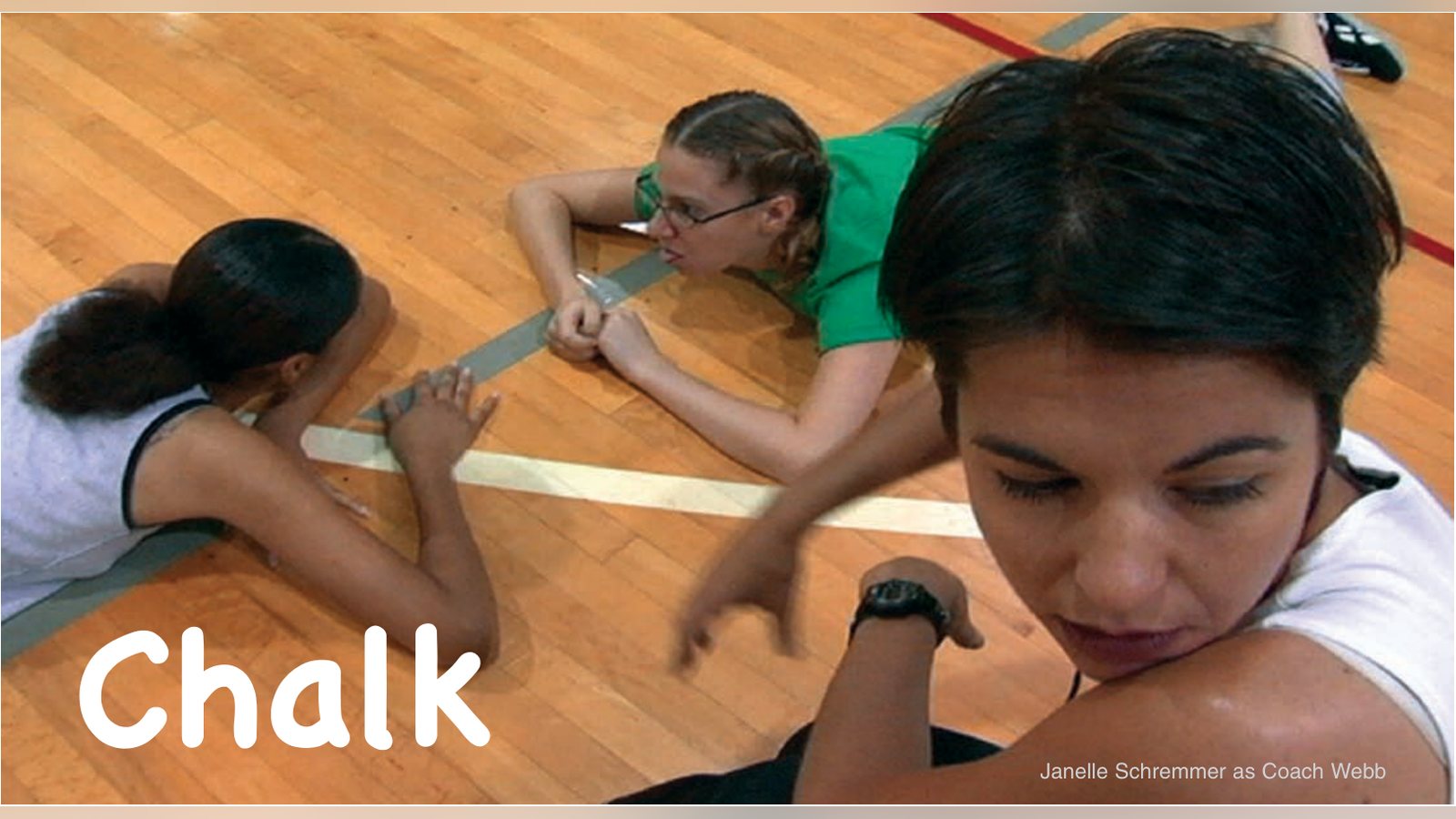
Chalk looks at high school from the teachers’ lounge. Mary Ann Skweres talks with the team about writing, shooting and selling their improvised feature.
Numerous films take on the theme of “high-school-as-hell” from the student point of view. Chalk makes its mark on the popular topic by hanging out in the teachers’ lounge and taking a peek at the public school pitfalls our underappreciated teachers face.
Following a group of novice teachers through the school year as they struggle with intractable bureaucracy, ambivalent students and their own desires to be liked, writer/director Mike Akel and co-writer Chris Mass bring their personal experiences as teachers to light in a mockumentary style full of wit and wisdom. The ensemble story blows conventional forms of filmic storytelling, forsaking common three-act structure, to focus on the individual arcs of the principal characters. This is largely achieved through a combination of documentary style interviews and first person confidences that draw the viewer into the characters’ innermost secrets and personal struggles while gluing together the narrative scenes.
Akel follows the philosophy that, “We are made to create. Some of us are made to exhale – musicians, painters, filmmakers – and I’m one of those people. Chris is too.” The pair collaborated on their last film, the award-winning short, Butchers 15, in 2000. Although they had bills to pay, Akel and Mass were ready for a new project and they wanted to kick it up a notch from their earlier effort, this time writing a feature film.
During the incubator phase both Akel and Mass were teaching, so they decided to write what they knew. Akel says, “I was really inspired by Morgan Spurlock [Super Size Me] in the way he used comedy and how he used himself as a rat in a cage. Chris and I are both teachers. We were always reminded that we couldn’t caricature this; we cannot parody this without heart because we know it. We are not observers; we are giving true testimony.”
There was an ebb and flow in the process between wanting to be funny and realizing the seriousness of teaching – statistics show that 50% of teachers quit within the first 3 years largely due to student apathy and lack of respect for authority. Nevertheless, they believed the best way to approach the subject matter would be with comedy. Akel explains, “You can tackle serious subject manner with humor because it defuses things enough to bring it to a gray area where you can talk about it.” The pair wrote for seven months and came up with a loose script that took into account the basic action and the emotional objectives of a scene, which was then shot semi-improvisationally with a largely non-professional cast. After Akel and Mass watched the first take of a scene, Mass would suggest lines, usually humorous ones to be used in the next pass. The actors also helped Akel and Mass create their characters; they picked their character names based on their favorite teachers.
The film started small. Besides Akel and Mass, the first people on board were producers Mike McAlister and David Gonzales. They pooled together their own money to hire a DP for three weeks of shooting, bought a camera and setup deferred payment contracts with the actors, which included three principal characters that were cast out of New York and played by theatrically trained actors with no prior film experience.
Executive producers Gonzales and McAlister handled the logistics behind the financial and legal matters, including fundraising. Because they did not have the benefit of previous projects or name actors, they waited until after production when they had some edited sequences to form an LLC and find investors. “To mitigate the risks to the investors, I wanted to be able to show them something that we had done,” says Gonzales. “They don’t have to read a script and wonder if we can get it done. We got it done through our own gut and determination and then we were able to go and raise money after that.” As the film started to get accolades at festivals, they continued to raise money.
The film epitomizes the advantages of regional independent filmmaking. Shot in Austin, Texas, the extensive outpouring of support from the local community included the students and teachers at the high schools where Akel and Mass taught. For three weeks during the summer of 2004, students attended “summer school,” participating as actors and extras in the film. Mass jokes, “That’s why some of the class sizes are a bit smaller than what we usually deal with.” Many of the students came cross-town on city buses in Texas summer heat, so the filmmakers were very pleased with the dedication shown. During the shoot, the students did not know what was going to happen, so they had to stay focused on what was happening in each scene resulting in real and natural reactions.
Other resources were also available. Abel explains the hometown advantage, “The beautiful thing about Austin in terms of shooting, and I lived in New York, is you can get locations, there is a phenomenal crew that has experience and you can tap into the University of Texas. Creatively there is this space without the pretentious pressure that might come in New York or LA. And the bills are cheaper.” When the assistant director raised concerns about feeding the cast and crew during the shoot, exec producer Gonzalez, who did not have $10,000 in the budget for meals, wrote 30-40 letters to restaurants all over Austin and invited them to help the arts by giving lunch or breakfast to a locally based film production. He admits, “We were blessed by how people showed up and gave.”
Most of the crew was from Austin with producer/UPM, Larkin Akel (the director’s sister) and editor, Bob Perkins coming out of Los Angeles. “We’re really about community, regional, organic relationships,” says Akel. Mark Harkrider is an example of the type of relationships formed. He met Akel in a Starbucks and was so impressed with him and the subtle political message about the state of education that he invested in the film and became an associate producer.
In keeping with their grassroots filmmaking style, the filmmakers, who had never worked in 35 mm film, saw no need to change on this project. The decision to shoot digitally was compelled by their desire for a fly-on-the-wall documentary style that would allow the viewer to eavesdrop in on public education, the teachers and what is going on today in schools. Cinematographer, Steven Schaefer, working with a second camera operator, shot 24p on mini DV using two Panasonic DVX100As.
Production mixer, Graham Davidson knew Chris Mass and was going to film school when he was asked if he wanted to be involved on the project. Other than student films, it was his first real project. He came on as production mixer, but his role quickly changed into producing and everything to do with sound. Davidson shares, “I did production sound mixing, all the post production sound design and editing. I was also the second editor. Whatever I could do. We edited on Final Cut Pro. For the first few months Apple actually sponsored us.”
Production sound was a challenge because with the improv there was no way to know where the next line was coming from, so there was a lot of on-the-fly trying to figure out how to do things. Still they were able to pull up the dialog on most takes and only needed three lines to be done in ADR. They did not do foley in the traditional sense of covering everything, but Davidson setup a recording studio and control room at his home and with assistant sound designer Gopal Bidari acting as foley artist, they filled in what was needed. To keep the sound authentic, the air conditioners and computers in different rooms were important to Davidson and were added as backgrounds in the mix to supplement those sounds in the production tracks. There were numerous temp dubs and re-edits for screenings and submission to film festivals. Veteran sound designer and re-recording mixer, Tom Hammond, who works with director Richard Linklater, mixed the sound.
Much of the soundtrack had a sparse documentary feel. Chris Jagich composed the original score. For the source music, the production looked for independent artists that were not well known, but made good music. Lawyer Brian Greene, who was responsible for music supervision and licensing, says, “It was choosing those moments when the song would come in and give the audience rest.”
Many of the story lines were developed in postproduction. There were 55 hours of footage and the process was very much like editing a documentary. Mass shares, “The editing was such an amazing process. How they weave the story and how the beginning sets up each character.” The project, which shot an additional five days of pick-ups in addition to the original 3-week shoot, took a year and a half to edit. Akel realized he needed to commit to the film, “I had to decide at the end of the summer whether I was going to go back to teaching. I talked to my principal and told him this is what I was made to do.”
Because postproduction involves a big commitment in time and energy, the filmmakers realized they couldn’t just work with volunteers. To go to the next level, Akel rejected the softball approach of “this is good for your resume.” The decision was made that anyone that came on board in post would be paid, so that is when the first investors started to come on board. They structured the deal so that investors get paid first, plus 20%, then the deferred contacts get paid when the film sells and then the nine owners get paid last. There was time off during editing to raise additional funding, but Akel felt that it was good for the process to step away and evaluate where they wanted the film to go.
After viewing edited sequences several months after the shoot, first assistant director, Angela Alvarez commented to Gonzales that Akel was either the luckiest person in the world or just brilliant. After seeing the response to the film Gonzales comments, “At this point, I’d say brilliant.” Akel credits his collaborators, “We had an amazing team. There is no “I” in team. If I can say I’m good at anything, it’s recognizing talent. I am surrounded with extremely brilliant people that I admire, from technical, philosophical, political and artistic standpoints.”
Because the film blends reality with fiction, it had a sneak preview at the True Falls Documentary Film Festival in Columbia, Missouri. Although the 30 films in the festival each received one screening, Chalk sold-out two screening and had a special high school screening. Since late February, the film has scored a number of trophies on the festival circuit including a Jury Award for Outstanding Performance by an Ensemble Cast at the Los Angeles Film Festival, the Audience Award for Best Feature Comedy at the film’s World premiere at Cinequest, in San Jose, the Grand Jury Award for Best Narrative Film at the Independent Film Festival of Boston and a Special Jury Award for Best Ensemble Acting at the Florida Film Festival.
Mary Ann Skweres is an award-winning independent writer/director with over a dozen produced short films under her belt. A member of the Editor’s Guild, she has edited feature films, documentaries and shorts. She writes about the art and craft of filmmaking for magazines including Below the Line, Film and Video, VFX World and Animation World Network. Contact [email protected].
Related filmmaking guides
Keep learning filmmaking
Want more lessons like this? Join StudentFilmmakers free for live webinars with working pros, and stream on-demand filmmaking classes in cinematography, directing, screenwriting, sound and post.