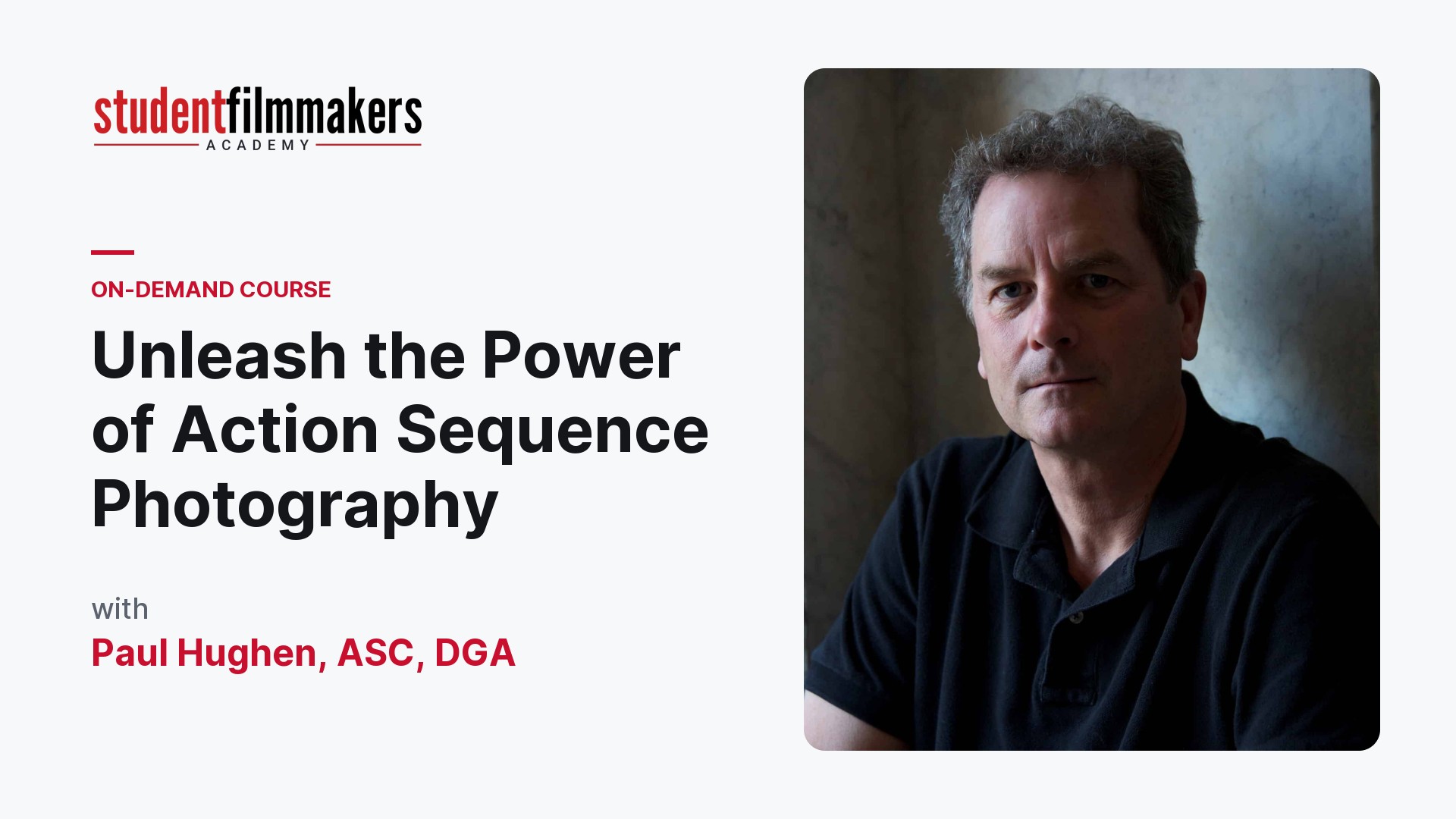
Paul Hughen, ASC, DGA was the second unit director of photography on Avengers: Endgame, and he has spent most of his career shooting the stunts, crashes and wire work that the main unit has no time for. His core lesson for anyone filming action: match the main unit so closely that the editor never notices the seam, and let the story, not a cool rig, decide where the camera goes.
Hughen did not start out calling himself a DP. After film school at the University of Texas at Arlington under Andy Anderson, he moved to Los Angeles in the early ’80s and took the long road up the camera department:
“I did not make a business card stating that I was a cinematographer. I went and started working as a loader.”
From loader he moved to second AC, first AC and operator. The break came around 1994, when cinematographer Peter Deming hired him to operate on a Pauly Shore comedy and let him shoot a splinter unit: an airplane “flying” that never left the tarmac. Watching those dailies, Hughen knew he wanted to shoot action.
What does a second unit actually shoot?
Whatever the main unit cannot afford to stop for. Hughen’s example is a car flip on the Angeles Crest Highway. With prep, rehearsal and shooting, a flip can eat three days, and if it fails you do it again. The main unit shoots the actors reacting before and after; the action unit shoots the flip itself.
The size of that unit swings wildly. He has worked with six people and no principal cast. On Endgame, his unit was 250 crew members with five cameras. His personal record is 13 cameras, for an opening car sequence on the 105 freeway.
Scheduling follows from the boards. If a sequence with 16 stunt performers on wires needs four days to shoot, add two days of prep and the calendar almost writes itself.
How do you match the main unit’s look?
This is the heart of the job, and Hughen is blunt about it: “I will not show up on a set and shoot my own movie. I’m matching to the main unit.” On the first day of prep he gathers what he calls information:
- Storyboards and previs, which show exactly which beats belong to the second unit.
- References. He asks the main unit director and DP what they watched and studied in prep. The answer might be Bullitt, The French Connection or Sebastião Salgado’s photographs, and he studies the same list.
- Dailies. Getting on the dailies list through the producers takes effort, but if the main unit shoots an actor on Monday and you shoot an insert of his phone on Tuesday, you need to see Monday.
- Time of day. If the sun hits the left side of the star’s face in the main unit’s car shots, it has to hit the same side in yours.
- The director’s plan, a thick book of schematics showing doors, entrances and where every actor comes and goes.
The lighting package follows the same logic. If the main unit is all tungsten or all HMI, so is he. He also checks what lights are being left behind, so production doesn’t pay twice, while making sure he isn’t caught short. If the main unit used four 18Ks and is taking two away, he orders two.
Why does rehearsal matter more than money?
Safety comes first on every action set Hughen describes, and he refuses to treat prep time as a budget line to squeeze:
“It shouldn’t be about money. If there’s two days of prep, there’s two days of prep.”
Stunt teams now build what he calls stunt vis: they rehearse a sequence with camcorders or phones, cut it together, and send it to the first unit director for approval. Nobody wants to be working out a sword fight on the day. “But rehearsal, rehearsal, rehearsal, I can’t stress that enough.”
When an actor insists on doing a gag, the stunt coordinator often just shows them: the double goes into the harness, onto the wire, and gets ratcheted back onto the pad. Usually the actor watches and decides to see it in dailies instead.
How many cameras should cover a fight?
Fewer than you think. On a simple fight between two people, Hughen has seen extra cameras hurt the coverage:
“If you have more than two cameras trying to cover that, they’re bumping into each other. They’re getting in the way.”
Usually it is the wide or the tight that gets shoved out of position, and the lighting starts to suffer too. A third camera earns its place when time is short, or to grab a single piece like a knife coming out of a pocket. His basic fight coverage is a wide, a tighter close-up, a profile, a reverse on the other fighter, and a super wide so the audience knows where everyone is.
He plans this every day in a written list: cameras, operators and gear for each shoot day. Three cameras Monday means three operators Monday. On the Marvel films, he said, it was generally three cameras. The A camera delivers the exact previs shot the first unit expects, which matters for trailer moments, and the B and C cameras add closer or alternate angles.
Which crash camera should you risk?
A filmmaker asked what he uses when a vehicle might destroy the camera. Hughen’s answer is to put the choice in production’s lap, with the stakes spelled out.
| Camera | What Hughen said |
|---|---|
| Blackmagic (about $3,000) | His pick if a truck might roll over it, but it can stop recording when crushed before the shot is safely written to the card |
| RED, including the Komodo | “A little bit more forgiving.” He has put the Komodo in a crash housing many times |
| ARRI Alexa | “Happy every day of the week” if production accepts the risk to a six-figure camera |
| GoPro | Not a fan, because productions often don’t use the footage |
| Sony A7 | Worked well on a Chicago shoot because he could mount any lens |
His fix for the recording problem is an external recorder that captures the picture right up to what he called the strike point. Horses are another matter: a hoof on a housing is bad news unless it is packed in foam, which he has done on Westerns. On mixing camera brands with a RED main camera, his advice was simple: don’t mix the color space if you can avoid it.
Where should the camera go for a stunt?
He starts with the story, and with hiding the double’s face. If a stunt performer rides into a brick wall, do you follow, pan in profile, or cut a hole in the wall for a low impact shot? When the double can’t be hidden, the actor steps in afterward in matching wardrobe for the medium and close shots, so the editor has faces to cut to.
He has a personal taste, too: “I tend to shoot things really low.” On cars he likes being down across the tires, and if an actor leaps from a tanker truck onto a car, a low angle shooting up as they jump over is hard to beat. But a camera move should never force the performance:
“The story should dictate the photography, not the other way around.”
That even goes for gear. A 30-foot move might mean a 50-foot Technocrane, a track, a cable cam or a stabilized head on a fast vehicle. Prep decides which one fits the beat.
Should one person direct and shoot second unit?
Hughen has done both. On WandaVision, his first job in the DGA, he directed and shot second unit, with a stunt coordinator watching his back. Still, he thinks the jobs work best apart: setting up six cameras for a stunt while also talking with performers is “a lot of work.” When a second unit director and DP really gel, he said, that is the “seamless beauty” of the unit.
He also talked about shooting on the volume for Disney’s streaming shows, where the main unit can light an environment, leave, and the action unit can return to the same content days or even months later to match it.
For more on how the two units divide a shoot, read The B Team: Working with a Second Unit, and for the stunt side, Deputizing the Fight Coordinator Posse. If your action starts on paper, Storyboards: The Benefits to Production is a good companion.
In the full class, Hughen also answers questions on syncing multiple cameras, face replacement and AI, and how the second unit builds its lighting package.