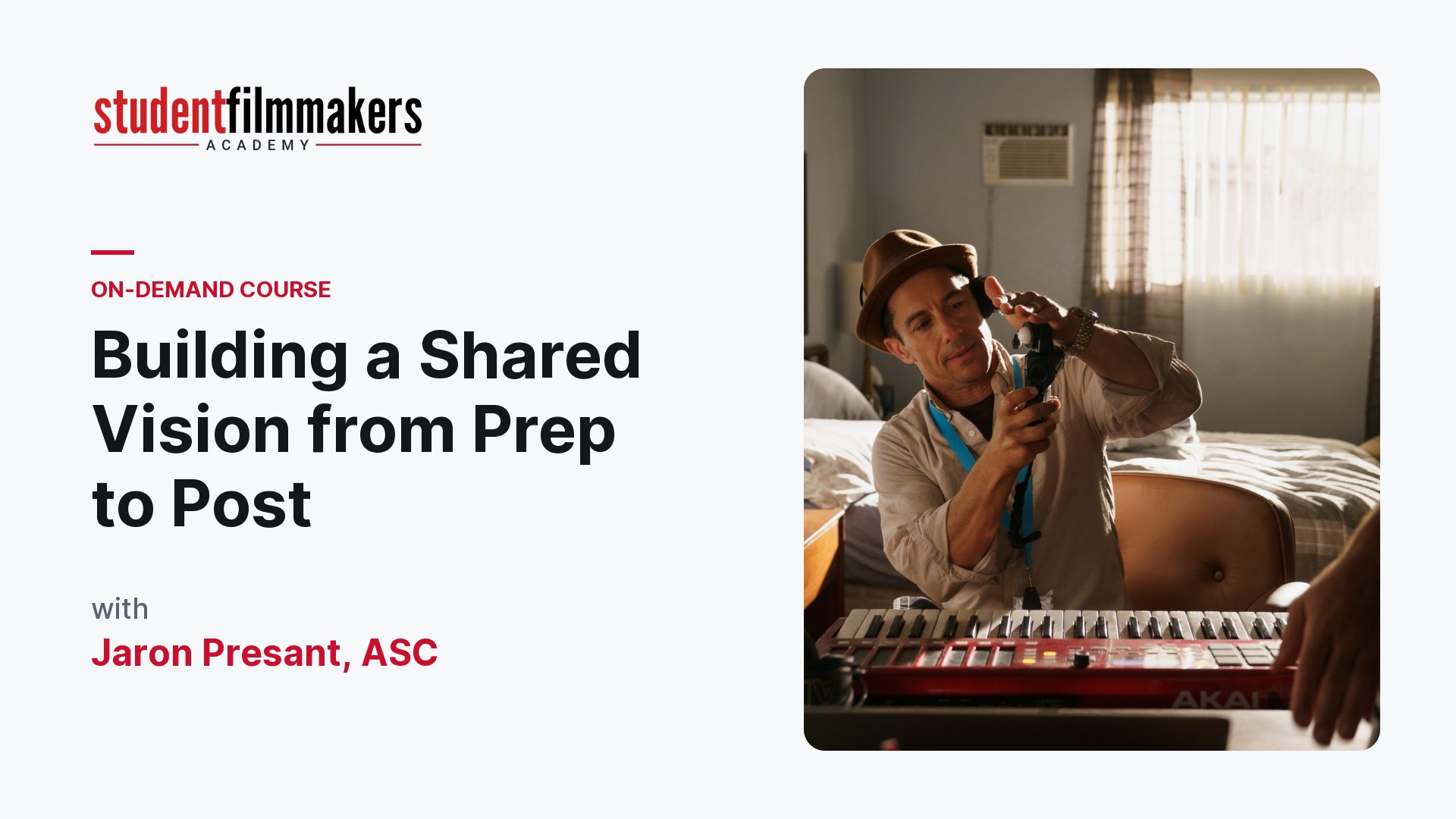
Jaron Presant, ASC, cinematographer on Rian Johnson’s Poker Face and the feature Rampage, and a second-unit DP on Star Wars: The Last Jedi, says most trouble on a production starts when people stop picturing the same movie. Speaking to filmmakers on a StudentFilmmakers webinar from a hotel room after a canceled flight, he shared the decks, boards and documents he uses to keep a director, a studio and every department aligned, and why the best of those tools stay a little vague for as long as possible.
Why is a shared vision so hard to hold on to?
Because a film is a complicated machine with many hands on the wheel. Presant listed them: the director, creative producers, writers (very strong voices in television), studios and networks asking for changes, and every department head with an opinion. All of those views shift over time, and they often collide.
Digital tools have made it harder in one way. When film had to be developed before anyone saw dailies, feedback came slowly. Now producers watch near-perfect monitors on set and react in seconds. Presant’s answer is not to fear that speed but to bring people inside the process early, so their input pushes in the same direction.
Which decks does a cinematographer make in prep?
On Don’t Make Me Go, directed by Hannah Marks, three people made reference decks: production designer Felicity Abbott, the director and Presant. His own process moves in two steps.
- Discussion deck. Made very early, from images that speak to him while reading the script. It is not a plan. It is there to start conversations.
- Design deck. Built after those talks, with sharper picks and notes on exactly what each frame is meant to show: out-of-focus lights in the background, contrast and saturation that build across the film, very tight close-ups.
Marks also gave him a music playlist, one more way to get everyone into the same headspace. A filmmaker asked whether the decks use the real cast or locations. No, and on purpose. Showing the actual actor in the actual space pushes people toward specific shots before anyone has had room to imagine.
On bigger films, concept art joins in. Presant likes it slightly impressionistic, as with the art he showed from The Last Jedi. A Rampage painting was more realistic, and its shot ended up in the movie, but with the framing changed.
What makes a good storyboard?
Not good drawing. While mentoring students for the Santa Barbara Film Festival, he kept hearing apologies for weak sketches. He sees it the other way around: the more chicken scratch they are, “oftentimes the better they are.” He borrowed an idea from cognitive science:
“What we’re really looking for to me in storyboarding is we’re looking for scaffolding creativity, not anchoring it.”
He compared two boards. One, from Poker Face, showed only a woman rising out of a water tank with two people helping her. No lighting, no set details. That left him free to hang a 10K above the tank for a hard beam of light. The other, from a commercial, already showed light from the right and a toy hitting an alarm clock in one exact way. On the day, people got stuck matching the drawing, and the shoot slowed down.
A director in the class pushed back: what if a drone move down to a medium shot is essential? Then draw exactly that, Presant agreed. A board should carry the crux of a shot, the few things that truly matter, and leave the rest to the team.
When does previs become a problem?
When it gets too exact too soon. Previs companies make their 3D actors look as close to the real cast as they can, and the frames come with lens, distance and overhead diagrams. On San Andreas, an opening sequence had a car leaving the road and going straight off a cliff at a right angle. Everyone loved it, but real cars don’t turn like that, and the team had to reinterpret a sequence people were already attached to.
Presant borrows a map from a friend who teaches product design. Every project moves from abstract to concrete, and from loose to fully defined. Each tool sits somewhere on that path, and each invites a different kind of talk:
| Tool | How open it is | What people discuss |
|---|---|---|
| Script, discussion deck | Very open | Themes, feel, what the film is about |
| Rough storyboard | Open | The crux of each shot |
| Director’s finder stills | Still movable | Framing, with everyone looking at one image |
| Previs, tech-vis, schematics | Locked | Lenses, distances, vehicle paths |
The locked end is necessary, since visual effects work has to start before the shoot. The trick is knowing you can still move back up the chart if the story needs it. He admired Rian Johnson for doing exactly that on The Last Jedi, asking for small shifts even deep into previs. His summary: don’t let “the tools drive the creative, but rather let the creative drive the tools.”
How do you stay loose on set?
By staying with flexible tools as long as you can:
“Once we’ve put a crane on top of a car, we’re not changing the shot at all now. Now the shot is the shot.”
His favorite tool here is a screen-based director’s finder, the Artemis Prime. He can take stills with it and pass them around, so the director, operator and key grip are all looking at the same frame instead of pointing at a door and a chair. He showed a photo of that moment on Poker Face, with Natasha Lyonne directing.
He also explained why physical tools help at all. Moving around the set with a finder takes some of the work out of your head and into your body, and that lets your mind look at the result with fresh eyes. The decks still matter on set. When the day gets frantic, he can point back to the design deck and ask whether a shot still fits. Too much rigidity can damage relationships, budgets and schedules, he said, while too much flexibility leaves everyone lost.
How does the plan survive post?
Presant shares, rather than guards. Once the design deck feels right, it goes to every department head and the producers, and to the studio if they want it.
“The more that people can feel like they’re part of a team, the less they feel the need to put their stamp on it.”
He also writes an image pipeline document that travels to the studio, the network and post, laying out how the image gets from camera to the final display. Set life is fast and stressful, and a shot can look great on a monitor while everyone forgets what will happen to it later. The document keeps that plan in front of people, so a choice planned for the grade doesn’t fall through the cracks.
He doesn’t micromanage the details, though. When a production designer asks about gloss or matte paint, they already agree on the direction. With electricians he asks for a feeling, not a door position, because people do their best work when they feel invested.
What does Jaron Presant look for in a director?
Asked how he chooses to work with a director who isn’t well known, he answered quickly:
“I want them to have a vision and I want them to have a clear idea in their head of what they’re going for.”
They don’t have to be good at explaining it. That’s what all the decks and boards are for. Some directors name what they need right away, others need to see options, but both know it when they find it.
For related reading, see the benefits of storyboards to production, our overview of pre-visualization tools, and planning your workflow from the end.